
Giuliano da Empoli: ‘The key to Trump’s success is moving fast and spectacularly, even when he contradicts himself’
The Italian thinker, speaking at a breakfast organized by the World In Progress forum, an initiative of PRISA, called for Europe to challenge the power of tech companies
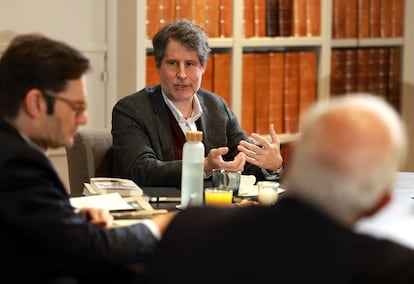

It is the perfect collusion. The standard-bearers of authoritarian, national-populist politics and the top executives of the major tech companies walking hand in hand to free themselves from anything that challenges or opposes them. This is, in essence, the core idea of Italian thinker and essayist Giuliano da Empoli in these dark times, when all the stars seem aligned against liberal democracy and large swaths of the population — including the younger generations — are leaning toward reactionary ideas.
Brought to widespread attention by his hyperrealistic and award-winning novel The Wizard of the Kremlin, Da Empoli laid out his critical vision this Wednesday at a breakfast organized by the World In Progress (WIP) forum — a PRISA initiative — describing a new era in which the digital ecosystem and social media “have taken over the stage and impose their rules” on parliaments and public debate in general. It is, according to Da Empoli, the perfect breeding ground for the seeds of opportunistic and unscrupulous political leaders — with Donald Trump at the forefront — to flourish amid the breakdown of rules. A state of anomie.
“Initially, it wasn’t part of a grand plan, but rather a side effect of the business model,” explained Da Empoli. “But in this new phase, these aggressive political leaders, who wield power in a deeply vertical and traditional way, are managing to exploit the digital sphere through an explicit alliance with the heads of technology platforms.”
The objective? “To rid themselves of anything that could challenge their power,” continued Da Empoli, flanked by the chairman of the PRISA Group, Joseph Oughourlian, as he spoke to a small group of prominent figures from the world of politics, culture, and business — including Spanish Defense Minister Margarita Robles, former EU foreign policy chief Josep Borrell; and former deputy prime minister Soraya Sáenz de Santamaría.

Born in Paris to a Swiss father and Italian mother, and now living and teaching at Sciences Po, he expresses his pleasant surprise at the “energy” he sensed during his visit to Madrid, where the day before he met with subscribers of this newspaper. He is working on a new novel, but most of his reflections focus on a global politics dominated by what he calls the predator profile. A term he coined himself, but one that — as with his ideas — has long been permeating major global forums, especially in Brussels.
Da Empoli’s profile goes beyond the purely academic. Before theorizing, he served as an advisor to former Italian prime minister Matteo Renzi, a period in which he experienced firsthand the challenges of decision-making in the res publica. He also learned the importance of energy in politics. “Obviously, I don’t agree with predators. But I’m certain that we gain nothing from indignation and condemnation: it’s much more interesting to try to understand their political appeal.”
In Trump’s case, he says, the key to his success is “action.” “Faced with inertia, his miracle — and that of other political predators — is to make it seem as if they are breaking with the old world,“ he said. ”To move quickly, energetically. Constantly changing direction and contradicting themselves, yes, but always in a spectacular way.”
On the other side of the equation, social media and, more broadly, tech platforms “are not just a way to make money, which they have done a lot of, but also a new way of organizing things, the world. And these politicians are the ones exploiting the fact that we live in the digital age.”
After Barack Obama’s second term, Da Empoli argued that “a conservative backlash was predictable.” But, he continued: “Trump wouldn’t have been able to get [to the White House] without a digital ecosystem where it doesn’t matter what’s good or bad, true or false: the only thing that matters there is interaction, engagement.”
A decade later, sovereignty still resides in presidential palaces: “With [Elon] Musk, for example, Trump wanted to make it clear who the sovereign is.” But something may be changing: “With [J. D.] Vance, it would not be the same: the platform owners would take the lead. It’s not just a new form of power, but one that has the capacity to replace the old.”
What can be done about political leaders who, even while breaking all the rules, continue to garner public support? “Those of us who disagree can simply say: ‘You can’t break the rules in the international system.’ We’ll be right, but we’ll be in a weak position: they can always say they’re breaking them to achieve a result, solve a problem….”
Greater ambition
What should be done when political leaders, even while breaking all the rules, continue to gain public support? “Those of us who disagree can simply say: ‘You can’t break the rules in the international system.’ We would be right, but we would be in a weak position: they can always claim that they break the rules to achieve a result, to solve a problem…”
According to Da Empoli, this is one of the major mistakes the U.S. Democratic Party has made in trying to confront Trump: “If you don’t have an ambitious and compelling plan, you are in a position of weakness. His great lesson — and that of other predators — is that many things we thought were impossible are actually possible. So the positive takeaway is that our ambition has to be much greater.”

The underlying problem, however, is something else. “The amplification power of these platforms: that’s the big issue, and if it’s not addressed, these kinds of politicians will continue to emerge.” A staunch Europeanist, the Italian sociologist considers this threat to be on the same level as a military one, if not higher. “Perhaps it’s more dangerous, because we are defenseless against this new reality in the public sphere.”
So what should be done? “We have to confront them, impose rules. The cost to Europe will be high, and it will provoke a clash with the United States and with the tech companies, but regulation is essential. If we take this seriously, there will be disruption and conflict, but I am sure that European alternatives will emerge,” he said. “We are at a stage where we have lost control, and it won’t be easy to regain it. But that must be our obsession: to learn from the mistake made by the American Democrats, who, when they had the chance, decided not to regulate these [technological] powers and now see how they are bigger than the state itself.”
“There is a European way of life that we all enjoy, even those who criticize it,” said Da Empoli. “Now, the question we must ask ourselves is whether there can also be a European way of doing things in the digital realm. A more attractive and user-friendly way, where life is better. I am sure there is.”
Sign up for our weekly newsletter to get more English-language news coverage from EL PAÍS USA Edition









































