
Elena Kostyuchenko: ‘I’m not afraid. If I wasn’t afraid of Putin, I won’t be afraid of Trump’
In 2022 the Russian journalist, who covered the war in Ukraine, fled to Germany after receiving death threats. There, she was poisoned and nearly died. Now she teaches at a US university and has published the book ‘I Love Russia’


When Elena Kostyuchenko (Yaroslavl, Russia, 38 years old) arrived in Berlin after covering the beginning of the war in Ukraine and learning that she could never return to Russia because a price had been put on her head, she thought she was safe. However, a few months later, she was poisoned in Germany with an unknown substance that continues to wreak havoc on her body even today. “At least I can now work more than three hours a day,” she says, sitting in a Paris café, the location of the interview, hours before boarding a flight to North Carolina, where she will teach two courses at Duke University: one on journalism and another on literature in dark times. Before that, in Russia, she worked for 17 years at Novaya Gazeta, the newspaper that has the terrible distinction of having the highest number of journalists murdered for doing their job and defending freedom of expression. It was precisely Anna Politkovskaya — a reporter for the same publication who was murdered in 2006 — who inspired Kostyuchenko’s journalistic career. Now, far from her newsroom (closed by the Russian government in 2022, after the start of the war against Ukraine, and reopened in Riga, Latvia), the journalist has compiled in the book I Love Russia: Reporting from a Lost Country (Penguin Press, 2025) the articles she wrote in the newspaper anticipating what everyone sensed until it became an irreversible reality: the fascist drift of Vladimir Putin and, consequently, of Russia.

Question. You left Russia only to end up in the United States at a time of extreme tension. What do Trump and Putin have in common? Are you frightened by what you’re seeing?
Answer. I understand that what’s happening is very bad, but I’m not afraid. I mean, if I wasn’t afraid of Putin, I won’t be afraid of Trump. The U.S. right now is like Moscow was in 2012. The same reactions, from “let’s go out with funny signs and show how numerous and entertaining we are to scare the regimes” to those who take their families and leave for Canada or learn to speak in euphemisms.
Q. It’s not an idyllic situation.
A. No, no, no. In the United States, everything is developing quite rapidly now. But at the same time, the country and Americans are in a better situation now than we were in 2012. Because the institutions, in some ways, are working. I mean the electoral system. I mean the independent press. I mean the courts, Congress. In other words, it’s not like the wasteland our country was in 2012.
Q. Is 2012 the year in which authoritarianism began in Russia?
A. No, I think it started earlier. But 2012 was when there were massive protests in Moscow, St. Petersburg, and other cities. That’s why I say it was 2012. My background is very modest, and I’m not a political analyst, but it seems to me that there were several turning points throughout Russian history. One of them was Beslan, the terrorist attack on the school, after which the order was given to storm the building, and many hostages died. And it seems to me it was then Putin realized that, in principle, he could do whatever he wanted with the people and nothing would happen to him for it. Shortly afterward, he canceled the gubernatorial elections. He stopped playing at democracy.
Q. It was a slow process.
A. And persistent. The thing is, few of us understood where that process could lead. I, for example, didn’t expect at all what 2022 brought.
Q. The war against Ukraine?
A. Yeah.
Q. But the war had already been going on since 2014.
A. Yes, but it was a hybrid war. Local self-defense forces, among others, participated. But in 2015, I personally witnessed Russian soldiers on the ground. That conflict was very complex, and so when, thanks to the Minsk agreement, the intensity of the fighting was drastically reduced, I thought Putin would leave things as they were. Because he had already achieved his objective: to create a source of instability in Ukraine that would prevent them from joining the European Union. Not even in my worst nightmares did I imagine Russian pilots bombing Ukrainian cities.

Q. Do you remember what you did on February 24, 2022?
A. I remember it minute by minute. I woke up in the night because I had very vivid dreams, so vivid they were painfully beautiful. I went to the kitchen to get a drink of water, and when I came back to bed, my girlfriend, now my wife, was sitting with her phone in her hand and a strange expression on her face. I asked her what was wrong. And she replied, “They’re bombing Kyiv.” I said, “What? Who? Us?” She answered, “We’re bombing Kyiv.”
Q. I understand that you couldn’t go back to sleep.
A. I forced myself to sleep a couple more hours because I knew that when dawn broke there would be a meeting in the newsroom and they would choose who to send to Ukraine, and I was the newspaper’s most experienced conflict reporter. Everyone wanted to go, but luckily, they chose me.
Q. Do you consider yourself lucky?
A. Absolutely. It was very important for my professional identity. If you’re a journalist and your country bombs another country and kills people, you have to be there, alongside those people.
Q. You visited several Ukrainian cities, but you didn’t achieve your goal of reaching Mariupol.
A. I deeply regret not having made it to Mariupol. When I was at the checkpoint to enter the city, I learned that my newspaper had been shut down. And I had already been in Ukraine for five weeks when, according to our regulations, we were only allowed two. I had to leave, and when I did, Muratov [editor of Novaya Gazeta] asked me not to return to Russia because they wanted to kill me.
Q. So you were left without a newspaper and with no possibility of returning to Russia, and you decided to write this book.
A. I made up my mind back in 2015, the first time I was in Ukraine. If Russian soldiers were being killed in that war, where were their families? I didn’t understand it. In the wars in Afghanistan and Chechnya, families, mothers, actively spoke out against it. And here, there was only silence.
Q. Did you manage to understand it?
A. I started looking for the families, but they all refused to talk to me. Until one woman agreed. Her little brother, the person she loved most in this life, had joined the army during peacetime. He saw it as a way to climb the social ladder. Suddenly, he was sent to Ukraine and killed on the front lines. They returned a closed coffin to her. She started asking questions, searching for the truth. Until she, too, fell silent. I found her and asked, “Why this silence? Are you afraid?” Do you know what she said in reply?
Q. No.
A. She told me, “In my life I have had two great loves: my brother and my country. My brother is dead, and I would do anything to bring him back to life. But I can’t. But if I say that my country killed my brother, I will also lose my second love. And then I will be left empty. And I want to love my country.”

Q. To love Russia.
A. Yes. What she told me is probably the most terrifying thing I’ve ever heard. I kept thinking: how strange, the love for my country, which I also feel, gives me the strength to work, to keep going, and to speak out, but that same love has silenced her.
Q. Do you also love Russia?
A. I love my country. It’s the country I love most. But I never thought it would all end like this. I’ve spent 17 years writing about the rise of authoritarianism in Russia, the development of fascist ideas, and at the same time, I maintained a completely foolish optimism.
Q. I’ve always found it curious how Ukraine and Russia, two countries with the same past, which experienced the same collapse with the fall of the USSR, developed in completely opposite directions for 30 years.
A. Russia had one thing that Ukraine did not have, and Ukraine had two things that Russia did not have.
Q. What are they?
A. Ukraine did not have a president who came from the KGB, who saw the world as an endless succession of threats, who knew human nature, human weaknesses and fears very well, and who, so to speak, took advantage of all this knowledge, mechanisms and instruments, and created new mechanisms and instruments.
Q. And what things did Ukraine have that Russia didn’t?
A. First, Ukraine had a very strong regionalism; there were regional oligarchs who supported regional political forces. It wasn’t a highly centralized system. And second, Ukraine had two very successful revolutions. The history of civil society in Ukraine is a history of victories.
Q. People know that if they go out into the street, things change.
A. Yes. The history of Ukrainian life shows that if we all work together, we win. The history of Russian civil society is a history of defeats. I don’t recall a single Russian protest that ended in a victory for civil society.
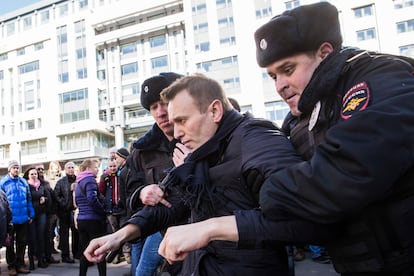
Q. Historically, demonstrations in Russia have ended in repression. You yourself have participated in many of them.
A. Yes. Putin, as someone obsessed with his own security, has been constantly expanding the security apparatus. We now have four million members of the security forces in Russia, which is a huge number, and they are armed to the teeth. Many of their weapons and equipment for dispersing demonstrations or suppressing crowds haven’t even been used yet. Incidentally, they bought those weapons and equipment in Europe.
Q. How?
A. Before the 2022 war, Europe preferred to ignore all of this. If Putin had been stopped in Chechnya, when he was laying waste to the land, bombing it, when the Russian army was committing the same crimes against humanity as it is today in Ukraine — the same crimes denounced by journalist Anna Politkovskaya, who tragically paid with her life for them…
Q. Who could have stopped him then?
A. I don’t know, but back then he was still a friend of the West. But this feigned impotence of European politicians… I highly doubt there is nothing they can do. In the sense of selling weapons and uniforms to our security forces, they certainly could. And now, what? We have a gigantic repressive apparatus that didn’t just appear in February 2022. But you can’t say we lived in a free country before. John Donne wrote that no one is an island. In the modern world, everything is so interconnected that when something happens in a remote corner of the world, everyone pays the consequences. When Putin, an old man who, in my opinion, is terrified of his own death, is desperate and wants to go down in history, and decides to attack Ukraine, children in Africa begin to die of famine.
Q. There is also the idea that every nation gets the rulers it deserves.
A. I don’t want to absolve my fellow citizens or myself of responsibility. Did I know everything was going to hell? Yes. I worked at a newspaper. I wrote about it three times a week. Why didn’t I focus on the main issue? Why didn’t I fight for a change of power in Russia?
Q. Are you alone?
A. Well, I probably wouldn’t do it on my own, but there are 146 million of us. I, like many of my colleagues, believed before the war in what is probably capitalism’s main lie: that journalists shouldn’t interfere with reality, that we simply describe it. That we’re like snowy birds flying through the sky and shouldn’t touch this filth with our wings because then we’d lose our damn objectivity.
Q. And now?
A. Now, of course, both I and many of my colleagues have come to understand that professional duty doesn’t negate civic duty. You might be an accomplished journalist, a superb baker, a superb doctor, but if authoritarianism and fascism are on the rise in your country, well, you have to fight against it. We’ve paid a very high price for understanding this. But, to answer your question honestly: I liked my life, I liked how I was living. I understood that if I started to become actively involved in politics, at the very least, my life would change drastically. And, at worst, I’d be dead.
Q. They put a price on your head when you were in Ukraine. You went to Europe and were poisoned. Have you recovered?
A. Almost. The investigation is still ongoing, but they’re not informing me of anything.
Q. You wrote that you felt ashamed when you were poisoned.
A. When you experience a traumatic situation, when you suffer abuse, or when someone tries to kill you, your brain, hoping to regain control, tells you: if you had done this or not done that, this wouldn’t have happened to you. When I reported it, I felt terrible shame. It’s very unpleasant to think that someone wants to kill you. It’s not that it’s scary, but it’s unpleasant, like being covered in something sticky that you want to peel off.
Q. What is your life like now?
A. Every morning I wake up and the first thing I do is look at what my country has done overnight. I remember all those years when I chose my own comfort, my own professional identity, over the lives and safety of others. How am I living? This book has helped me. Yana, my wife, has helped me; without her, I wouldn’t be alive today. I understood that writing is a way to survive.

Q. You now teach courses at the university, meet with activists, unite people…
A. I want people to see that you can’t do anything alone when you’re dead. If you’re dead, that’s the end of the story. As long as you’re alive, there’s hope, you have options. When I went to the U.S., to a different continent, with a different language, and saw that they behave like we did in 2012… I thought, it’s not about pro-Russian or pro-American, it’s about scared people, and scared people behave that way. And now, the more I travel, the more I see that there’s much more that unites us than divides us. And that, on the one hand, allows and helps authoritarian regimes around the world to learn from each other, support each other, adopt each other’s tactics, rewrite the laws. And, on the other hand, it allows us, citizens of different countries, to share experiences, strategies, tactics, survival tools, to not see each other as strangers. And actually, I think there’s a lot of hope in that. Although current politicians do everything to polarize society as much as possible, both within [their own] countries and globally, so to speak. Why? So that people simply don’t talk to each other out of fear.
Q. You can’t return to Russia, but your mother and sister still live there. Are you worried about them?
A. I’m very worried about my family. My mother is 78 and doesn’t want to leave. She says, “If you’ve missed your chance in Russia, it doesn’t mean I have to miss my chance to live in Russia, among my people, in the country I love.” I understand her. If only I could…
Q. Go back?
A. The deepest and most unbearable thing for the human psyche is ambiguity. I envy the people who have left Russia, and I also envy the people who have stayed because both have made a choice. I went to work in another country and I cannot go back.
Q. What would you do if you could?
A. Right now I’d give my left arm to be there, to take notes on everything that’s happening. But I understand that Putin and his team have gone mad and that, afterward, everything will have to be fixed, and that means I have to live for a long time, that I have to work a lot. And that cheers me up a little.
Sign up for our weekly newsletter to get more English-language news coverage from EL PAÍS USA Edition









































