
The fight to jail Brother Wang, the Chinese fentanyl kingpin
Mexico is intensifying efforts to take custody of Zhi Dong Zhang, a priority target of the United States who remains detained in Cuba after being expelled from Russia
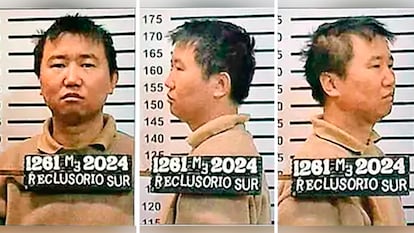

The story of Zhi Dong Zhang is more reminiscent of a Cold War double agent than a Chinese fentanyl kingpin. Accused of moving thousands of kilograms of drugs and laundering millions of dollars through a criminal organization with tentacles around the world, Zhang was arrested last fall in Mexico City. He is a priority target for the United States, and everything seemed set for his imminent extradition. But this past summer he escaped, and began a journey through several countries in a desperate attempt to escape U.S. justice. Mexican official sources have confirmed to EL PAÍS that Brother Wang, one of his aliases, is currently in Cuba, where he arrived with a false passport after being denied entry into Russia for the same reason. Mexico is waiting for Cuban authorities to complete his interrogation before receiving him in Mexico and, according to the same sources, automatically deporting him to the United States.
The U.S. Drug Enforcement Administration (DEA) has been pursuing Zhang for some time, accusing him of leading a criminal network that has worked for both the Sinaloa Cartel and the Jalisco New Generation Cartel since at least 2016. Zhang’s organization is based in Los Angeles, California, and Atlanta, Georgia, but it has ties to Central and South America, Europe and Asia. His escape from Mexico City, confirmed on July 11, generated much controversy. He was being held in a maximum-security prison until a judge granted him house arrest, from which he escaped despite being in military custody.
The judge’s decision was criticized even by President Claudia Sheinbaum. In the midst of negotiating a security agreement with the U.S., which considers fentanyl its public enemy number one, the Mexican president came out to defend her government’s progress in combating crime, and criticized the judicial decision. “The judge, without any supporting arguments, because the Prosecutor’s Office was presenting all the arguments, granted him house arrest. That ruling should never have come from a judge. How was that possible?” said the president, who argued that her government has been insisting “on the corruption of the judiciary.” The same judge who issued the controversial order to place Zhang under house arrest did the same with former Attorney General Jesús Murillo Karam, accused of forced disappearance and torture in the Ayotzinapa student massacre case.
The Chinese drug lord’s escape also occurred at a particularly sensitive time. Six days earlier, a federal court in Georgia had issued new charges against Zhang. Specifically, he is accused of laundering at least $20 million in the United States between 2020 and 2021 alone, through a complex network of more than 150 shell companies and 170 bank accounts.
Mexican cell, Chinese cell
The noose around Zhang tightened after the recent arrest of one of his operators, Ruipeng Li, whose hundreds of banking documents linked to Zhang were seized. According to the Georgia court complaint, to which this newspaper has had access, Li explained to U.S. authorities how the criminal business was organized. On the one hand, a Mexican cell was responsible for collecting the money from drug sales to the final traffickers. On the other, a Chinese cell was dedicated to receiving this dirty money and laundering it through the network of companies and bank accounts.
The complaint contains an exhaustive list of the payments made to various accounts in different states: Georgia, California, Illinois, New York and Michigan. Always for sums under $100,000 and always to reputable institutions such as Bank of America, JP Morgan or Wells Fargo. According to the complaint, this was because “these banks are accustomed to receiving large sums of money without asking too many questions.” Most of the transactions were made to Mnemosyne International Trading Inc., one of the front companies linked to Brother Wang.
The DEA investigation includes wiretaps, text messages, and surveillance of the safe houses where the drugs were stored. Zhang used code words to communicate with his accomplices. “Coffee” meant fentanyl. “Food” meant cocaine. The total amount of drugs the organization transported from Mexico to the U.S. is estimated at more than 1,000 kilos of cocaine and nearly 2,000 kilos of fentanyl.
The legal complaint also includes a description of Zhang. Born in Beijing in 1987, he is just over 5′7″ tall and weighs approximately 175 pounds. He has black hair and brown eyes. Aliases: Brother Wang, El Chino, Tocayo, Pancho, and Nelson Mandela. The enigmatic Chinese drug lord used various identities and false passports to move undetected between the Americas, Asia, and Europe. That is, until his escape from Mexico City and his attempted entry into Russia and subsequent journey to Cuba. This time, Zhang’s adventures appear to be closer to landing him in a U.S. prison.
Sign up for our weekly newsletter to get more English-language news coverage from EL PAÍS USA Edition









































