
Wall Street’s biggest players rake in the profits, beating analysts’ forecasts
JP Morgan, Morgan Stanley, Citigroup, Wells Fargo and Blackrock increased their earnings thanks to the stock market boom and corporate dealmaking
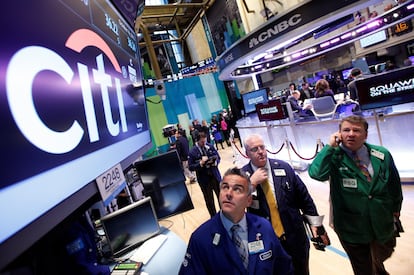

In the world of finance, there is a small group of banks whose names are known around the world. These are the big Wall Street banks, the global institutions with legendary names like JP Morgan, Goldman Sachs, Citigroup, Morgan Stanley, Wells Fargo, and the wealth management fund Blackrock. These institutions are experiencing a golden spring in their businesses.
Between Tuesday and Wednesday, Wall Street’s biggest banks reported their financial results. These institutions have boosted their profits, exceeding all analysts’ forecasts. The sector is experiencing a golden age, thanks largely to the exuberance of the stock market and the boom in corporate dealmaking, despite the uncertainty about the U.S. economy. The value of global transactions surpassed $1 trillion in the third quarter for the second time on record, according to data compiled by Bloomberg.
Stock markets, at record highs, also fueled an increase in equity market trading and borrowing by funds to buy even more securities.
JPMorgan, the largest U.S. bank by asset size, reported a third-quarter profit of $14.39 billion, up 12% from a year earlier. CEO Jamie Dimon’s bank grew its earnings to $47.1 billion, a 9% increase.
Dimon, however, issued a message of caution amid growing uncertainty over geopolitical tensions, tariff pressures, and the risk of inflation spiking again as the U.S. labor market begins to show signs of slowing.
Goldman Sachs is also headed for a record year. The investment bank announced that it is on track to achieve the best year ever for its core division, investment banking, thanks to the strength of the equity markets. Goldman reported earnings of $15.18 billion, a 20% increase over the previous year. This strong performance included a 42% rise in investment banking revenues to $2.66 billion.
Goldman CEO David Solomon justified the gains by highlighting the strong performance of the stock market, but announced staff cuts in order to position the firm for the future. “As part of this broader responsibility, we will constrain headcount growth through the end of the year, in addition to a limited reduction in roles across the firm,” he said in a statement.
Citigroup, for its part, reported third-quarter profit of $3.8 billion, up 16%. Wells Fargo reported earnings of $21.4 billion, up 5% from a year earlier. This growth allowed it to increase its profits by 9% to $5.6 billion.
BlackRock isn’t a bank per se, but it is the world’s largest money manager. On Tuesday, it broke a new record by announcing that it now has $13.5 trillion in assets under management, up 17% from the previous year. Market dynamism allowed the asset manager to surpass the $13 trillion mark for the first time. BlackRock’s revenues grew 25% to $6.5 billion.
Bank of America, the second-largest bank in the United States, also reported an 11% increase in revenue to $28.1 billion, earning a net income of approximately $8.5 billion, up 23% from the $6.9 billion it achieved in the same quarter last year. The bank’s figures also exceeded analysts’ expectations thanks to the surge in mergers and acquisitions and strong net interest income.
Morgan Stanley also smashed analysts’ forecasts by the largest margin in five years. Booming equity trading, investment banking, and wealth management boosted profits by 45% to $4.6 billion in the third quarter. Revenue increased 18% to a record $18.2 billion, the company reported.
Beyond stock market volatility, the policies of U.S. President Donald Trump are generating some uncertainty for markets and investors. At the same time, he is paving the way for financial dealmaking with an increase in mergers and acquisitions. Two weeks ago, the acquisition of Electronics Arts by a consortium of companies was announced for $55 billion, in the largest leveraged buyout in history. The banks advising on the transaction are Goldman Sachs and JP Morgan, which financed a $20 billion tranche.
Added to this are massive investments in the artificial intelligence boom, the construction of data centers, and other related infrastructure. AMD’s deal with OpenAI, worth hundreds of billions of dollars, is another example of the sector’s bubbling rise.
High-profile bankers are urging caution against “investor exuberance” in the financial markets. Jamie Dimon of JPMorgan said that “we have a lot of assets out there which look like they’re entering bubble territory,” the Financial Times reported.
Goldman Chairman David Solomon added that “as students of history, we know that following periods of broad-based excitement around new technologies, there will ultimately be a divergence where some ventures thrive and others falter.” And Citi CEO Jane Fraser also referred to the market exuberance: “The global economy has proven more resilient than many anticipated, thanks in part to investments in AI. That said, there are pockets of valuation frothiness in the market so I hope discipline remains.”
Sign up for our weekly newsletter to get more English-language news coverage from EL PAÍS USA Edition









































