
‘I tried to commit suicide to avoid being stoned’: How to build an accusation against the Taliban regime for its persecution of women
Using testimonies from Afghan women and experts, the Permanent People’s Tribunal documents how fundamentalists have established gender apartheid and committed crimes against humanity against Afghan women
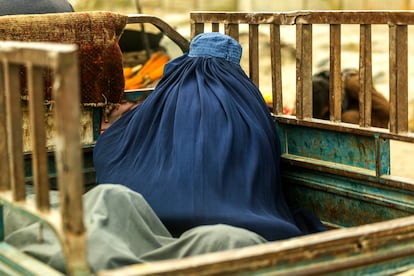

“I paid a heavy price for participating in women’s rights protests when the Taliban took over Kabul on August 15, 2021. Months later, about 10 Taliban members surrounded my car. I was traveling with my mother, sister, brother-in-law, and nephews, ages six and 10. They beat my brother-in-law and took my 10-year-old nephew. They dragged me out of the car and hit me with their AK-47s and stun guns. They covered my eyes, put a gun to my head, and told me they would kill me if I moved. Then they locked me up.”
The woman speaking is the 22nd witness in the special session held this week by the Permanent People’s Tribunal (PPT) in Madrid to document the gender apartheid imposed by the Taliban since their return to power on August 15, 2021. The preliminary verdict, based on the testimonies and evidence collected, finds the Taliban’s conduct constitutes crimes against humanity due to gender persecution, although the final decision of this people’s tribunal, which will be announced in December, is not binding. However, since the creation of this court in 1979 to address serious human rights violations ignored by states, its rulings “have had great symbolic value and have been used to pressure parliaments and governments to promote specific political changes,” Shaharzad Akbar, former president of the Afghanistan Independent Human Rights Commission and director of the NGO Rawadari, one of the organizations promoting the process, told this newspaper.
They dragged me out of the car and hit me with their AK-47s and stun guns.Witness 22
The voice of Witness 22, who testified in person, sometimes trembles but never breaks. She recounts with surgical precision, before the court’s panel of experts, the suffering she endured during her imprisonment: the beatings, the electric shocks, and the psychological torture she was subjected to when she was forced to listen to the screams of her brother-in-law, who was also being abused in a nearby room. Her captors told her she had been sentenced to “stoning.” “I tried to commit suicide because I thought it was better to die than to stay alive and be stoned, but I couldn’t do it,” she admits. She was released weeks later, forced to sign a confession and swear that she would not tell the press about her suffering. She still suffers from chronic headaches. “But I want to tell my story, which is just one of thousands that women in Afghanistan have experienced and continue to experience,” she tells this newspaper.
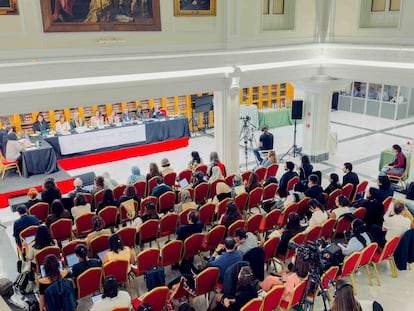
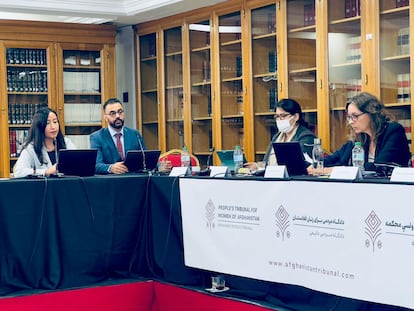
Her testimony, along with that of dozens of other Afghan women, is part of the evidence presented by an international team of prosecutors to demonstrate that “the Taliban have institutionalized the persecution of women.” “It is not just repression, but a crime against humanity,” denounces prosecutor Benafsa Yaqoobi, a member of the group of lawyers who drafted the indictment against the 10 men who “represent the core of the Taliban’s current power hierarchy,” including its supreme leader, Haibatullah Akhundzada, the Taliban as a whole, and the State of Afghanistan. No Taliban representative appeared to exercise their right to a defense. In addition to testimony, the evidence includes official documents and decrees that reflect a structure of control designed to “reestablish men’s absolute dominance over Afghan society.”
Decrees against women
Since returning to power, the Taliban have issued at least 126 decrees that, according to Prosecutor Azadah Razmohammad, “have deliberately stripped Afghan women and girls of their most fundamental rights.” Of these, “between 70 and 80 are explicitly gendered,” imposing restrictions that prevent women from studying beyond primary education, working in most sectors, or traveling without a male escort. Those who dare to defy these rules, she adds, “are arrested, tortured, disappeared, or even executed.”
“I participated in many peaceful protests in Kabul demanding freedom, equality, and education for women. But during one of them, the Taliban opened fire to disperse us,” witness number 21 stated, present but with her face covered. Shortly after participating in that demonstration, she was kidnapped from her workplace. “They pointed their guns at me and ordered me to be silent. They covered my face and took me to an unknown location,” she says. At the detention center, she was beaten, electrocuted, and subjected to psychological torture. “They called me impure, told me I must repent and accept the Taliban leader as my guide or I would die like a pagan.” “They beat me until three of my ribs were broken. I couldn’t breathe. Sometimes I thought about committing suicide because I saw no hope. Four minutes of torture left me with a wound that has been with me for four years,” she says. After weeks in detention, she was released under threat: “I was ordered to remain silent and obey the Taliban’s decrees.” She eventually managed to escape to Pakistan through the Torkham border crossing.
Four minutes of torture left me with a wound that I’ve carried for four years.Witness 21
“These acts are not isolated incidents, but rather part of a deliberate, systematic, and widespread state policy” that seeks to erase women from the public sphere,” Razmohammad asserts. Prosecutor Moheb Mudessir adds that the measures adopted by the Taliban meet the criteria established by the Rome Statute for crimes against humanity. “The persecution of women and girls in Afghanistan is not a side effect of the regime, but its ideological core,” he asserts. According to Mudessir, the strategy is so extensive that it is applied “throughout Afghanistan, without exception of provinces or districts,” through agencies such as the Ministry for the Promotion of Virtue and the Prevention of Vice or the Directorate for the Supervision of Decrees, which are responsible for enforcing segregation rules. Furthermore, the repression particularly affects women from ethnic or religious minorities, victims of raids and arbitrary arrests.
After an attack on a haara school, “I was injured and most of my friends were killed.”Testigo 11
Witness 11, an ethnic Hazara, has experienced three attacks on her school. In the last one, after the Taliban arrived, nearly 50 people were killed and she was seriously injured. “It was just before the university entrance exam. I was about to take a very important step toward achieving my aspirations, but I was injured, and most of my friends were killed.” “After that, I couldn’t continue my education because the Taliban banned us from attending university. I was forced to leave Afghanistan to survive and rebuild everything from scratch. But I’m still receiving treatment as a result of that explosion and still suffer from headaches and insomnia,” she says.
In addition to barring their access to secondary and university education, the Taliban have banned women from working in most sectors and have restricted their access to healthcare to the point of being virtually eliminated. They can only go to clinics if accompanied by a man and only if there is a woman to assist them. “Outside of Kabul, there are hardly any female doctors or nurses,” says Prosecutor Yaqoobi.
A doctor refused to treat me because he told me his clinic would be closed if he treated women.Witness 20
Witness 20 has been a victim of this healthcare exclusion. “Getting medical care, even the most basic kind, is a challenge. During a protest I participated in after the Taliban arrived, I was stun-gunned in the arm, but a doctor refused to treat me because he told me his clinic would be closed if I treated women. Now we even have trouble going to the dentist,” she says.
As a result of the expulsion of women from all public, social, healthcare, and work spaces, the team of prosecutors denounces the lack of safe havens for Afghan women within their homeland. “We are facing one of the most urgent and irreparable violations of international law in the world today,” says Mudessir.
They pointed their guns at me, hit me on the head, and didn’t give me a drop of water. My children cried of thirst.Witness 3
Witness 3 confirms this with her testimony. After a life marked by physical and psychological abuse from her husband, she told the court that she decided to summon her courage and report him. “I went to the police station, but the Taliban tore up my letters, beat me, and threw me out. They told me, ‘You are a bad woman.’ They forced me to return to that house, which was hell for me,” she testified in an audio recording. But before she could return, she was “beaten and whipped in a detention center” in front of her children. “They pointed guns at me, hit me on the head, and didn’t give me a drop of water. My children were crying of thirst,” she recalls. After several attempts to escape, she managed to reach Kabul with the help of a relative who pretended to be her male guardian. “A woman alone cannot travel; they asked me where my brother, my father, my uncle was… I told them, ‘They are dead. I had no one.’” She later managed to cross into Iran, but without her children, who were left in the care of her husband. Her latest news is that her daughter has been forced to marry an older man. “I cry day and night,” she sighs. And she wonders: “Who listens to the voices of Afghan women? What crime have we committed?”
Sign up for our weekly newsletter to get more English-language news coverage from EL PAÍS USA Edition









































