María Corina Machado: Venezuelan opposition leader wins 2025 Nobel Peace Prize
The Norwegian award committee chose the candidate ‘for her tireless work promoting democratic rights for the people of Venezuela’
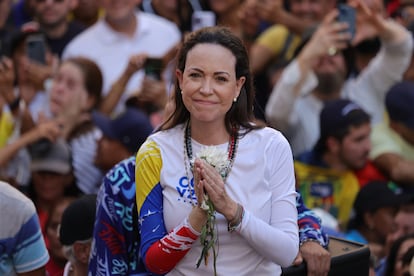
The Norwegian Nobel Committee awarded the 2025 Nobel Peace Prize on Friday to Venezuelan opposition leader María Corina Machado, 58. The committee recognized her “for her tireless work promoting democratic rights for the people of Venezuela and for her struggle to achieve a just and peaceful transition from dictatorship to democracy.”
Machado has been living in hiding since late August last year due to the repression unleashed by Nicolás Maduro’s regime following the presidential elections on July 28, 2024. Machado, barred from running in the election, had supported the candidacy of diplomat Edmundo González Urrutia.
“I’m in shock,” Machado told González in a phone call that the opposition politician, now exiled in Spain, shared on his social media. “I can’t believe it,” she added, visibly moved during the conversation. The two politicians had received the Sakharov Prize for Freedom of Thought from the European Parliament in October of last year, but the Nobel Peace Prize now represents a major boost to the democratic cause of the Venezuelan opposition.
¡Nuestra querida Maria Corina Machado, galardonada con el Premio Nobel de la Paz 2025! Merecidísimo reconocimiento a la larga lucha de una mujer y de todo un pueblo por nuestra libertad y democracia. ¡La primer Nobel de Venezuela! ¡Enhorabuena @mariacorinaya, Venezuela será… pic.twitter.com/jpmrUEujtL
— Edmundo González (@EdmundoGU) October 10, 2025
“As the leader of the Democratic Forces in Venezuela, Maria Corina Machado is one of the most extraordinary examples of civilian courage in Latin America,” said committee president Jorgen Watne Frydnes, when announcing the award. “Machado has been a key unifying figure in a political opposition that was once deeply divided — an opposition that found common ground in the demand for free elections and representative government.”
Machado was chosen by the Norwegian committee over the candidate who had campaigned most heavily in recent months: U.S. President Donald Trump.
A veteran political leader, Machado confronted former president Hugo Chávez directly, who often disparaged her with personal attacks and insults — even calling her a “petite bourgeois with fine manners.” After years working away from the front line, she is now, alongside Edmundo González, the main rival to Maduro and Chavismo.
Before the 2024 elections, she was the first Venezuelan political leader in more than a decade able to mobilize the vast majority of the opposition. Machado succeeded in uniting a coalition with differing sensitivities, ideological traditions, and strategic visions. Evidence of this was her decisive victory in the primaries held in October 2023, where she won 92.5% of the vote — a springboard for her presidential campaign. Her candidacy was cut short by a disqualification imposed by the Comptroller’s Office, a body controlled by the ruling party, which forced her Democratic Unity Platform to scramble to find an alternative candidate.
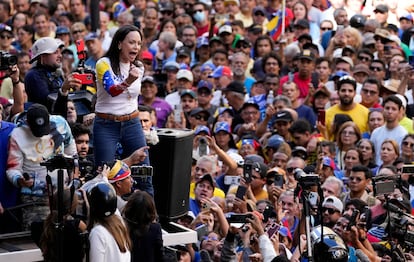
Machado’s influence in Venezuelan politics grew over time. While Machado was always a visible figure in the struggle against Chávez and Maduro, she has not always been a popular one. In the 2012 opposition primaries, she garnered only around 4% of the vote, compared with 64% for former presidential candidate Henrique Capriles Radonski. She then came to represent a sector of hardline anti-Chavismo, favoring election boycotts and convinced of the effectiveness of diplomatic pressure.
When, in 2019, a then-unknown lawmaker, Juan Guaidó, challenged Maduro by proclaiming himself interim president and attempting to consolidate a parallel government, Machado took a step back and worked on the sidelines. It was not until early 2023, after the opposition acknowledged the failure of Guaidó’s attempt, that Machado’s project began to take shape.
Machado — who has been close to the White House since the George W. Bush era — knows that any U.S. decision has a direct impact on Venezuela’s political balance. Yet she has always relied on the resilience of Venezuelans, confident that Maduro’s time will eventually end.
In her last interview with EL PAÍS in July, she denounced the regime’s persecution and spoke openly about her fears: “It’s hard, extremely hard, and I live with the threat hanging over my head, because they’ve made it very clear to me that if they find me, they’ll make me disappear.”
She also made clear her chosen mission: “I decided to dedicate my life to the freedom of Venezuela. While this is extremely hard, being completely locked up, without talking to anyone, without seeing anyone, without touching, hugging, kissing, caressing or even seeing my children, my husband, my mother, my colleagues, it has also allowed me to be completely focused on our work. We are ready,” she said, referring to the horizon of a transition.
Maduro claimed victory in the 2024 elections without offering any evidence, while Machado’s campaign released the voting records showing a decisive win for González Urrutia. Public outrage sparked widespread protests, prompting militarization of the streets and repression by Chavismo-controlled police forces. Four months after the elections, the Venezuelan Attorney General’s Office, under Chavista control like all public institutions, opened an investigation against Machado for allegedly supporting a new set of U.S. sanctions against Caracas. By then, the opposition leader was already in hiding, only emerging briefly in January to participate in demonstrations in the capital against Maduro’s inauguration.
“The Nobel Peace Prize awarded to María Corina Machado should help revitalize international efforts to promote a peaceful transition to democracy in Venezuela,” said Juanita Goebertus, Americas director at Human Rights Watch (HRW), one of the first to react to the announcement. “The Venezuelan people have suffered for too long under a brutal government responsible for systematic human rights violations and a devastating humanitarian crisis. Foreign governments should support Venezuelans in their fight for a democracy that respects human rights,” she added.
Nobel Peace Prize
Since 1901, the Norwegian Nobel Committee has been responsible for selecting the individual it believes best fulfills the criteria set out by the prize’s founder. In his will, Alfred Nobel explicitly stated that the Peace Prize should go to person, “who shall have done the most or the best work for fraternity between nations, for the abolition or reduction of standing armies and for the holding and promotion of peace congresses.”
The Nobel Peace Prize — the last of the five awards established in Nobel’s will, alongside those for Medicine or Physiology, Physics, Chemistry, and Literature — is traditionally announced on October 10, the anniversary of Nobel’s death, following the other prizes revealed earlier in the week.
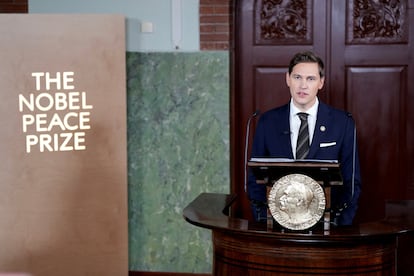
In 2024, the prize was awarded to Nihon Hidankyo, Japan’s national organization of survivors of the atomic bombings of Hiroshima and Nagasaki — known as hibakusha — “for its efforts to achieve a world free of nuclear weapons and for demonstrating through witness testimony that nuclear weapons must never be used again,” according to the Norwegian committee.
This year, the frontrunner for the award, based on the latest data from Polymarket, one of the world’s largest prediction markets, was Sudan’s Emergency Response Rooms (ERR), a community-led initiative created in response to the humanitarian crisis triggered by the civil war that erupted in April 2023. They were followed by Médecins Sans Frontières (Doctors Without Borders), which operates aid missions worldwide; Yulia Navalnaya, widow of Russian opposition leader Alexei Navalny; the International Court of Justice; and, in fifth place, Donald Trump. Machado climbed rapidly in the odds on Friday morning, just hours before the Nobel announcement in Oslo.
Sign up for our weekly newsletter to get more English-language news coverage from EL PAÍS USA Edition