
Flotilla carrying aid to Gaza reports first ‘intimidation attack’ by Israeli naval vessels
The mission, in which EL PAÍS is traveling, reports that a Navy boat surrounded several ships and remotely disabled their communication systems


The flotilla carrying aid to Gaza by sea is entering its final days of its journey. As of Wednesday morning, the ships were about 130 miles (just over 200 kilometers) from the Gaza Strip. It has been almost a month since the first vessels set sail from Barcelona, and the next few hours will be decisive. Most of the 47 ships continuing the mission — around 10 have dropped out along the way due to various issues — have reached what the organization calls the “possible interception zone” by the Israeli military, where crew members have detected an “increase in drone activity” and the first acts of intimidation by the Israeli Naval Force.
“The Navy ships are approaching. We are preparing for interception. Security cameras on several ships have been disrupted,” the mission leaders communicated to the crew during the early hours.
The night was marked by extreme tension. After the organization reported that the risk had decreased and that “it was most likely” that no imminent intervention would occur, at dawn they spotted a ship approaching one of the flotilla vessels. The security protocol was immediately activated, and many crew members discarded their cell phones, throwing them into the water.
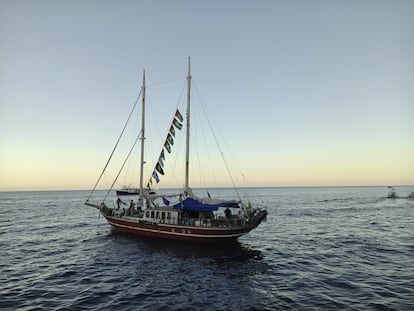
“We had our first encounter with Israeli Navy ships, which surrounded our lead vessel for about six minutes, remotely disabling all our communication systems. Strong evasive maneuvers were required by the captain to avoid a head-on collision, and the crew responded well,” the mission reported this morning.
“After the intimidation attack on the Alma, the military ship moved toward another vessel, the Sirius, and carried out the same maneuvers for a longer period before leaving. There were reports of other military ships throughout the night. We expect another tense moment in a few hours, so this is the best time to rest and be prepared,” the statement continued.
The flotilla is about 115 nautical miles (213 kilometers) out. In the next few hours, they are expected to reach 110 miles — the distance from the coast where the Israeli military intercepted the ship Madleen last June, which was leading another voyage of the Freedom Flotilla. The Handala, another recent vessel, was intercepted at 50 miles.
Stéphane Amiguet, a Swiss citizen aboard the Captain Nikos, recounts that the formation of the ships during the night, when the Israeli vessels approached, with all the ships very close to one another, “complicated” the implementation of the protocols, although it proved effective. “Israel has conducted tests and will change some things for tonight’s intervention,” Amiguet continues. “We are facing a large military force and are carrying only humanitarian aid, so I’m on high alert and keeping my eyes wide open for the next few hours.”
Despite the harassment, the flotilla continued its voyage. The frigates sent to the area — one from Spain and another from Italy — are not expected to act in the event of an interception or attack, as their mission is limited to carrying out rescues. “So, why did they come?” many of the participants on the Captain Nikos — the vessel carrying EL PAÍS — asked themselves.
On Tuesday night, the Spanish government told the flotilla members that the Spanish ship Furor, sent to assist the mission alongside an Italian vessel, would not be allowed to enter the “exclusion zone” established by the Israeli military, and therefore strongly advised them to abandon the journey. Sources from La Moncloa, the Spanish seat of government, emphasized that the mission “is commendable and legitimate, but the lives of its members must come first.” Former Barcelona mayor Ada Colau said on Wednesday that the volunteers heading to Gaza are “disappointed” that the Furor will not enter the exclusion zone.
Israel continues to view the vessels — which have suffered up to three drone attacks since the voyage began a month ago — as serving the Palestinian militia Hamas. The Israeli Foreign Ministry insists that its offer to allow the humanitarian aid to be delivered at a port under Israeli control for “peaceful” distribution shows that the flotilla’s goal is not to provide aid, but to “serve Hamas.” The organization counters that there are dozens of trucks with humanitarian aid at the Gaza border that Israel does not allow in, so they cannot trust that the boxes of food and medicine they carry will be allowed through.
Since 2008, roughly 50 flotillas have set sail for Gaza, of which only the first five succeeded in reaching their destination. In 2010, the Freedom Flotilla movement was officially founded; this time, it has been renamed the Global Sumud Flotilla. The word sumud translates from Arabic as “steadfastness” or “constant perseverance.”
Sign up for our weekly newsletter to get more English-language news coverage from EL PAÍS USA Edition









































