
Sheinbaum steps out of López Obrador’s shadow in her second year as president
The Mexican president has released her first federal budget. She has also strengthened her security strategy, with the issue of judicial reform now resolved
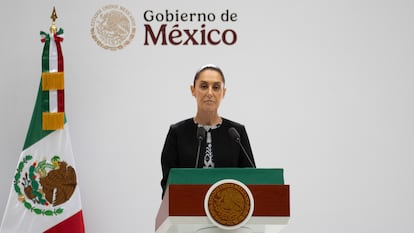

After a year in office, no one doubts President Claudia Sheinbaum’s distinctive style. Long gone are the ghosts stirred by the opposition that the first woman to lead the country would be a puppet of her predecessor. The task she faced was certainly daunting: Andrés Manuel López Obrador was — in addition to being president from 2018 until 2024 — the leader of the Mexican left. The new president, who has defined her six-year term as the second stage of transformation, continues to invoke her mentor: she refers to her administration as “continuity with changes.” But the truth is that Sheinbaum will begin her second year in office with the issue of judicial reform resolved, a very different security strategy in place and with the formal release of her first federal budget. The president is flying solo.
This past Monday, Sheinbaum presented her first government report. From the more than 1,000 pages in the document that she submitted to the Senate, the president highlighted what she considers to be her main achievements. She did this at an event in the courtyard of the National Palace. Supported by the legislative and judicial branches, her political party, Morena, was the clear protagonist. At the gathering, only a few opposition governors provided a discordant note to the overwhelming “cherry-red” colors of the ruling party.
At the very beginning of her speech, Sheinbaum claimed to be the first woman to be accountable to the nation; she then recalled that her administration was the “fruit of the collective will that, for decades, resisted, fought and dreamed of a country with justice.” Before beginning to list her accomplishments, she declared that they were “based on the great achievements of President López Obrador.”
“She’s the president… but, above all, she is us. In her report, she spoke first of women, then of the movement… and, only in third place, she spoke of Andrés Manuel López Obrador,” Vanessa Romero notes. This political analyst believes that Sheinbaum’s autonomy is complemented by a deep loyalty to the movement founded by AMLO (and, therefore, to the former president). “She has separated herself from him on issues of security, medicines, fuel theft, or on programs in which he clearly didn’t go far enough, or failed. But this difference in execution cannot be considered to be a separation from Andrés Manuel,” the lawyer asserts.
Sheinbaum has closed out her first year in office with a very high approval rating of 79%, according to an Enkoll survey for EL PAÍS. This support is even higher than that garnered by López Obrador at the end of his first year (which stood at 73%). In a specific question, half of those surveyed believe that the start of Sheinbaum’s administration has been better than that of the former president. This comes at a moment in which Sheinbaum has faced controversy surrounding judicial reform (which López Obrador approved and commissioned), the struggle with Donald Trump, and the war unleashed in the state of Sinaloa.
With the unprecedented judicial reform complete (the consequences of judges now being elected by popular vote remain to be seen) and with the relief of having signed a security agreement with the U.S. government, the path is now clear for the president. On Monday, September 8, she presented her budget proposal.
“She now has budgetary autonomy,” says Alberto Espejel, a political scientist at the National Autonomous University of Mexico (UNAM). “While the scope of Sheinbaum’s control doesn’t exceed 10% of the federal budget — the remaining funds have already been allocated — this is still important, because it will allow her to generate her own strategies when redirecting the budget.” Sheinbaum, a scientist by training, announced on September 5 that there will be more support for the scientific field.
In academia, Espejel explains, it’s observed that when leaders have their own political capital and an independent budget, they tend to separate themselves from their predecessors. However, he cautions, this “doesn’t necessarily imply a rupture.”
“Sheinbaum is leaving her own mark. It’s been happening very gradually and will be more noticeable going forward… also because López Obrador has kept his promises and hasn’t popped up. This has left room to maneuver: [there’s] a space, a void that Sheinbaum and her strategies have been able to fill,” Espejel believes.
After the Embrace
The figure that Sheinbaum has boasted about the most in recent weeks isn’t a comparison with Felipe Calderón or Enrique Peña Nieto, who governed Mexico from 2006-2012 and 2012-2018 respectively. From September 2024 to June 2025, homicides have fallen by 25%. The president and her cabinet emphasize this on every occasion, creating the image that yes, indeed, the new security strategy is working. Alongside Minister Omar García Harfuch — the omnipresent security czar — the president has sought a master plan, with which she hopes to lower the crime numbers in a besieged country.
Andrés Manuel López Obrador’s famous phrase, “hugs, not bullets,” was buried by a six-year term in which the number of murders reached 100 a day. The former president, who was focused on what he described as “attending to the causes” of crime, left a gap in what’s still the principal concern among the Mexican people. Faced with this, the new administration made a U-turn: “Omar García Harfuch speaks of an ‘intelligent’ strategy, of reaching strategic points and making priority arrests,” explains Iliana Padilla, a security researcher at the UNAM’s National Security Institute. “They’ve talked about intelligence and investigation and about [utilizing a] militarized force (the National Guard).”
Sheibaum operates in a very different scenario than the one López Obrador had to face. “Donald Trump’s foreign policy of identifying six organized crime groups as terrorist organizations undoubtedly has consequences for the strategies that Sheibaum must implement,” Padilla points out. “She’s had to distance herself from ‘hugs not bullets’ and instead opt for bullets… at least [when it comes to] a very strong military presence, for example, in Sinaloa and in the pursuit of [cartel] leaders.” These actions have not only been driven by Trump, but also by internal pressure from citizens who have been living in the crossfire for a year due to the Sinaloa Cartel’s fratricidal war.
The UNAM security researcher believes that it’s still too early to assess the results, or to determine which strategies will be consolidated under the new administration. It’s unclear if the reduction in homicides can be maintained to reverse the upward trend of past years.
Sheinbaum has maintained the militarized strategy established by her predecessor. She has incorporated — with great resistance — the National Guard into the Ministry of Defense, while focusing part of her attention on the causes of crime, via the implementation or expansion of scholarships and social programs.
“López Obrador’s influence continues to be felt: Sheinbaum’s political profile was built with him,” Espejel points out. “For instance, he laid the groundwork [when it came to] bringing the issue of poverty into the public sphere. He built it from his position as head of government in Mexico City, long before [he became president]: ‘For the good of all, the poor first.’ And Sheinbaum hasn’t dismantled the social programs; on the contrary, she’s injected more money.”
The president has deployed a “historic” expenditure — in her own words — for what she calls “the most ambitious social plan in the history of Mexico.”
“The expansion of social programs is a commitment to ensuring that people will live even better lives under her than they did under López Obrador,” Vanessa Romero adds, “so one of the historic parameters will be poverty reduction; she needs to continue [boosting] people’s incomes.”
Sign up for our weekly newsletter to get more English-language news coverage from EL PAÍS USA Edition









































