
Mexico ushers in a new era for its justice system with a judiciary elected by popular vote
The only country to elect all its judges at the ballot box embarks on trial and error of a model unparalleled anywhere else in the world
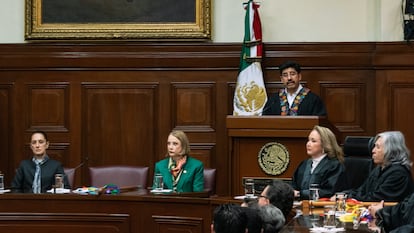

For a year and a half, the media inside and outside Mexico has been writing about the implications of the sweeping judicial reform promoted by former president Andrés Manuel López Obrador and the ruling Morena party. The constitutional amendment changed the way in which judges are appointed in the Latin American country: through direct citizen vote. Thousands of lawyers campaigned to win a position in the judiciary. The crown jewel was the Supreme Court, whose seats were filled by nine jurists sponsored by Morena. Mexico is now the only country in the world that elects all its judges by popular suffrage. Leading figures from the ruling party, starting with President Claudia Sheinbaum, maintain that the judiciary has been democratized and that from now on it will truly serve the interests of the people. On Monday, 881 elected federal judges took their office, which they must perform amid the tension of “serving the people” — according to Morena’s slogans — but without overly challenging the institutions of the government to which they are beholden.
The independence of the Supreme Court from political power has been a subject of debate in academia and political circles. Morena deployed a massive electoral operation to steer the vote in favor of Hugo Aguilar, the new president of the Supreme Court, and the rest of the judges who will serve on the judicial body. Ignoring the criticism, Sheinbaum attended the Supreme Court Monday night for the inauguration of the new plenary session, prompting critics to point out the interference that, in their opinion, the government will have in the judiciary. The last Mexican president who reformed the judiciary, Institutional Revolutionary Party (PRI) leader Ernesto Zedillo — three decades ago — decided not to attend the installation of that bench, in an attempt to publicly emphasize the separation between the branches of government. Zedillo’s reform sought to shake up a court that for years had been heavily subject to the will of the PRI presidential system. Morena maintains that the reform did nothing to change the subjection of judges to political and economic power and their separation from civic causes.
The ruling party is boasting about the beginning of a new era for the judiciary, with a Supreme Court headed by an Indigenous lawyer — Aguilar — that will hold “itinerant” sessions, that is, outside the capital. To emphasize the new pact with the people — the term is at the heart of the Morena creed — the elected justices participated in an Indigenous purification ceremony and the transfer of the baton of command in Mexico City’s Zócalo, the country’s main public square and the epicenter of López Obrador’s political struggles. On Monday night, the main doors of the Supreme Court chamber were opened — they had been closed due to the Covid pandemic in 2020, and remained closed to protect the recently departed judges from the constant protests taking place outside. A floral arrangement was placed inside the portal that read: “Towards a reconciliation of justice with the people.”
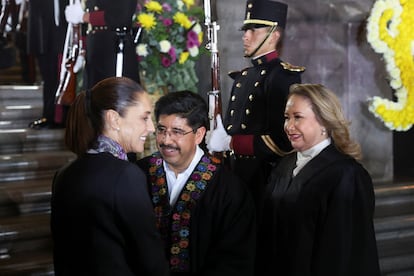
President Sheinbaum entered through those doors, following in the footsteps of the judges. In the plenary session, she met with the Morena leadership: legislators, secretaries of state, and political allies (for example, businessman José María Rioboó, husband of Justice Yasmín Esquivel and close to Morena and López Obrador). At the podium, Sheinbaum sat next to Aguilar, flanked by the presidents of the Chamber of Deputies and the Senate, Sergio Gutiérrez and Laura Itzel Castillo, respectively. It was a republican ceremony, as all three branches of government were represented, according to Aguilar. But the noteworthy thing was that they are all linked to Morena.
From the ruling party’s perspective, the president’s attendance at the first formal act of the new Supreme Court marks the reestablishment of dialogue between the executive branch and the judiciary. Judicial reform during López Obrador’s time entailed a complete rupture of relations between the two branches of government, an unprecedented clash that undermined the balance of the Republic. The former president viewed the judiciary as a trench where conservative interests lurked, hindering the advancement of his political project — judges slowed his laws and infrastructure projects. He also considered judges a gilded caste attached to luxuries and privileges. The former president promoted judicial reform as a campaign promise, and in the 2024 federal elections, his party won an overwhelming majority in Congress to pass the constitutional amendment without further ado.
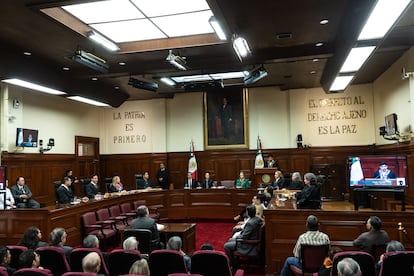
The entire election process was marred by doubts about Morena’s connection with the candidate judges. The rush to hold the elections put enormous pressure on the electoral institutions and led Congress to make errors in the legal framework that supported the vote. Dozens of lawyers without experience in judicial work will be installed in the courts, not to mention the fact that the requirements to become judges and magistrates were excessively lax. The screening of nominations was left to evaluation committees controlled by the ruling party. During the election, Morena deployed a massive operation to steer popular support in favor of certain candidates. In fact, the nine members of the Supreme Court were included in the voting guides — called “accordions” — that the ruling party distributed to the population.
After López Obrador left office almost a year ago, Sheinbaum is now tasked with implementing profound changes to the judicial system without a roadmap. Inevitably, she will also have to bear the political costs of implementing a judicial model unparalleled in the world.
Sign up for our weekly newsletter to get more English-language news coverage from EL PAÍS USA Edition









































