
The other side of violence in Sinaloa: Schools closed and at least 50 students killed
The academic year ends without any celebrations in the midst of the Mexican state’s ‘narco-war.’ Entire families sheltered their children at home, turning classrooms into virtual spaces, not by choice, but for survival
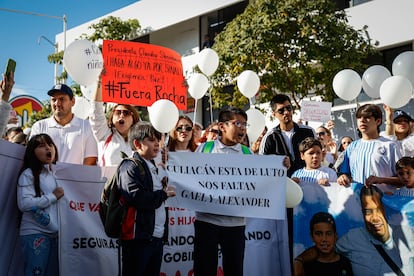
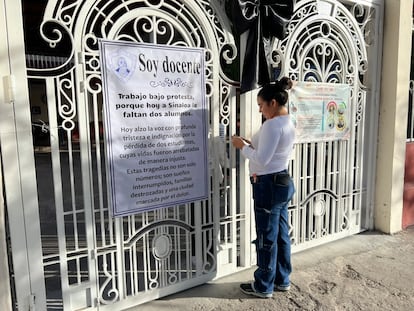
This school year in Sinaloa began with violence, and the only thing that was there at the end of the academic year in the classrooms was violence: the students had gone home long since. There were no celebrations or social gatherings when classes officially ended. Many graduating students were deprived of the chance to get their photos taken with their friends, or to write on their classmates’ shirts as mementos. At least 80 elementary schools ended the academic year with students taking classes remotely and graduating in the same way. Even worse, at least 50 children and teens didn’t even make it to the end of the year: they were murdered.
The schools were deserted this year, not because of disinterest, but out of fear. It is understandable given scenes like the one seen on April 28, just as people were returning from Easter holiday. Four schools in the Emiliano Zapata neighborhood of Culiacán extended the break because a car laden with explosives, enough to blow up a 500-meter radius, was found outside a high school.
Since the armed conflict between the Sinaloa Cartel criminal groups began in September 2024, parent-teacher associations decided not to send their children to in-person classes. In doing so, they defied the official call from the Sinaloa Department of Public Education and Culture, which consistently insisted that the situation could be controlled, and that conditions existed for a return to the classrooms.
Faced with an unprecedented escalation of violence — murders, shootings, forced disappearances, bodies abandoned near schools, some of them dismembered — entire families chose to shelter their children at home, turning classrooms into virtual spaces, not by choice, but for survival.
The issue is no small matter: mothers and fathers have called on authorities to provide real guarantees for the safety of children and teachers. “We are not asking for classes to be canceled, but for them to be held virtually, as during the Covid-19 pandemic,” says Verónica Guzmán, the mother of a student at Technical Secondary School 85, located south of Culiacán. She says she is concerned about the insecurity at the beginning of this “narco-war.” Just a mile away is the Benito Juárez Highway, which has become a path of death, with dozens of men and women murdered, their bodies abandoned out in the open, or buried in clandestine graves.
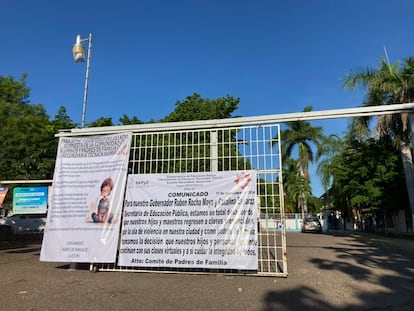
State and federal authorities implemented a security operation to “protect students”: patrol cars were placed outside schools, and both teachers and children were trained to respond during shootings.
After deploying patrol cars and hooded police officers with long guns — creating more fear than sense of safety — authorities insisted there were “sufficient conditions” for students to return to classes. But that only happened in the urban areas of Culiacán, Mazatlán, and Elota.
This was not the case in rural areas, where violence and fear have been even more intense. In Cosalá, Eldorado, Navolato, San Ignacio, and in neighborhoods on the outskirts of Culiacán, schools have been closed due to the absence of children.
“Sometimes 60% come, other times 80%. But we can’t do more if the parents don’t want to send them to school. We fully understand it’s for their safety and that they’re worried,” says Pedro Ángel Ventura Villa, principal of Technical Secondary School 96, located in the El Mirador neighborhood. The school serves as a middle school in the morning and becomes a high school in the afternoon because there’s limited access to public schools in that region.
Even with operations in place, the reality was — and still is — different: shootouts in broad daylight, bodies abandoned outside schools, and classrooms transformed into military barracks, as at the Niños Héroes elementary school in the CNOP neighborhood, south of Culiacán. There students were sent home so soldiers could occupy their classrooms as a temporary base for nearly four days. “They sent us a letter requesting to occupy the space, but we denied it,” said Gloria Himelda Félix Niebla, Secretary of Education in Sinaloa, after acknowledging that this request arrived before the soldiers set foot inside, but was lost among parents’ demands for safety.
The institutional refusal to recognize the state of emergency has created a deep rift between the educational community and the state government, which worsened over the months, when children were murdered — like Gael and Alexander, who on January 19 were attacked by armed men who wanted to steal their father’s car while he was driving in the Los Ángeles neighborhood, north of Culiacán.
“We can’t go anywhere anymore. We can’t do anything. We can’t even stay home. Something could happen to us, and the government wouldn’t do anything,” said Eduardo, Gael and Alexander’s teammate on the soccer team, during a January 23 demonstration demanding justice.
And they are not the only ones. It also happened to Danna Sofía, a 12-year-old girl murdered on March 24 as she was heading to school in the La Campiña neighborhood, east of Culiacán. Leidy and Alexa, ages 9 and 11, were shot by the Army as they traveled from Lapara, Badiraguato, to attend in-person classes in Culiacán.
“It makes me think it could have happened to me too, because I go out at the same time as her,” says Laura (a fictitious name to protect her identity), Danna Sofía’s schoolmate.
“They have attacked what we love most, which are the children,” says Víctor Manuel Aispuro, the principal of Sócrates Elementary School, where Gael and Alexander were enrolled.
Schools went from holding celebrations for Children’s Day to holding tributes in their community squares. The end of the school year was marked by silent marches demanding justice.
In Sinaloa, there is a collective mourning process and children are caught in the crossfire, while the right to education — and to life itself — has been conditioned by the truce between armed groups.
Sign up for our weekly newsletter to get more English-language news coverage from EL PAÍS USA Edition









































