
Mexico’s Maya Train: More than 60 workplace deaths, route changes and corruption allegations
Tuesday’s small derailment at a station in Yucatán has once again put the spotlight on the megaproject’s extremely rapid construction, the lack of operational testing, and possible hidden defects
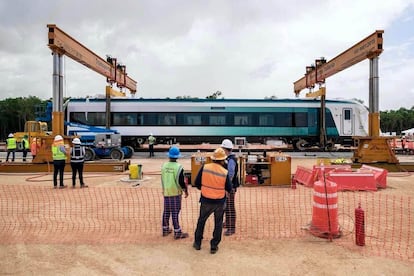

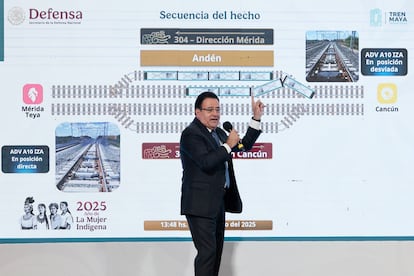
“A mistake in the automated track switches.” “An anomaly that should not have happened in the design of the railway system.” This is how Óscar David Lozano, Director General of Mexico’s Maya Train, explained the “track incident” during the morning press conference, which caused a minor derailment of two train cars at the Izamal station in Yucatán on Tuesday afternoon.
The incident has once again put the spotlight on the Maya Train. It has raised concerns that former president Andrés Manuel López Obrador’s (2018–2024) flagship megaproject may not have had enough time for proper operational testing. Experts also worry that the accelerated construction could be hiding structural problems. So far, the project has been linked to more than 60 workplace deaths, multiple route changes, and allegations of purchasing materials from corrupt networks.
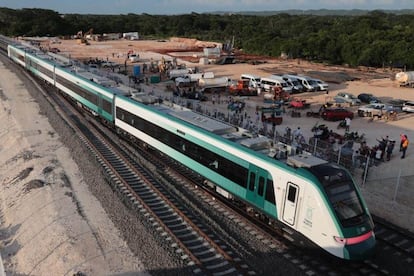
In December 2023, during the first of three inaugurations of the Maya Train, López Obrador boasted of having built four of the seven sections in record time — just three and a half years since construction began in June 2020. The project entails a network of more than 930 miles of track across the Yucatán Peninsula, starting in Palenque (Chiapas), and its budget, originally set at 150 billion pesos ($7.95 billion), ended up approaching 500 billion ($26.5 billion).
The government’s rush to complete the Maya Train before López Obrador left office was evident throughout the administration. López Obrador visited one of the seven sections almost every two months, pressuring construction companies during each visit. In a consultancy carried out by PriceWaterhouseCoopers for the project in 2019, Mexico’s main construction firms stated that they would need between 36 and 48 months to complete each section, but in the government bidding process, they were only given 28 months.
“The Maya Train is a very complex project that was scheduled to be completed during López Obrador’s term, which meant the timelines had to be accelerated,” explains Dr. José Gasca Zamora, a professor at the National Autonomous University of Mexico (UNAM) and coordinator of the book Maya Train: Territorial Impacts and Change Scenarios in the Yucatán Peninsula. “Combined with the fact that Mexico abandoned its railway tradition, this has led to the project not having enough operational testing or a certain level of quality to ensure smooth functioning overall.”
The previous derailment, which occurred last March at the Tixkokob station, shares many characteristics with Tuesday’s incident: a station, a train moving at low speed, and not enough operational testing. In the March case, the problem was that a component designed to be automated was being operated manually.
Since its first inauguration, the train has experienced various mechanical and service failures, including delays, air conditioning problems, and unexpected stops. The opposition PAN party, which has called for an immediate suspension of operations, claims there have been at least 45 incidents as of August 2025.
During construction, there were several workplace accidents. In February, a retaining wall along the railway between Felipe Carrillo Puerto and Chetumal, in Quintana Roo, collapsed and injured three workers. According to the report The Preventable Deaths of the Maya Train by the organization Community Cohesion and Social Innovation, a total of 64 workers died from 2021 to September 2024. Most of these deaths — 47 — occurred in 2023 and 2024, when the rush to complete the three inaugurations was at its peak.
Although all sections of the Maya Train underwent route changes, the one that underwent the most changes was Section 5, which runs from Cancún to Tulum in Quintana Roo. Its original design ran parallel to the federal highway at ground level. Once on site, it was decided to elevate a few miles to pass above the city of Playa del Carmen, but a few months later, with construction already underway, the idea was scrapped, and the project returned to the initial plan. Then came pressure from the hotel industry, which didn’t want the tracks to obstruct the grand entrances to their luxury resorts, leading to yet another change: routing the track a few miles into the Maya jungle.
Once construction was underway on the 41 miles of track with a 40-meter-wide corridor within the most important forested area in Latin America after the Amazon, they decided to elevate 26 miles to protect the karst terrain, cenotes, caves, and underground rivers in the area. This led to the irony of placing 10,000 pillars that ended up slicing through precisely the ecosystems they wanted to preserve. All of this happened without processing the required changes in environmental and construction permits mandated by law.
Additionally, in the works on Section 3, where the two “track incidents” occurred, there are suspicions of corruption. In March 2024, the outlet Latinus published a report based on a series of audio recordings in which Pedro Salazar Beltrán could be heard speaking with businessman Amílcar Olán, the cousin and personal friend, respectively, of López Obrador’s children. In the recordings, they bragged about buying low-quality basalt, bribing the laboratory to approve it, and then selling it to the builders. “Hell yeah, the corruption network,” Salazar is heard saying, “and when the train derails, well, that’ll be another problem.”
Sign up for our weekly newsletter to get more English-language news coverage from EL PAÍS USA Edition









































