
Ozempic menu: Could restaurants be normalizing a weight loss drug?
A nutritionist, a sociologist and a gastronomic consultant help us understand the impact of GLP-1 agonists on the food establishments. Some are starting to offer smaller menus for those whose appetite has shrunk
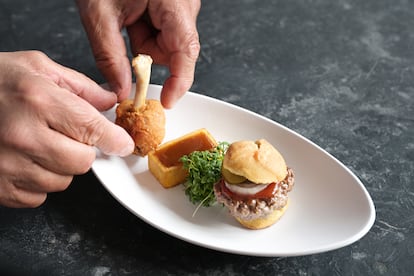

At the beginning of August, the New York Times reported how some restaurants in New York had begun to reduce their portions and adapt their menus to address the lack of appetite of a very specific demographic: Ozempic consumers. This injectable drug is used to treat type 2 diabetes, but thanks to its ability to curb appetite, it has become the ultimate weight-loss miracle drug. Its popularity is due, in large part, to its promotion by celebrities and influencers, but also to massive controversial advertising campaigns.
Ozempic and other similar drugs, known as GLP-1 agonists, mimic a hormone that regulates blood glucose by inducing increased insulin secretion from the pancreas. This slows the rate that food leaves the stomach and enters the intestines, giving a feeling of satiety that reduces appetite and can consequently lead to weight loss. Those who take Ozempic eat less because they feel full on less food. In addition to acting on metabolism, these drugs also act on the central nervous system, modifying the way we crave certain foods. People on Ozempic claim the mental noise generated by food disappears.
The U.S. continues to be the country with the highest consumption of weight-loss drugs, although their consumption is also growing in Europe. In pharmacies in Spain, sales of Ozempic, Wegovy and Mounjaro exceeded 4.8 million packages in 2024, a 51% increase on previous year. A 2023 report by Morgan Stanley estimated that 24 million people in the United States — 7% of the population — would take LPG-1 by 2035 and warned of its possible impact on the food industry and hospitality sector.
In May 2025, the U.S. multinational released a new report on the exponential increase in the consumption of these drugs in the coming years, driven by the introduction of a pill format, making it easier to administer than current injections, and the spacing of doses, which could go from weekly to monthly. In this recent report, analysts mention there could be reduced spending on food and restaurants by those who consume these drugs and raises the numbers of people who could take them in 2035 to 30 million, six million more than in their previous forecast.
Does Ozempic really pose a threat to gastronomy? Or will there be someone who, as is already happening in New York, will find a niche in this new market of diners? Dietitian-nutritionist Gabriela Uriarte, a specialist in eating behaviors, points out that eating out is not just about food, “it is a cultural, social, affective and profoundly human act. If a drug reduces appetite to the point that eating no longer makes sense beyond the minimum necessary to stay alive, we are missing something essential,” she says. If the effects are this radical, it could prompt people to cut socializing, cook less at home and even seek pleasure elsewhere: “If eating ceases to be enjoyment, other sources will be sought, that are not necessarily healthy,” says Uriarte.
Sociology has a lot to say about eating out. Iñaki Martínez de Albeniz from University of the Basque Country and author of the book The Gastronomic Idiot, agrees with Uriarte that restaurants are not just places to eat: “They are also spaces in which to show off, social showcases where cultural capital and social status are on the menu. It may be that, as a result of the consumption of drugs such as Ozempic, the material component of the diet, that is, the amount of food, has decreased, but the symbolic component, the one that grants social status, has not. In fact, the latter may have increased: there is something very powerful, from the point of view of social status, about going to a public place to be seen to eat very little.”
Social networks have been quick to pick up on the impact of the drug in the hospitality sector, either predicting a future in which there is an Ozempic café that only serves water or reflecting a present in which going out to dinner with friends consists of removing the food no one is going to eat from a plate. It might be funny, if it weren’t for the fact that the comments on that particular video are full of people asking how to get the drug and if it is sold without a prescription; there are even those who advertise it with a discount.
@dolltwink Welcome to the Ozempic cafe where we serve only cvnt
♬ original sound - Doll Twink
If the consumption of Ozempic were to become as widespread in Europe as in the United States, it would affect our dynamics as diners, although Martínez de Albeniz predicts that, paradoxically, eating less could lead us to talk more about food. “Taking a pill — or giving yourself an injection — to eat less, means that eating is still present, even if it’s by default,” he says. “Stopping eating, when done voluntarily, can be an incentive to talk about eating, or rather, not being able to eat. We would be facing a kind of gastronomic dystopia inhabited by people who have a melancholic relationship with food.”
Will we see Ozempic menus in European restaurants? In a country like Spain, where there is a culture of tapas and portions that are small and to be shared, would it make sense? Gastronomic consultant Alejandra Ansón, from Ansón+Bonet, is well aware that, in order to survive, restaurants have to keep tuned to the market and that “the moment they see that people want smaller portions, they will probably have to adapt.”
She points to a change already underway. “Before, going out to eat was much more of a celebration. For a segment of the population, eating out is now a much more everyday thing, done in a more functional way,” she says. “In general, restaurant fare is less healthy than at home cooking, because everything is meant to be tastier. But places where people go to eat regularly and in a more functional way are already taking into account the health aspect. We see it in the type of dishes, but also in the quantities and focus on vegetables.”
Ansón also believes that in Spain we still value the feeling of fullness when we go out to eat and says this is one of the factors people prize when writing a review. “If you look at TripAdvisor, a large percentage of the reviews have to do with the relationship between price and quantity. The idea that if you leave full, it’s good value for money is still very common.”
The sociologist Iñaki Martínez de Albeniz has a more speculative theory regarding quantity. “If we apply a strictly materialist logic, eating tapas is a way of eating less and doing so in company, within the framework of a socially accepted, if not politically promoted, ritual,” he says. “Tapas is, if you will allow me the expression, a ‘social Ozempic,’ because the speed of intake is slowed by the force of the ritual. However, the existence of an Ozempic menu would have a different component, beyond the gastronomic, which would be the identity component.” He believes that those who consume this drug could become a kind of community with its own “gastronomic identity” and that, if that happens, it would not take long for someone to appear who would note the gap in the market.
Menus for people with little appetite?
Martínez de Albéniz wonders if, at this rate, we will end up turning restaurants into gyms. “Gyms and restaurants today are places where ‘ornament has surpassed function,’ as Adolf Loos would say. While the function of both is, respectively, to do physical exercise and to eat, their use is not currently limited to these two functions; there are other latent functions such as flirting or simply showing yourself off to others involved.”
He continues: “On the other hand, many gyms focus on nutrition and offer this type of service to their customers. It might seem absurd to think that restaurants could begin offering fitness services on their premises (although more and more restaurants are providing consulting in wellness-oriented resorts), but give it time.” De Albéniz believes this hybrid of gym and restaurant, a place to eat and exercise, could well be in the pipeline.
Whether the existence of Ozempic menus could contribute to normalizing diet culture or are simply a way for more people to feel included when it comes to eating out, Gabriela Uriarte believes that there is a risk of normalizing “the idea that there are ‘correct ways’ to eat according to what the pharmaceutical industry or the market establishes, which comes dangerously close to the culture of dieting.”
If there are still many restaurants where it is difficult to find vegetarian or celiac options, it would be surprising if they began to offer menus for people with little appetite. “For a restaurant to prepare a special menu for this implies reinforcing the idea that eating less is a value in itself,” says Uriarte, who also points out that if these drugs are consumed on professional advice “the adjustment of the diet does not have to have a ‘special menu,’ but is more about listening to internal signals and adapting the experience of eating accordingly.”
Broadening the focus, it is worth asking what kind of relationship with food we are generating with the broader use of these drugs. Supermarket shelves are crammed with protein supplements and social networks have been filled with food advice that, above all, is concerned with making food functional, leaving aside other equally important factors, such as the social and cultural or mere enjoyment.
Uriarte establishes a direct relationship between the pressure to lose weight at all costs and this obsession with proteins. “When the social message is ‘your value goes up when your weight goes down’ two markets flourish: the pharmacological and the specialized food sector. Both feed on the same anxiety about body control. And we return to bodies being pathologized without understanding context, habits, diet history, stress, sleep, mental health and access to resources.”
As the consumption of slimming drugs becomes more widespread, it is important that we continue to question what discourses are reinforced in their promotional campaigns and what repercussions these have on our relationship with food. We know that eating goes far beyond nutrition, but sometimes it is difficult to remember that when there are so many messages around us that only emphasize calories, proteins and the size of our pants.
But as nutritionist Gabriela Uriarte reminds us, the key question should be “do we want our health to be based on stamping out our appetite and our human inclinations, or on being at peace with our hunger, satiety and the pleasure of eating?”
Sign up for our weekly newsletter to get more English-language news coverage from EL PAÍS USA Edition









































