Why Putin and Xi won’t live to be 150, especially not through organ transplants
A hot mic caught the leaders of China and Russia exchanging ideas about increasing their own longevity that science doesn’t support. They’d be better off focusing on healthy lifestyles for the years they may have ahead of them
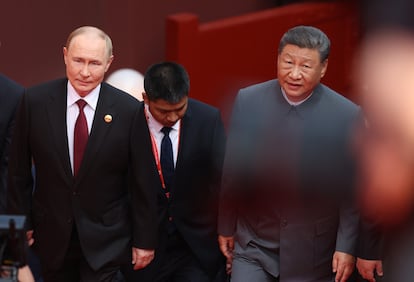

If human beings are capable of extending life to 150 years, Vladimir Putin and Xi Jinping will most likely not live to see it. The presidents of Russia and China flirted with this idea, and even with their own immortality, during events in Beijing marking the 80th anniversary of the end of World War II. The remarks, caught by state media microphones, mentioned constant organ transplantation thanks to the development of biotechnology.
Not even the most optimistic biotechnologists would dream that two 72-year-old men could easily break the human longevity barrier, which generally ranges between 110 and 115 years, with the record held by Frenchwoman Jeanne Louise Calment at 122. “Although it is not clear whether there is a biological limit at this point, the truth is that it has never been surpassed, and with current science, it is not possible to go beyond it,” says José Viña, a professor of physiology at the University of Valencia and director of the first Chair of Geroscience in Europe.
Immortality goes against evolution. As Manel Esteller, Salvador Macip, and Noemí Sobregués Arias explain in their book The Secret of Eternal Life, it would be of little use in increasing a species’ ability to reproduce and perpetuate itself, which is ultimately what natural selection seeks. “A species that maintained its genome intact over many generations would be doomed to not evolve and would eventually become extinct,” they conclude.
Humans, however, have been defying evolution for decades. But if the longevity limit is ever broken, it doesn’t seem likely that some kind of organ transplant chain will be the way to go.
To compare the body to a car whose parts can be replaced indefinitely is a gross simplification. Cells throughout the body deteriorate over time as they reproduce, losing function, becoming weaker and more vulnerable to disease. Even if organs could be created that were genetically identical to the recipient’s and could not cause any rejection—something that is not possible today—it would not be a recipe for immortality. Muscles, bones, and, above all, the brain deteriorate, and replacement is impossible.
“Even in animals, we haven’t been able to significantly extend lifespan through transplants. We don’t have this evidence in public science. What we have achieved in animal models is extending lifespan by 15% or 20% by replacing genes,” Viña says.
Xi and Putin aren’t the only powerful men fantasizing about immortality. Some Silicon Valley gurus are investing billions of dollars in researching ways to achieve, if not eternal life, then at least extend it far beyond what is currently biologically possible. If there’s a revolution in the future thanks to these investments, who knows whether humankind might not make a spectacular leap in longevity. But for now, it’s all science fiction.
What is true is that humanity has managed to extend life expectancy dramatically in just over a century. At the beginning of the 20th century, it was around 35 years, and today the global average exceeds 72. This does not mean that in the past, people died at 35 as a general rule: the figure is heavily influenced by the extremely high infant mortality rate of the time, which is now negligible. There have always been elderly people, but if a few centuries ago reaching old age was a rarity reserved for those who escaped successive fatal illnesses, in modern society, reaching old age is the norm. In the most advanced countries, life expectancy exceeds 80 years—in Spain, it is close to 84, one of the highest in the world.
Healthy living
Xi and Putin would be more realistic if they focused their efforts on living healthily for the 10, 20, or 30 years they may have ahead of them. Their longevity plans almost certainly don’t envision reaching 100 (or 150) with serious cognitive impairment and complete dependency, which is the state that many people find themselves in at an advanced age.
Every year that humanity has added to life expectancy in recent decades is a year of poor health, explain the authors of The Secret of Eternal Life. “For example, a man born in 2014 will live three more years with chronic diseases than one born in 2006,” they state.
The most plausible longevity research focuses precisely on increasing the number of years of healthy life and, to put it simply, advances along three main paths: slowing down cellular metabolism (for example, with rapamycin or moderately low-calorie diets), eliminating old and damaged cells that cause tissue inflammation, and controlling the rejuvenation of epigenetic signs of aging with cellular reprogramming. In animals, these strategies extend life and, above all, a healthy life. But from animal models to humans, there’s a huge leap.
In humans, there is still no anti-aging pill. There is promising research, such as rapamycin analogs, which improve vaccine response in older adults, or trials with senolytics that reduce the burden of senescent cells and improve function in age-related diseases. Epigenetic reprogramming is promising, although still in its infancy, and it poses safety challenges.
The most realistic way to achieve a longer, healthy life does not involve these or other drugs that can stretch the years, but rather leading a healthy lifestyle: a frugal Mediterranean diet, exercise, and good control of risk factors.
Sign up for our weekly newsletter to get more English-language news coverage from EL PAÍS USA Edition