
Memes mature to help us understand a world in flames
Jokes that are born and die on the internet have become soundbites that explain everything from the trivial to the profound
Memes have become the clearest and most direct language of digital culture: condensed fragments of reality that synthesize the complexity of the present and circulate at the same speed as a society surrendered to hyperstimulation. From the Dancing Baby of the 1990s to the endless templates of X, Instagram, or TikTok, memes have evolved from simple ephemeral jokes to veritable systems for decoding the world, semiotic capsules that allow us to process the political, the social, and the intimate with irony, humor, and a kind of collective lucidity.
“Like any art form, memes reflect the feelings and perspectives of their creators. But they also reveal how the audiences who like, share, or forward them feel,” explains Aidan Walker, a writer and researcher of digital culture. His Substack is called How to Do Things with Memes. “It’s not always about making people laugh. Memes are a form of rapid communication, but they allow us to see how attention is organized and how collective identities are expressed.”
Eudald Espluga, a philosopher and journalist specializing in digital culture, observes that memes always carry a value judgment: “I don’t see them so much as a symptom of an attention crisis, but rather as an expression of how platform capitalism segments and predefines what we will pay attention to.” He points out that memes transform social unease into humor, but their function depends on the context: “The same meme can serve to raise awareness about access to housing as a collective problem, if it’s created by the Tenants’ Union, or to sell more chicken wings if KFC publishes it.”
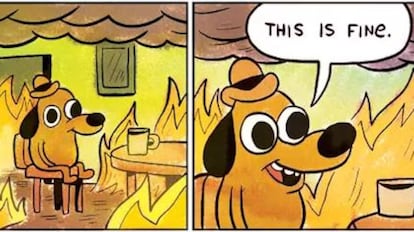
Memes that express fatigue or cynicism — so-called apocalyptic memes — function as collective alarm signals, redirecting attention to our capacity to act in the face of problems like the climate crisis or the housing market. “The perfect example is the ‘This is Fine’ meme, which was originally a meme by the artist KC Green, known as Question Hound, who drew it as a critical way of representing the anhedonic state induced by antidepressants,” Espluga recalls. “When it was repurposed as an apocalyptic meme, the rest of the comic was lost: the moment when the dog got up from the chair, put down its coffee, and started yelling that nothing was right, that we had to do something to change things.”
Thus, memes also play a social and political role. Paolo Gerbaudo, professor of digital politics and director of the Centre for Digital Culture at King’s College London, points out that “they allow for the construction of collective identities, especially in marginalized communities. They activate debates that would otherwise be inaccessible.” This observation connects with Walker’s idea: some are propaganda; others inform and comment on current events. “Ideally, journalists and media outlets would learn to work with communities of creators to better inform the public,” he concludes.
Walker adds that memes are also spaces for collaborative play and transnational encounters: “People from different countries, backgrounds, and perspectives connect through memes.” But he also emphasizes their limitations, since “many aspects of reality fall outside the logic of memeification. Often, these are things that are less easy to share or communicate, more abstract and ambiguous. Furthermore, they tend to overrepresent the feelings of those who spend a lot of time online, and that doesn’t represent everyone.”
Sign up for our weekly newsletter to get more English-language news coverage from EL PAÍS USA Edition









































