
Age of Segovia aqueduct revised after discovery of ancient coin
City council orders reprint of tourist brochures to reflect the new construction date
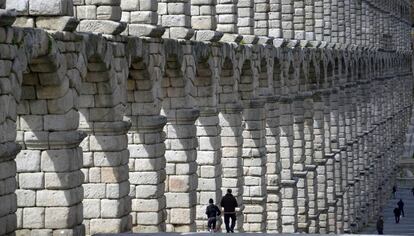
One of Spain’s most emblematic monuments is younger than was originally thought. New archeological studies have placed the construction date of the Segovia Aqueduct in the second century, between 112 and 116 AD. The traditional date attributed to this Roman World Heritage site was around 98 AD. In response to the findings, the city council of Segovia has already ordered a new print run of tourist brochures featuring the new date.
The new data about one of the most famous and best conserved aqueducts in the world were made public recently at a conference entitled Roman Cities from the Duero Valley, which was celebrated in Segovia last month. The project was presented by the director of the Segovia Museum, Santiago Martínez Caballero; UNED university lecturer Víctor Manuel Cabañero Martín; Castilla y León regional government archaeologist Luciano Municio; and Segovian archeologists Clara Martín García and José Miguel Labrador Vielve.
The study is based on the analysis of archeological materials removed from an excavation carried out in 1998, at the location of the three pillars from the Roman construction located in the Plaza del Azoguejo – just where the aqueduct measures 29 meters high and for many its point of greatest splendor.
The material that filled the foundations includes ceramic materials created in workshops in La Rioja
The material that filled the foundations of these pillars includes ceramic materials created in workshops in La Rioja around the first third of the second century AD. What’s more, an ancient Roman coin minted between 112 and 116 was also recovered.
According to Luciano Municio, the analysis leaves no recourse but to revise the long-standing evaluation of the age and history of the aqueduct, given that these foundations could only have been closed up around these dates.
Previously, academic studies had pointed to the year 98 AD as the construction date of the aqueduct based on research carried out in the 1990s, above all due to a find in one of the arches: anchors that were once used to secure large bronze letters in place. The letters were long gone, although some of them had lasted until the 16th century.
Historian and epigrapher Géza Alföldy, from the University of Heidelberg, had proposed a theory that the text was dedicated to the Roman emperor Trajan in the year 98 AD, a potential construction date that stood until this latest analysis.
English version by Simon Hunter.









































