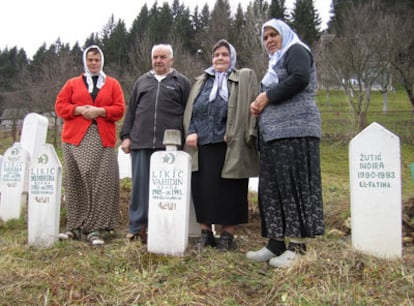
"We're going to do something worse. We'll burn them alive..."
Ivica Rajic, who ordered the Stupni Do massacre, is released from a Spanish jail
Seated on a sofa in one of the reconstructed houses in the village of Stupni Do, Ferida Lukic counts on his fingers. When he has finished his calculations, he starts to cry and shout: "Not even three months in prison for each death. I feel humiliated. It would have been better if they had left all these animals at liberty."
The deaths to which Ferida refers are 37 residents of this mountain village, among them her husband, Mehmet. The "animals," were members of a unit of the Croatian Defense Council (HVO) that its former commander, Ivica Rajic, unleashed on Stupni Do on October 23, 1993 during the Bosnia war that claimed 100,000 lives. The objective of Rajic's unit was the extermination of the population, almost exclusively Muslim, of the village. Its women were raped and its buildings razed to the ground. Rajic's men nearly succeeded in wiping Stupni Do from the face of the earth.
Rajic was sentenced to 12 years in prison by the International Criminal Tribunal for the former Yugoslavia as the author of the Stupni Do massacre. On Thursday, he was paroled from the Navalcarnero penitentiary outside Madrid. High Court Penitentiary Surveillance Judge José Luis de Castro, ordered Rajic's release as he had served eight years ? two-thirds of his sentence ? and in view of his good conduct and favorable prognosis for reintegration. Rajic was taken to Barcelona, where he caught a flight to Croatia. Ferida's calculation was correct: two and half months per victim.
Eighteen years after the massacre, the 50-year-old Ferida, who testified against Rajic in The Hague, recalls how she managed to escape. At 8am, she, her husband and 17 other residents hid in a cellar but Rajic's unit discovered them. "The soldiers took a child as hostage and after killing her mother in front of her eyes, forced her to give us away. They took us from the cellar and lined us up, the men on one side, the women on the other. The men, among them my husband, were killed instantly. A woman asked them not to do the same to us and the children but they shot them anyway. I was the last in the line."
The soldier who had shot her neighbor tried to provoke Ferida. When she didn't react he fired two shots either side of her head and one between her legs. "I couldn't move. I was in shock," she says. Two HVO commanders ordered the shootings to stop. "We're going to do something worse," Ferida recalls one saying. "We'll burn them alive."
The villagers were locked in a wooden cabin that was then set ablaze. "We couldn't jump out as the windows were very high," Ferida says. Someone found an ax and managed to break down the door. "When we got out the village was burning and there were corpses in the streets."
After Stupni Do, Rajic changed his name to Viktor Andric but he was arrested in Split in 2003 and taken to The Hague. He received a reduced sentence for giving up many of his former unit. "He confessed and incriminated many of our associates," says Miroslav Sokoro, president of the Association of HVO Ex-combatants. "And he cooperated to see them put in front of a judge."
Sokoro then took a plaque out of a cupboard which will be unveiled when Rajic returns to Kiseljak, his native town. "In eternal memory and gratitude for his extraordinary contribution to the life and liberty of his people," it reads. "For his courage in the organization of his military unit for the defense and protection of the Croatian people of Central Bosnia."