Art caged in reality
Prize-winning photographer José Manuel Ballester seeks blend of architecture and abstraction
Three years ago, during Madrid's Arco contemporary art festival, a psychoanalyst from Toronto named David Dorenbaum walked over to José Manuel Ballester and directed him to his car. Inside, Dorenbaum played the aria Ah! mio cor from Händel's opera Alcina, which tells the dramatic story of a queen who is abandoned by her young lover.
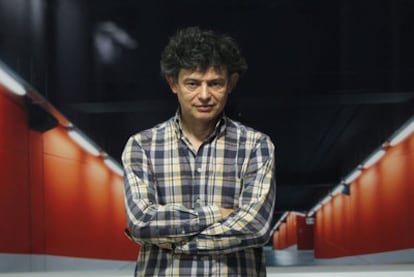
"It was the music that my work moved him to listen to," says Ballester, the latest winner of the National Photography Award, standing inside the Madrid exhibition hall Alcalá 31. "A queen who screams out of her social status but weeps bitterly because of her condition as a woman."
La abstracción en la realidad (or, Abstraction in reality) uses 50 images of artistic or cultural buildings, from New York's MoMA to Niemeyer's ongoing center in Brasilia, to explore the duality between the character and the real person in every human being. It is the same kind of tension that results in a figurative-abstract duality in art. But the Madrid artist has ended that division with a show that deliberately blends both concepts through a series of shots taken between 1999 and the present.
Ballester is a Madrid artist who also works in Beijing, Toronto, Rio de Janeiro, New York and Paris, and feels especially captivated by São Paulo, the most populated megalopolis in the Americas. In fact, his next exhibition will show at the Brazilian museum Lasar Segall, which the artist is planning to take down piece by piece and redecorate with items borrowed from the architect who designed it in the first place, Gregori Warchavchik.
Ballester's way of ordering things consists of emptying them out, depopulating them, evacuating them. "The void is not nothing; it is a way to fill things in another dimension, for instance using light, volume and color," he says. He once famously demonstrated this technique in a show called Espacios ocultos (or, Hidden spaces), where he took all human and animal life forms out of emblematic paintings at the Prado Museum, including Hieronymus Bosch's The Garden of Delights .
The same principles are on show in Alcalá 31, combining figurative shapes with visual poems based on abstract geometry. There are images of buildings, many taken from "the great Chinese display window" as Ballester calls the 2010 Shanghai Expo. His fascination for the Asian giant was evident in his 2007 exhibition at Casa de América, where he showed hundreds of photos of new hyperbuildings in four giant cities: Beijing, Hong Kong, Shanghai and Zhengzhou.
José Manuel Ballester. La abstracción en la realidad . Until November 20 at Alcalá 31, Madrid. Tel. 91 720 82 51