Rousseff visits Argentina's Kirchner to promote "strategic relationship"
Two presidents sign a series of deals to boost political and economic ties
Continuing in the footsteps of her predecessor Luiz Inácio Lula da Silva, Brazil's new president, Dilma Rousseff, on Monday made Argentina the choice for her first state visit abroad.
Rousseff, who took office on January 1, met with Argentinean President Cristina Fernández de Kirchner, underscoring the importance of political and economic ties between the two neighbors. Rousseff and Kirchner agreed to work together in several areas, among them the development of biofuels, research on two new 30-megawatt nuclear reactors, sharing electricity, and extending broadband access in the region. The two countries will also work together to develop generic pharmaceuticals.
A series of trade deals were also lined up to jointly promote their goods abroad. Brazil is Argentina's leading trade partner, and commerce between the two countries has grown tenfold over the last two decades to around 24 billion euros in 2010. A particularly thorny issue could be the current 2.9-billion euro annual trade surplus that Brazil runs with Argentina. That figure widened from only 182 million euros the previous year.
"I consider Brazil and Argentina to be crucial to transform the 21st century of Latin America"
Argentina has seen its influence wane as Brazil reaps the rewards of stability
Speaking at a joint press conference on Monday, Rousseff said: "It is a great joy for me to be in Argentina. My first visit is to this country because I consider Brazil and Argentina to be crucial to transform the 21st century of Latin America. They are the biggest countries in the region and have a great potential that Latin America can use."
"The cooperation strengthens and allows the integration of our countries," she added.
Rousseff, a 62-year old former leftist guerilla, was elected Brazil's first woman president last October after serving as a cabinet minister in the Lula administration. She had not previously run for elective office.
In contrast, Kirchner is an accomplished politician. A lawyer by training, the 57-year-old has been a senator for the provinces of Santa Cruz and Buenos Aires before succeeding her husband, the late Nestor Kirchner, as president in 2007.
The countries have been rivals for much of the last century, but Argentina has seen its influence wane as Brazil reaps the rewards of nearly two decades of political stability and economic reforms. As a result, Brazil is now Latin America's largest economy, and is increasingly flexing its economic and political muscles on the international scene. The country's companies have established a global presence in mining, aerospace, steel, and food processing, and Brazil is a key member of the Group of 20 industrialized and major emerging nations.
Meanwhile, Argentina has struggled with political and economic instability. The free-market policies of the 1990s, which are blamed for devastating local industry, were followed by a sovereign debt crisis and economic meltdown in 2001-2002.
Under the Peronist tandem established with her late husband, Argentina's economy has begun to post high levels of growth, but at the cost of inflation that is widely believed to be running more than double the official 10.9 percent reported for 2010.
Rousseff described Brazil's relationship with Argentina as "strategic" and stated she wanted to establish "extremely close" ties with her counterpart. "The Brazilian government wants a joint policy to promote a development strategy for the region. For me the main idea is that of a strategic relationship with Argentina," she said.
"I'd like to have an extremely close relationship with President Kirchner," continued Rousseff. "Firstly because Brazil and Argentina have major responsibilities for the whole of Latin America to provide our region with a bigger international stage presence."
Antonio Simões, Brazil's general undersecretary for South and Central America, said the Rousseff visit represented the start of a third stage in the Brazil-Argentina relationship since the two countries emerged from military regimes more than two decades ago. Following the trip to Argentina, Rousseff is scheduled to visit Peru in February, and Paraguay and Uruguay in March.
Leader hints at change in Iran policy
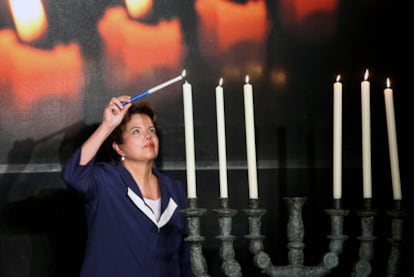
In a move clearly designed to highlight her changing foreign policy priorities, Dilma Rousseff addressed a meeting of the Brazilian Israeli Confederation last week, telling Holocaust survivors in the audience of her commitment to human rights.
The president's speech sent out a message that she intends to make radical changes in Brazilian foreign policy toward Iran, moving away from the strong ties with Tehran established by former president Lula during his time as president, especially within his second term. In a speech that earned her a standing ovation, the Brazilian leader vowed to protect human rights.
"My government will be a tireless defender of equality and human rights in any part of the world," she said. "We are not a nation that hates, or a nation that respects hate, and this is why Brazil has a historic position that we are proud of."
Claudio Lottenberg, president of the Brazilian Israeli Confederation, said: "I have the moral duty to align with those who preserve democracy and those who fight against the intolerant." Earlier this month, Rousseff told The Washington Post that she would reconsider the position of her government toward the Iranian regime, saying: "I believe that it is necessary for us to differentiate what we mean when we refer to Iran. I do not endorse stoning. I do not agree with practices of a medieval nature when it comes to women. I will not make any concessions on that matter." Lottenberg said he was gladdened by Rousseff's apparent shift in position. Former President Luiz Inácio Lula da Silva personally befriended Iranian President Mahmoud Ahmadinejad and never openly condemned Iran's disregard for human rights.