
Parmesan: The cheese used as bank collateral
A symbol of Italian gastronomy, these edible wheels have unique characteristics and are far more than just something to grate over pasta
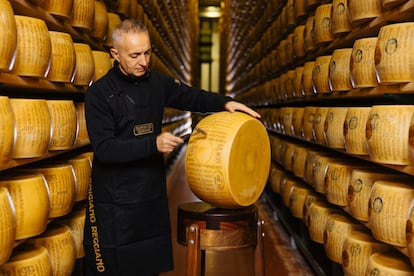
What do medieval monasteries in Emilia-Romagna have in common with a local bank founded in 1910? Both made food preservation part of their daily work. In their own ways and in their own eras, monks and bankers have pursued the same goal in the same place: to profit from a singular product — a cheese capable of staying in good condition for years and increasing in value as it ages. This food, which ensured monastic survival in the 12th century, is now part of Italy’s gastronomic heritage and lies at the heart of a financial model that is so peculiar it has even been studied by Harvard Business School.
What makes the model remarkable is that the bank — Credem — accepts wheels of cheese as collateral when granting loans to producers. The institution lends between 60% and 80% of the product’s value and stores it under its own custody in its warehouses. If the producer defaults, the bank recovers its money by selling the cheese it has been aging. The system works thanks to the product’s economic value — these warehouses are estimated to hold around €325 million ($378 million) worth of cheese — and its outstanding culinary reputation worldwide. And what is used as collateral is no ordinary product, but wheels of Parmigiano Reggiano cheese.
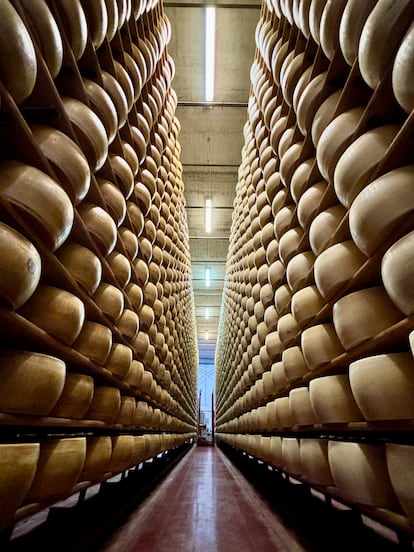
This is one of Italy’s most traditional foods and, at the same time, one of its leading ambassadors abroad. In many parts of the world the taste and appearance of Parmigiano Reggiano are better known than the particularities of Parma, Reggio Emilia, Mantua, Bologna and Modena — the only places on earth where it may be produced under that name. And that is no exaggeration. This cheese, of which nearly 84,000 tonnes are exported annually, is closely tied to the history, territory and culture of those five Italian provinces. That is why it has had Protected Designation of Origin (PDO) status for 30 years; because of its unique qualities and the abundance of imitations.
A $2 billion theft
Parmesan cheese is protected by intellectual property rights. In Europe, PDO certification guarantees its origin, its ingredients, and the methods used in its production. It also prevents similar cheeses from using its name or misleading labels — such as “Parmesan-style” or “Parmesan-type”— to benefit from those similarities. Outside the European Union, however, the situation is very different, to the point that this cheese is one of the most counterfeited foods in the world. And it’s a market that moves millions.
“The phenomenon of imitations is more significant in North America, Latin America and some parts of Asia, where the term ‘Parmesan’ is often used generically to identify hard grated cheeses or similar products,” explains Fabrizio Raimondi, communications manager for the Consorzio del Parmigiano Reggiano. “These are products that try to recall our cheese through names, colors, images or packaging that evoke Italy without any connection to the territory or the PDO specifications,” he adds.
According to the Consorzio’s estimates, the market for imitation products that recall Parmigiano Reggiano is worth more than €2 billion ($2.3 billion).
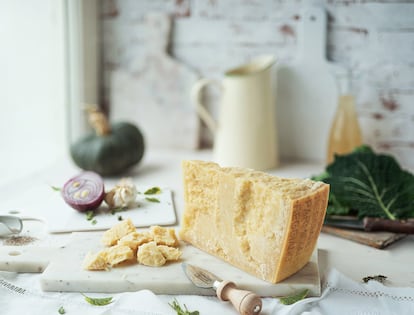
“Counterfeiting causes very significant economic damage because it devalues producers who adhere to very strict rules and bear high production costs to guarantee the product’s quality, traceability and naturalness,” Raimondi says.
But that is not the only problem. There is also harm to consumers. “Imitations exploit the notoriety of the name without respecting those standards. They are perceived as equivalent, while behind Parmigiano Reggiano there are nearly a thousand years of history, a specific territory and a production system that is completely natural and regulated,” he says.
Milk, rennet, salt… and time
The recipe for Parmesan has not changed in the last thousand years. It takes 520 litres of raw milk to produce a single wheel of Parmigiano Reggiano, which initially weighs about 50 kilos but reduces in weight as it matures and loses moisture. Calf rennet — a natural enzyme indispensable for coagulating the milk — is also used, along with a lot of salt, since these cheeses begin their life submerged for three weeks in brine. The mineral helps remove moisture and acts as a preservative, but it penetrates slowly into the product and takes almost 10 months to reach the center. That is why the fourth ingredient is time.
The wheels of Parmesan rest on long wooden racks for a year while awaiting a quality inspection. In that exam, an expert gently taps the rinds with a hammer, paying attention to the sound. If no external defects — such as cracks — or internal defects — such as air pockets — are detected, the wheel receives the quality seal, which is branded into its surface. From that point, the cheese continues aging until it reaches the market. And its journey goes far beyond being grated over a plate of pasta.
“Parmesan is an extraordinarily versatile product, able to pair with haute cuisine, the wine world, cocktails and even desserts and snacks,” Raimondi notes.
Different maturation periods produce completely different aromatic profiles: creamier and more delicate in younger cheeses, more intense, spicy and rich in umami in longer-aged examples. The most common commercial maturations are 23, 36 and 40 months, but there are also exceptional wheels that are much older. In search of new nuances and flavors, some age up to 100 months. Paradoxically, the oldest wheels are the most innovative.
Master cheesemakers
The existence of aged Parmesans, more dotted than others with tyrosine crystals, is not the only novelty. Production has seen other improvements — such as more precise temperature control, enhanced food safety and better traceability — and decisions have been made about animal feed to produce a more consistent product every day of the year. But the cheese’s production methods and ingredients remain the same as at its origins. There are hardly any differences between what medieval monks did and what master cheesemakers do today.
“The master cheesemaker is a central and highly specialized figure. The craft is learned through direct experience, working daily alongside more experienced cheesemakers. This knowledge is passed down from generation to generation, combining technique, sensibility and the ability to interpret the raw material,” explains Raimondi.
It is no coincidence that many of the 287 Parmigiano Reggiano producers are families, artisan businesses and small operations.
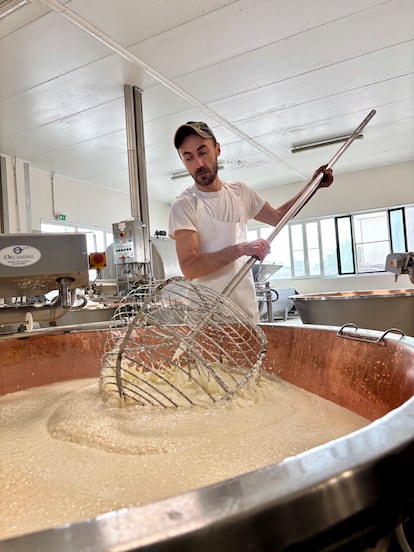
“The cheesemaker works with a living, natural product: the milk changes daily according to the season, the climate and what the cows are fed,” he adds, and the latter matters more than it might seem. Parmigiano Reggiano’s link to its territory runs deep: its uniqueness lies above all in a microbiological factor that cannot be reproduced elsewhere. The cows’ diet — based on local forage, grass and hay — gives the milk a distinctive bacterial activity of its own, like a fingerprint shaped by the local microflora.
This strong sense of identity is also inseparable. That is why the Consorzio del Parmigiano Reggiano has decided to go a step further and place the cheese at the center of a tourism project designed to showcase the strengths of its region, dotted with traditional farms, dairies and gastronomic experiences. The aim is to increase visitor numbers from the current 85,000 to 300,000 by 2029.
For now — at least — authenticity can still be felt in a city like Parma. There are no souvenir shops replacing traditional businesses, and it is even hard to find the typical fridge magnets. The real attraction lies in the many food shops, where you can buy treasures to keep inside your fridge, not to decorate the outside.
Sign up for our weekly newsletter to get more English-language news coverage from EL PAÍS USA Edition









































