A toll in the Strait of Hormuz: Iran’s condition for peace that could raise oil prices indefinitely
Tehran is already informally imposing this arbitrary fee on ships from non-hostile countries and aims to make it a permanent practice
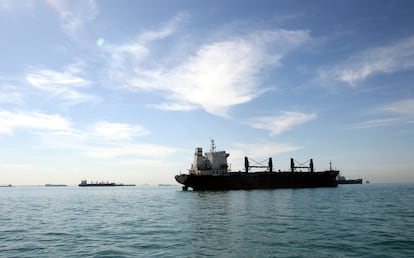

Pressure is mounting to reopen the Strait of Hormuz, which Iran has kept blocked for five weeks. Donald Trump has made the negotiation of a ceasefire contingent on the release and opening of the Strait of Hormuz — through which one-fifth of the world’s oil and natural gas passes — according to a post he shared on social media on Wednesday. And this Thursday, a group of 35 countries from around the world — led by the United Kingdom and including two Gulf states, the United Arab Emirates and Bahrain — is meeting to ensure free transit once the conflict in the Middle East comes to an end. However, the main obstacle to peace and to reopening the strait remains: Tehran’s demand to impose a toll, a condition that is complicating negotiations.
For weeks now, the Iranian Revolutionary Guard has been imposing an informal charge with arbitrary rates of up to $2 million per ship, according to Bloomberg, citing anonymous sources. In an attempt to formalize this extortion, the Iranian Parliament approved a draft bill on Tuesday to make a toll in the area official, though without setting specific amounts. And if approved, it would structurally increase the cost of fuel as well as other Gulf exports, such as fertilizers. It would amount to an additional premium on top of the usual risk premium already built into the price of oil — a commodity largely extracted in one of the most volatile regions on the planet.
“Any implementation of a transit toll would raise the cost of transporting energy from the Gulf,” says Rajesh Verma, an analyst at the maritime trade consultancy Drewry. Verma estimates that the toll Iran is considering could add an extra $2 to the price of a barrel of crude oil if the $2 million fees were to be officially implemented, with or without a war.
To put this into context, the price per barrel is hovering around $100 — 60% higher than before the war — driven by supply cuts and the risk premium resulting from the bombings in the Gulf, which is so high that many insurers have withdrawn coverage. The toll would add a further 2%. The impact would be felt first in Asia, the main destination for Middle Eastern crude, although the search for alternatives would ultimately drive up global prices.
“A prolonged application of the toll would redirect barrels from the U.S. and the Red Sea toward Asia,” notes George Morris, an analyst at the energy consulting firm Vortexa. Both analysts stress that formalizing the toll remains a hypothetical scenario. Moreover, the Iranian system is not uniform: some vessels have paid nothing, according to Bloomberg.
The few vessels without ties to Iran that have managed to cross the strait in recent days almost always divert their route toward the Iranian coast, heading for the islands of Qeshm and Larak — whose combined area is slightly smaller than that of Gran Canaria — in the middle of the Strait of Hormuz. This pattern, until now unusual, suggests an authorized corridor to allow passage, according to the maritime‑trade platform Lloyd’s List. It is there, the platform adds, that the tolls are reportedly being paid, citing anonymous sources.
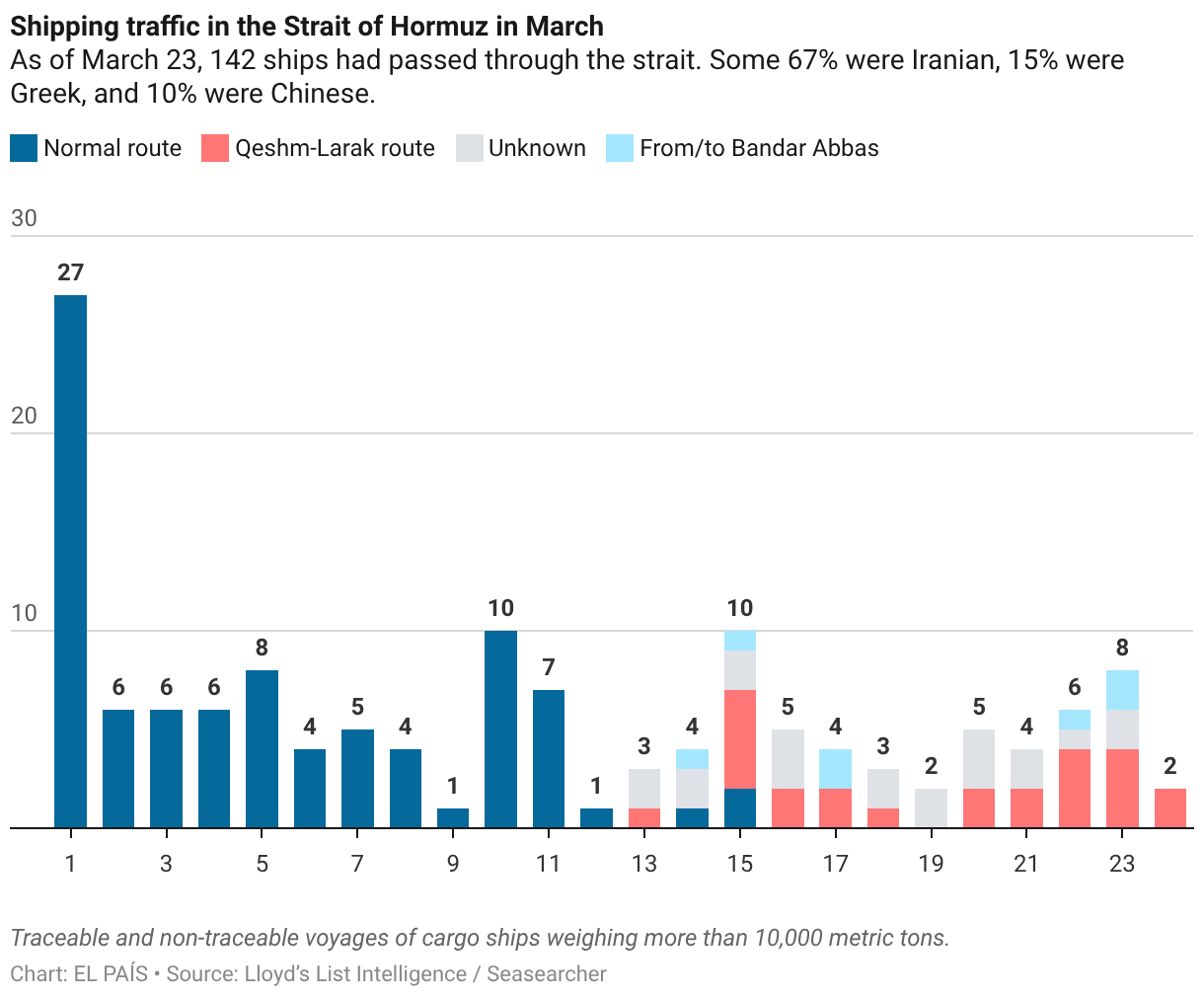
The rerouting to Qeshm and Larak began three weeks ago, after the blockade had already reduced daily traffic through the strait from about a hundred ships to just a dozen. The alternative route opened by Iran began precisely on March 13, according to tracking data from Lloyd’s List provided to EL PAÍS and updated through last week.
Since then, 56 ships have managed to cross in both directions, and 25 did so via the Qeshm and Larak route, including vessels owned by China and India — countries allied with Tehran — which did pay some toll, according to sources from the platform. The Iranian Ministry of Foreign Affairs announced last week that China, India, Iraq, Russia, and Pakistan will have free passage to the Gulf.
The rest of the traffic fared very differently. Only three ships followed the usual route, and since March 16, none have taken it again. Another seven remained anchored in the Iranian port of Bandar Abbas, at the entrance to the Gulf. And 22 switched off their tracking systems — a common practice to evade sanctions or remain undetected in conflict zones, a category into which the Strait of Hormuz has firmly fallen in recent weeks.
Analysts agree that it is precisely Iran’s inability to guarantee the safety of ships in such a vast area — and under jurisdiction shared with seven other countries — that casts doubt on its ability to turn the Strait of Hormuz into a canal like the Suez Canal in Egypt or the Panama Canal.
“Currently, ships trapped in the Persian Gulf might be willing to pay a toll to exit the strait, but it is unlikely that operators would pay to enter the Gulf and risk getting stuck or caught up in the conflict,” says Harrison Prétat, deputy director and a member of the Asia Maritime Transparency Initiative at the Center for Strategic and International Studies.
“It seems less like a legal fee and more like a protection payment,” adds Morris, an analyst at Vortexa. Even so, he believes the likelihood of a toll could increase if the blockade drags on. With Trump in the White House, nothing is predictable. Just a day before demanding the reopening of the strait as a condition for a ceasefire, the U.S. president posted on social media that the United States would withdraw in two or three weeks, even if it remained closed: “All of those countries that can’t get jet fuel [...] go to the Strait, and just take it. You’ll have to start
Even if the war were to end, it is unlikely that Iran will succeed, as the draft law approved on Tuesday envisions, in negotiating the toll with its Gulf neighbors. As Verma, the maritime trade analyst, notes, “if the toll remains in place even after trade normalizes, it would undermine the competitiveness of Persian Gulf crude against other sources of supply.” The consequence, he adds, is that they would be forced to offer discounts on their oil. The future, still highly uncertain, already seems to be pointing in that direction.
Sign up for our weekly newsletter to get more English-language news coverage from EL PAÍS USA Edition