
Adam Smith’s invisible hand: why his ideas are still influential today
The Scottish thinker – considered by many to be ‘the father of capitalism’ – published his magnum opus, ‘The Wealth of Nations,’ 250 years ago. In it, he coined the metaphor of the invisible hand, which refers not to a magical order, but to a market with an institutional framework that fosters growth. His ideas decisively influenced liberal thought, especially due to his belief in individual liberty and his wariness of state intervention
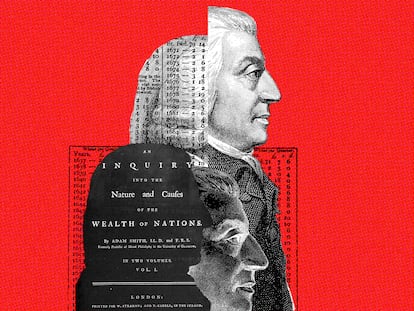
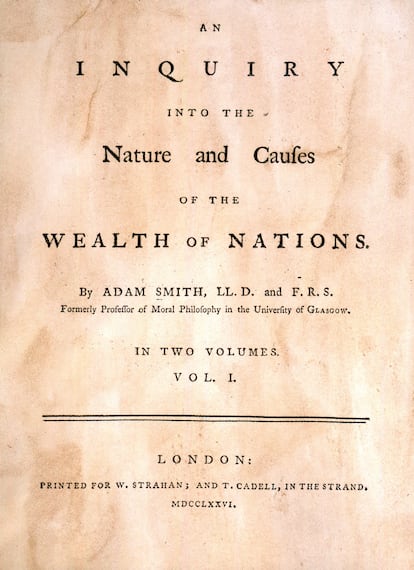
The full title of the book Adam Smith published in 1776 was: An Inquiry into the Nature and Causes of the Wealth of Nations. It was neither the first text on economics, nor on liberalism, and it wasn’t error-free. So why did it attract — and why does it still attract — so much attention?
I suspect that the answer lies in its title. It seems that Smith (1723–1790) did indeed do a good job of explaining the nature and causes of economic growth. And he did so from a modern and multidisciplinary perspective. This was because Smith was a thinker with a broad vision that extended beyond economics. He also advocated a nuanced form of liberalism that made his analysis compelling and applicable, both in his time and ours.
The book opens with these words: “The annual labour of every nation is the fund which originally supplies it with all the [necessities] and conveniences of life which it annually consumes.” This opening drew a line in the sand, rejecting the fallacy that based prosperity on natural resources or precious metals. Smith wouldn’t be surprised to learn that oil helped enrich the Norwegians, but not the Venezuelans.
His analysis is modern because it separated the wealth of a nation from that of the state. This was because, for him, the wealth that truly mattered was that of the people: “No society can surely be flourishing and happy, of which the far greater part of the members are poor and miserable.”
Economics, incentives and institutions
Smith explains the increase in wealth through the productivity of labor. And he notes that the division of labor cannot thrive until the size of the market grows. That’s why, when he selects the two most momentous events in human history, he doesn’t think of inventions, but rather two expansions of the market: the European colonization of the Americas and the sea route to the East Indies around the Cape of Good Hope.
Wealth is created through production and trade. There’s no such thing as a zero-sum game – another venerable fallacy – in which one loses what another gains. In fact, everyone can gain. And everyone has a powerful incentive, a constant of human nature that Smith emphasizes on several occasions: the desire to improve our condition, “a desire that comes with us from the womb and never leaves us until we go into the grave.”
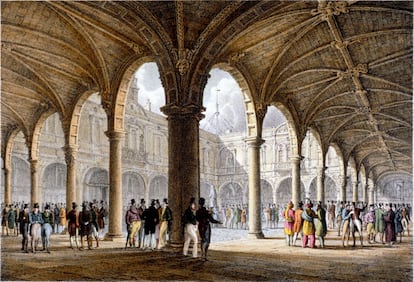
We all want to improve. And we achieve this by interacting with others. Smith doesn’t advocate individualism, because there’s no prosperity without voluntary exchanges for mutual benefit. His message is also contrary to selfishness, because selfish people attend to their own interests at the expense of others. The market is the opposite, where people satisfy their own interests, while also serving the interests of others.
That being said, productive citizens who are eager to progress aren’t enough. A favorable institutional framework is essential. Hence, Smith’s multidisciplinary vision of growth has had an impact on development theorists. The economy needs peace — which is why, he emphasizes, “defense is of much more importance than opulence” — as well as legal certainty: “Commerce and manufactures can seldom flourish long in any state which does not enjoy a regular administration of justice, in which the people do not feel themselves secure in the possession of their property, in which the faith of contracts is not supported by law.”
State and liberty
It’s clear that Smith values the role of the state. But to what extent? Well, he himself clarifies that, in a liberal system, the sovereign must fulfill three duties: defense, justice and “the duty of erecting and maintaining certain public works and certain public institutions, [a duty that can never be fall on] any individual, or small number of individuals [...] the profit could never repay the expense to any individual or small number of individuals, though it may frequently do much more than repay it to a great society.”
It’s easy to interpret the third duty as one that justifies indefinite interventionism. And, in fact, the Scotsman recommends anti-neoliberal measures in various fields, including education, flag protection in sea navigation, as well as the regulation of banking, among others.
His own practical distrust of the market, however, offers clues to his liberal position. Indeed, Smith defends capitalism, but not capitalists, whom he openly accuses: “People of the same trade seldom meet together, even for merriment and diversion, but the conversation ends in a conspiracy against the public, or in some contrivance to raise prices.” But this misgiving doesn’t lead him to side with the politicians — “an insidious and crafty animal” — but rather with the most vulnerable people, typically consumers: “Consumption is the sole end and purpose of all production; and the interest of the producer ought to be attended to, only so far as it may be necessary for promoting that of the consumer.” He would, therefore, not be surprised by the protests of big business owners who demand protectionism for their “strategic sectors,” making people pay more as a result.
Nor did Smith accept the usual arrogance of the powerful when it came to interfering in the property of their subjects: “It is the highest impertinence and presumption, therefore, in kings and ministers, to pretend to watch over the economy of private people and to restrain their [spending]... they are themselves always — and without any exception — the greatest spendthrifts in the society. Let them look well after their own expense and they may safely trust private people with theirs. If their own extravagance does not ruin the state, that of their subjects never will.”
The path to wealth, therefore, rests more on the citizens than on the authorities: “Every man,” Smith notes, “as long as he does not violate the laws of justice, is left perfectly free to pursue his own interest his own way, and to bring both his industry and capital into competition with those of any other man, or order of men. The sovereign is completely discharged from a duty [that — in attempting to fulfill it — would expose him to countless confusions] and for the proper performance of which no human wisdom or knowledge could ever be sufficient: the duty of [supervising] the industry of private people and of directing it toward the [tasks] most suitable to the interest of the society.”
A realistic invisible hand
The most famous metaphor in economics — the invisible hand — has been confused with perfect competition. But this was never in Smith’s mind: “If a nation could not prosper without the enjoyment of perfect liberty and perfect justice,” he writes, “there is not in the world a nation which could ever have prospered.
Society is a complex order. Hence, for Smith, it’s best to leave human beings alone, because “by pursuing his own interest, [an individual] frequently promotes that of the society more [effectively] than when he [actually] intends to promote it. I have never known much good done by those who [purported to be acting] for the public good.” Smith criticized wealth inequality, but, in his writings, he argues that “the policy of Europe, by not leaving things at perfect liberty, occasions other inequalities of much greater importance.”
Adam Smith made mistakes, such as in his flawed objective theory of value, or in his prediction of the limited future of corporations. But he was right in his fundamental theory — namely, that the wealth of nations depends on the effort made by each of us to get ahead, in a peaceful context, with justice and moderate taxation — and in the idea that we often succeed despite the government.
With prudence and realism, the philosopher cautioned against utopia and warned about the difficulties of liberalizing reforms, because interventionist regulations “introduce very dangerous disorders into the state of the body politic… [and these] disorders [are] often difficult to remedy [with free-market reforms], without occasioning, for a time at least, still greater disorders.”
Reappraisal and legacy
Adam Smith is being reclaimed by contemporary economists, which is remarkable considering how much both the real economy and economic theory have changed.
His institutional and multidisciplinary vision has been praised by leading academics. Speaking only of recent decades, and limiting ourselves to Nobel laureates in Economics, figures such as Friedrich Hayek, George Stigler, Amartya Sen, Ronald Coase, James M. Buchanan, Vernon Smith and Douglass North studied Smith and gained appreciation for his thought. This list of economists isn’t intended to be exhaustive, yet it’s illustrative of the scientific impact that the Scottish professor and his magnum opus have had.
Regarding his doctrinal and political legacy, Smith, due to his nuanced classical liberalism, has amassed critics among the more interventionist economists. But he’s also been criticized by adherents to the Austrian school, who advocate for economic liberalization. Although, not all of them have opposed Smith: Friedrich Hayek, for one, praised him.
Finally, a Smithian legacy can be detected in politics and public opinion. Appreciation for free trade and the market has spread, while a political and popular backlash against government interference and burdensome taxation continues to gain traction.
Sign up for our weekly newsletter to get more English-language news coverage from EL PAÍS USA Edition









































