
Changes to tax returns and the IRS in 2026: adjustments, benefits, and losses for households
While the child tax credit will increase next year, the expiration of federal assistance for millions of people who have health insurance thanks to Obamacare will raise the amounts to be paid
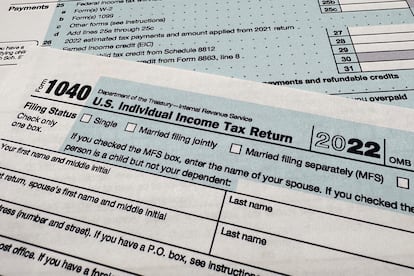

The 2026 tax season will bring changes that will impact millions of taxpayers in the United States. From inflation adjustments to tax brackets — which redefine the income ranges subject to each tax rate — to changes in essential credits such as those assigned to earned income or child credits, the Internal Revenue Service (IRS) has updated several parameters that determine how much households will pay and how much they could receive in refunds. Although many of these changes seek to reflect the cost of living and ease the tax burden on workers and families, others may change the filing strategy of those who usually calculate their deductions or rely on specific benefits.
President Donald Trump’s fiscal reform, passed in July of this year, adjusted the standard deduction for the 2025 tax year to $15,750. For heads of household, it will be $23,625, while for couples filing jointly, the amount rises to $31,500. Likewise, this year’s tax brackets are as follows:
- 10% for single people earning $11,925 and $23,850 for married couples.
- 12% for income from $11,926 for single filers and $23,200 for couples.
- 22% for income from $48,476 and above and $96,591 for married couples.
- 24% for income over $103,351 and $206,701 for joint returns.
- 32% when income exceeds $197,301 and $394,601 for married couples.
- 35% for income over $250,526 for single filers and $501,051 for joint filers.
- 37% for income over $626,351 and $751,601 for married couples.
It is important to clarify that someone who earned, for example, $105,000 last year will not pay 24%. As this is a progressive tax system, the IRS will take the taxpayer’s income and divide it into portions to which it can apply seven different percentages.
Changes to tax credits
The finances of millions of Americans depend on tax credits or rebates granted by the federal government. Some of these are refundable and can represent a significant contribution to the taxpayer, even if they do not have to file taxes.
One of the best known, the child tax credit, rose in 2025 to $2,200 for each dependent under the age of 17. Washington’s tax package approved a portion of this credit to be refundable, with a maximum payment of $1,400 per child or dependent minor. To be eligible, the rule states that at least one parent must have a valid Social Security number. This means that millions of children who are U.S. citizens but are the children of undocumented immigrants will not be able to claim the credit.
On the other hand, the Earned Income Tax Credit (EITC) is one of the most significant and can represent up to $8,046 per family if it has three or more children and an annual income of $68,675. The maximum amount that can be received individually or as a head of household is also the same. Similarly, the premium tax credit that has enabled millions of Americans to purchase health insurance through the Affordable Care Act (ACA), known as Obamacare, is about to change.
Payments are calculated based on the taxpayer’s income and how it compares to the federal poverty level, a parameter used by authorities to determine whether a person or family is eligible to receive public benefits. In 2025, this is $15,650 in annual income. But a subsidy granted by Congress has allowed thousands of families to reduce their health care expenses. This subsidy will expire on December 31 and was left out of the agreement reached by Democrats and Republicans to end the government shutdown. Now, 24 million people are at risk of losing their health insurance.
According to calculations by the Kaiser Family Foundation (KFF), a family earning $55,000 a year and paying 0.8% of that amount ($462) for their insurance premium will now have to pay 5.2% of their income to cover it: $2,404. That is almost six times the previous amount. In the case of individuals, if they earn $35,000 a year and pay 3% of their income for health insurance (about $1,033), with the expiration of tax relief they will pay $2,615, or 7.5% of their income.









































