
Tesla, Google and China leave Europe behind in the race for self-driving cars
The US automaker offered Musk a trillion-dollar bonus to focus on developing this technology. Volkswagen is trying to keep up with its Moia division
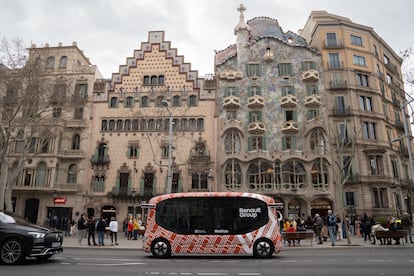

WeRide, Pony AI, Apollo Go, Xpeng, May Mobility, Zoox, Lucid, Waymo, and Moia. All of these names, which are mostly unknown to the general public, are companies that could be key players in the automobile of tomorrow. This is because of the development of autonomous mobility, the new holy grail of the auto industry that promises multi-billion-dollar profits to anyone capable of mastering the technology and dominating the sector in the coming years. While it seems unlikely to become a widespread reality in the short term, both China and the U.S. are encouraging the launch of trials of a technology that has already left its mark. Last year, General Motors announced that it was abandoning the robotaxi business due to its high cost.
The projects that continue to move forward are mostly supported by large technology companies or directly by the state, as is the case with WeRide, backed by the Chinese government. This month, with the help of a local partner, the company announced that it will begin testing a route through Singapore’s Punggol neighborhood, with the goal of launching a robotaxi rental service by early 2026. Another Chinese company, Pony AI, will compete in that same market, motivated by the city-state’s announcement that it will integrate autonomous vehicles into its public transportation network.
In the U.S., Waymo — owned by Alphabet, Google’s parent company — operates robotaxis in San Francisco, Los Angeles, Phoenix, Austin and Atlanta. In Austin, Texas, Elon Musk’s company Tesla transported paying passengers in a driverless car for the first time in June. This was hailed as a major step forward for Tesla, as the company — more akin to that of a tech giant than a traditional automaker — pins much of its stock market value on its ability to achieve a dominant position in the robotaxi business in the mid-to-long term.
Tesla is so certain of its strategy that it has offered Musk a bonus valued at approximately $1 trillion so that the tycoon can “focus his energies on Tesla” and put aside his active role in politics and his support for the far right, which has cost the car manufacturer dearly. Among the targets Musk must meet to collect the full, unprecedented bonus is putting one million robotaxis on the streets. For its part, Uber announced in July that between 2026 and 2032 it will deploy a fleet of more than 20,000 fully autonomous cars in “dozens of markets around the world” in partnership with Lucid and Nuro, two U.S. companies.
In Europe, meanwhile, initiatives are emerging, such as Moia, a subsidiary of Volkswagen. The company took advantage of the Munich Motor Show in September to announce the ID. Buzz AD, its first fully autonomous vehicle specifically designed to offer mobility services. Moia, whose autonomous driving system was developed by Mobileye, an Israeli company acquired by Intel in 2017 for $15.3 billion, plans to implement “sustainable and autonomous mobility on a large scale in Europe and the U.S.” starting in 2026, the company announced at the Bavarian motor show.
The ID. Buzz self-driving vehicles, said Volkswagen Group CEO Oliver Blume, are part of “a fully connected 360-degree package made up of leading technology, an attractive vehicle fleet, intelligent fleet management, and a customer-centric booking system. This positions the Volkswagen Group among the frontrunners in a multi-billion-dollar global growth market. Hamburg is our starting point.”
Donia Razazi, an industry expert at the consulting firm Ayming, believes, however, that autonomous vehicles will still take time to become a reality. “Initiatives like Moia’s in Hamburg are a very important step; they show us that the technology is already functional in controlled environments and that European manufacturers are willing to invest. However, we must be realistic: the mass adoption of autonomous vehicles in Europe is not imminent,” Razazi explains, citing organizations such as the World Economic Forum, which indicate that widespread adoption of this mobility is projected for the 2030-2040 horizon.
Musk himself has repeatedly promised fully autonomous driving, only to fail to deliver on his promises. Despite this, Tesla remains persistent and appears to be one of the leaders in this race, alongside other Chinese and American competitors such as Waymo.
“Europe maintains a relevant role in the global race for autonomous cars, but it’s undeniable that the United States and China have advanced more rapidly in recent years,” says Razazi. “The main reason lies in the regulatory framework. Although the EU has made important strides with the Vehicle General Safety Regulation, which allows for the approval of Level 3 autonomous driving systems and above, each country maintains its own regulations, which complicates large-scale deployment. Meanwhile, in U.S. states like Arizona and California, and in Chinese cities like Beijing and Shenzhen, driverless robotaxis are already operating regularly.”
Tensions between China and the US
A stumbling block in the development and widespread adoption of autonomous vehicles is the tension between China and the U.S., with mutual technological vetoes and tariffs, which could lead to “a fragmentation of technological ecosystems and a potential increase in costs, which could slow the scalability and accessibility of autonomous vehicles globally,” according to Razazi. Furthermore, autonomous vehicles open up a new battleground: who controls the data generated by vehicles.
“This is highly sensitive information that each bloc seeks to protect and capitalize on,” says Razazi. “In practice, the U.S. and China have already reached the most advanced level with the robotaxi. Rather than a direct confrontation between them, the real battle is to see who can establish themselves first in key regions such as Europe, the Middle East, or countries with high purchasing power, but without providing their own solutions."
He continues: “Europe, for its part, has established strict regulatory barriers, especially regarding data protection and artificial intelligence, which require guarantees of privacy, transparency, and system security. This does not prevent the entry of foreign actors, but it does limit their absolute control over data and forces them to adapt their models to European standards.”
Sign up for our weekly newsletter to get more English-language news coverage from EL PAÍS USA Edition









































