
Mexico prepares for tough USMCA treaty negotiations with the United States
The long list of trade barriers cited by the Trump administration includes energy, agriculture and intellectual property. The US president seeks to achieve gains not only in its balance of payments, but also in the political and immigration spheres

Mexico is preparing for what promises to be a difficult and lengthy renegotiation process of its trilateral treaty with the United States and Canada. What, according to USMCA regulations, should be a simple periodic review is now emerging as an opportunity for the Donald Trump administration—which has pointed out the existence of at least 50 barriers against it—to seek to achieve gains not only in its balance of payments, but also in the political and immigration spheres.
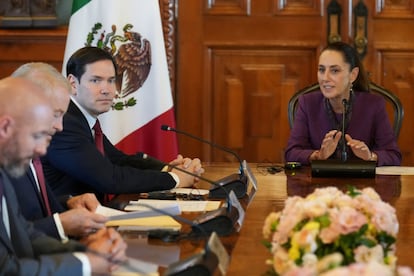
Following U.S. Secretary of State Marco Rubio’s visit to Mexico last week, President Claudia Sheinbaum acknowledged that they will review the disagreements one by one. She also warned that her negotiating team will raise protests when the balance tips in favor of Mexico’s counterparts.
The United States’ complaints cover multiple areas, some easier to resolve than others. In a March report, the Office of the U.S. Trade Representative (USTR) argued that Mexican energy policy disproportionately favors state-owned companies, such as Pemex and the Federal Electricity Commission (CFE), which restricts private participation and contradicts the spirit of the USMCA.
It also pointed to delays in approving health permits that slow the entry of U.S. products, as well as opaque and changing customs procedures that generate uncertainty among exporters. It also questioned Mexico’s growing protectionism toward local industries—such as electronic payments—and more lax patent policies. It even highlighted that the El Santuario and San Juan de Dios markets in Guadalajara, and Tepito in Mexico City, are on its list of Notorious Markets for Counterfeiting and Piracy, along with some 30 other global establishments that it considers a threat to intellectual property.
The treaty’s regulations establish the renegotiation schedule. The United States, Canada and Mexico must begin public consultations on the strengths and weaknesses of the agreement with their industrial sectors in the fall of this year, and a hearing among the three countries is planned for around October. The crucial date is set for July 1, 2026, when it will be decided whether to extend the treaty’s validity for another 16 years or terminate it in 2036. Economy Secretary Marcelo Ebrard has emphasized that his office has been engaged in the task since September, while the U.S. president has reiterated that he will seek a complete review, even though the terms originally stipulate a renegotiation of only the points that require attention.
“The implications of this negotiation are enormous. The continuity and updating of the region’s main trade agreement are at stake,” explains Héctor Magaña, coordinator of the Center for Research in Economics and Business at the Tecnológico de Monterrey. “If the renegotiation is conducted constructively, it could further strengthen these trade relations, resolving outstanding frictions in areas such as energy, agriculture and the digital economy. But if tensions escalate, there is a risk of a breakdown in trust between the partners. In fact, Trump has already shown a willingness to aggressively use tariffs, which could lead to a trade war in the region. In the worst-case scenario, if an agreement is not reached, it could even jeopardize the permanence of the agreement in the medium term,” he adds.
However, the expert emphasizes that “there have been signs” that the common interest in maintaining economic integration in North America will prevail. “Mexico and Canada, while defending their regulatory sovereignty, have shown a willingness to correct their course to align with their trade obligations,” he notes.
Trade deficit, but with a political banner
Trump is well aware that the trade balance favors his neighbor, although his tariff diatribe has focused on much more than just taxes, becoming a lever to achieve broader cooperation goals. “These barriers, described in the 2025 USTR report, target Morena’s economic policies, including those on energy, agriculture, telecommunications, intellectual property, and financial services regulations. Amid a historic $172 billion trade deficit with the United States in 2024, Trump is demanding concessions and linking issues of trade, migration, and security. With a 90-day deadline to avoid the imposition of tariffs, Sheinbaum faces pressure to balance pragmatic negotiations with the defense of Mexico’s sovereignty and the policies of the Fourth Transformation,” Bradesco BBI summed up in a market analysis.
Rubio’s visit was marked by the “historic” cooperation between the countries in the fight against drug cartels, which, according to the United States, extend their areas of operation from China, Canada, and Venezuela, permeating the entire continent. Also, although to a lesser extent, by the need to preserve the close commercial integration achieved to date.
After the meeting, the Mexican president announced that she is considering imposing tariffs on imports from countries outside the free trade agreement, including China, which, in turn, has warned about retaliatory measures if necessary. Although it was not immediately clear whether Sheinbaum’s statement was in response to pressure from the United States, the measure could facilitate negotiations for Mexico, according to Magaña. “It could be viewed favorably during the USMCA renegotiation sessions, given that it seeks to fulfill the United States’ desire to openly compete with Chinese trade.”
Sign up for our weekly newsletter to get more English-language news coverage from EL PAÍS USA Edition









































