
Apple falls back on the iPhone: 3 billion sold since 2007 and $200 billion in annual revenue
The popular device accounted for 47% of Apple’s revenue in the third quarter as the company now tries to position itself in the field of artificial intelligence
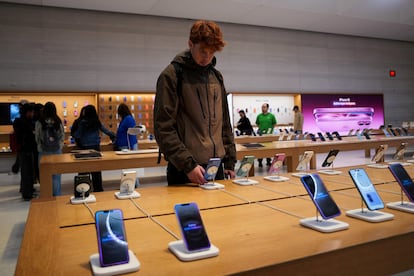

Apple announced its third-quarter earnings last week, reporting revenue of $94 billion between April and June, a new all-time high for this period and up 10 percent year over year. What’s more, Apple reported a historic operational and industrial milestone: it has now sold 3 billion iPhones since the product was launched in 2007 in a move led by its co-founder and CEO, the late Steve Jobs.
The company reached the milestone of 1 billion sold iPhones in 2016, nine years after its launch. This means that, in the following nine years, between 2016 and 2025, it has sold 2 billion devices. Current CEO Tim Cook highlighted to investors the strong growth in the iPhone 16 business, thanks to the popularity of the iPhone 16 model.
The executive highlighted the 13% growth in the iPhone business unit in the third quarter, surpassing $44.6 billion in revenue. This means the device has once again consolidated its position as Apple’s most important product, contributing 47% of total revenue this quarter.
In the first nine months of the year, the iPhone division achieved revenue of $160.56 billion, a 3.6% increase. With this growth, this business is on track to surpass the $200 billion mark in the current fiscal year, which ends at the end of September. Last fiscal year, this business unit already reached $201.18 billion.
The iPhone business received a boost in February thanks to a new entry-level model, the iPhone 16e. This device costs $599, well above the price of the model it replaced, the iPhone SE, at $429. All eyes are now on Apple, which will announce its next iPhones in September. As part of the company’s usual schedule, next-generation devices typically go on sale in the final weeks of the fiscal fourth quarter.
iPhone growth has allowed the company to offset declines in other units, such as wearables and the iPad. The latter generated revenue of $6.58 billion, down 8.1% and below Wall Street estimates, although the company launched its revamped, higher-priced iPad Pro last year, complicating the comparison. The wearables, home, and accessories division (which includes AirPods, smartwatches, set-top boxes, Vision Pro headphones, and HomePod speakers) continued its downward trajectory. Revenue fell 8.6% to $7.4 billion, also below estimates.
Apple did see growth in its Mac division, with revenue of $8.05 billion, above market forecasts, following the launch in early March of new MacBook Air and Mac Studio models with faster processors.
Similarly, the services division recorded 13% growth to $27.4 billion, also above market expectations. However, the company has not offered any guidance, amid concerns about the impact of regulatory changes in various countries regarding the App Store, which could affect its revenue.
The company’s current focus is its positioning in the field of artificial intelligence (AI). Last week, following the financial presentation, Cook gathered the workforce to explain the company’s prospects for AI and its “incredible” product portfolio. According to the executive, the AI revolution is “as big as or bigger” than the internet, smartphones, the cloud, and apps. “Apple must do it. Apple will do it. This is sort of ours to grab,” Cook told employees, indicating that the company will pursue the necessary innovation.
The company’s responses to the unknowns in AI, where groups such as Alphabet, Microsoft, OpenAI, XAI, and Meta are making a strong commitment, could lead to its recovery on the stock market. Apple’s shares have dropped nearly 19% since the beginning of the year, compared to a rise of nearly 9% in the Nasdaq 100. With this trend, the company has moved away from the global leadership of corporations by market capitalization, where Nvidia and Microsoft have exceeded four trillion dollars in recent weeks, while Apple, the leader in recent years, has remained around three trillion.
Sign up for our weekly newsletter to get more English-language news coverage from EL PAÍS USA Edition









































