
The miracle of ‘Romeo + Juliet’: How Leonardo DiCaprio, Claire Danes and Baz Luhrmann reinvented Shakespeare
Thirty years on, Baz Luhrmann’s film retains its status as a 1990s cult classic thanks to iconic costumes, an addictive aesthetic, and a singular cinematic language
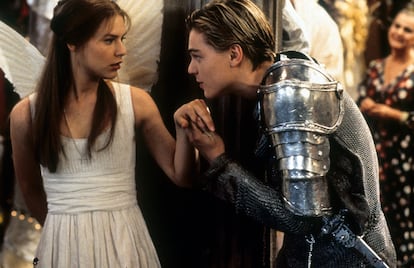

Thirty years ago, Leonardo DiCaprio, at just 21, won the hearts of half the world starring opposite Claire Danes in Romeo + Juliet, a modern adaptation of William Shakespeare’s classic directed and adapted by Baz Luhrmann.
The film bestowed the California-born actor with “star” status, a label that would be cemented after the release of Titanic the following year. Seen again in 2026, Romeo + Juliet retains an energy and originality that go far beyond the nostalgia with which some remember that era and the cinema of the time. The film is a compendium of visual beauty and stylistic risk that makes you wonder whether a movie like this could even get made today.
There is a paradox, though, With Romeo + Juliet: although it is based on a 16-century text, it set out to be utterly modern and yet has managed to become timeless. It is a piece of wild craftsmanship — full of Hawaiian shirts, sacred hearts, palm trees, souped-up cars, fantasy weapons and neon lights — that functions as a time capsule preserving the best essences of the much-revisited 1990s.
Chaos, guns and California sun
To understand the impact of Romeo + Juliet, it helps to remember where the 1996 audience was coming from. Until then, cinematic Shakespeare adaptations tended to evoke the Renaissance world with period costumes, palaces, and stage-like performances. Luhrmann and co-writer Craig Pearce kept Shakespeare’s verse but shattered everything else, inventing their own world: Verona Beach.
Verona Beach, where the action takes place, is a hybrid of Miami, Los Angeles, and Mexico City — a border city in perpetual social unrest, inspired by the 1992 Los Angeles riots. In this almost comic-book universe the Montagues and Capulets are no longer noble Italian families but rival corporate and criminal conglomerates vying for control of the city.
To bring this fictional space to life, the crew shot almost entirely in Mexico City and Veracruz. Chapultepec Castle became the Capulet mansion, and the spectacular church of the Purísimo Corazón de María in the capital stood in for the neo-Gothic cathedral where the lovers’ tragedy reaches its climax.
But beyond the locations, the opening of the film stages a surprise with its use of audiovisual language. The tragedy’s prologue is recited by a news presenter seen on an old cathode-ray TV, followed by a breathless first sequence set at a gas station where members of the two rival families encounter each other.
As Luhrmann told The Face in a 1997 interview, the choice of a gas station was no accident. “In the Elizabethan Verona, you had a center of town where boys paraded,” he explained. “In a modern American city, a gas station is the one place where enemies are forced to cross.”
Shooting that sequence was the most complicated of the film, Luhrmann said. “Mexico is the most polluted city in the world,” he began. “I’d been ill so I was directing from a wheelchair with this breathing mask. When we came to this shot with [Montague gang member Benvolio, played by] Dash Mhok, he ran down the wrong street. So he’s running down a real street and he jumps up on a real car with real people, a family, and starts shooting back at us and all the cops jump out, people are screaming and I’m going ‘Cut cut cut cut!’ We kept the shot in the film.”
Unlike today’s commercial cinema, where almost everything feels predictable, the gas-station scene in Romeo + Juliet drips with novelty and pace. A frantic edit full of close-ups, unconventional framing and fast camera moves that likely baffled viewers at the time but now makes perfect sense as a true reflection of the era’s pulse.
Dolce & Gabbana and angel wings
As journalist Liam Hess recalled in 2021 for the British edition of Vogue, designer Kym Barrett, together with Catherine Martin, Luhrmann’s wife, built a textile narrative that defined the decade’s wardrobe and still inspires men’s runways today.
In fact, each rival family has its own aesthetic universe. The Capulets are defined by a Latin gangster and urban cowboy look — vests, Cuban-heeled boots and fantasy weapons. The Montagues are more casual: they look like tourists who have just stepped off a plane in Hawaii, wearing colorful shirts, white tank tops and bleached streaks in their hair.
Barrett recalls that the movie’s total budget of $15 million didn’t stretch far, so they had to work directly with brands like Dolce & Gabbana, which lent archival pieces for the Capulets, and Prada, which provided Romeo’s suit.
The swords and daggers named by Shakespeare in the original play were replaced on screen by weapons adorned with heavy Catholic iconography — virgins and crosses that add irony and gave the modern weapons the personality needed to stand alongside the old.
But beyond the designer pieces, the film’s most iconic items were created in-house. One example is Romeo’s Hawaiian shirt with a Sacred Heart motif and flowers that he wears toward the end of the tragedy; it was hand-painted from a vintage shirt found at a Miami flea market.
The masquerade ball outfits in which Romeo and Juliet fall in love to the rhythm of I’m Kissing You by Des’ree were conceived with the characters’ backstories in mind. Romeo wears armor that evokes Lanzarote, the tragic hero of medieval chansons de geste. Juliet wears a white dress and angel wings that serve as a poetic counterpoint to Romeo’s costume. And Paris, the bumbling heir played by Paul Rudd who hopes to marry Juliet, is dressed as an earnest astronaut.
Undeniable chemistry
But despite everything, we might not be talking about Romeo + Juliet if the lead couple had been different. It’s hard to imagine the film without DiCaprio, who was only 21, and Danes, who was barely 17 during filming, in the main roles. Their youth and innocence translate perfectly onscreen and make the tragedy feel like a stab to the heart.
Indeed, their meeting through a fish tank remains one of the most moving love-at-first-sight scenes in film history. Romeo, slightly disoriented after washing his face in the Capulets’ restroom, is drawn to a huge aquarium that divides the men’s and women’s facilities. On the other side is Juliet, watching him among corals and colorful fish. He thinks the vision is almost a hallucination, but it isn’t, and in that instant they realize nothing makes sense unless they can be together.
In The Face, Luhrmann revealed the genesis of that scene. “I got the idea when I was writing in Miami: we went to this nightclub called The Dome, and while I was in the bathroom I was thinking about how Romeo could meet Juliet in a surprising and interesting way. And I’m looking at this fish tank that was there and next thing I know I see this girl combing her hair. The foyer parts of the bathrooms where you wash your hands are connected by a giant fish tank — you could see the girls in their side through the tank. I thought, ‘I’ll take that.’”
When doves cry
Another essential element in understanding the Romeo + Juliet phenomenon is its soundtrack. The album became a worldwide bestseller, reaching triple-platinum status in the United States.
Rather than a conventional soundtrack, music supervisor Karyn Rachtman and Luhrmann selected each track for its narrative function. “If you look at the Elizabethan stage they knew their audience was like 3,000 drunken punters,” Luhrmann told The Face. “They had stand-up comedy one moment, then pop song, and then tragedy, all cut within the same piece. The notion of sticking popular music into the piece was written into the text.”
Every song feels tailor-made for its scene. For example, Radiohead’s Talk Show Host perfectly captures Romeo’s melancholy before meeting Juliet, The Cardigans’ Lovefool conveys the crazy euphoria of falling in love, and the choral version of Prince’s When Doves Cry elevates the absolute solemnity of the temple where the tragedy will end.
The best Shakespeare adaptation?
Three decades after its premiere, Romeo + Juliet remains a surprising and still somehow “new” film. Time seems not to have touched it because perhaps it never expected to be preserved at all. It chose instead to be wild, boldly romantic and utterly faithful to its moment.
While the usual fate of fashionable films is to fade from memory soon after their success, Luhrmann’s Verona Beach still feels possible in a world that has little in common with the one that produced it.
Perhaps, as critic Stephanie Zacharek wrote of DiCaprio and Danes in TIME in 2021, “their Romeo + Juliet is one of pure feeling, a flame burning fast and clean. Movies are neither made nor received in a vacuum, and they have a life beyond what we can initially imagine for them. That’s why so many of today’s grownups who saw Romeo + Juliet as kids will never forget it. And that is how a play lives forever, reinvented again and again across the centuries, even as its bones and its heart remain intact.”
Sign up for our weekly newsletter to get more English-language news coverage from EL PAÍS USA Edition









































