
All of America’s Mexican friends
Ambassador Ronald Johnson calls for a ‘sovereign Mexico’ that is ‘free of criminal organizations’ at a gathering in which Mexican governors, lawmakers and government officials praised the successful relationship with the US amid political and economic tension
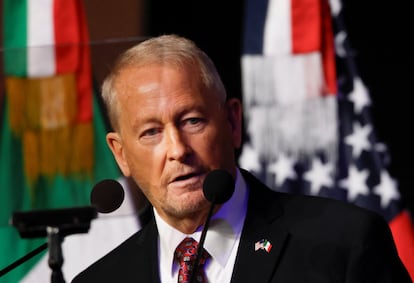

It’s the relationship du jour: the United States and Mexico are partners, allies, brothers. The nearly trillion-dollar link, the “envy” of the rest of the world, a shared history behind a border. Now, after months of strangling tension, both countries agree that the relationship is doing very well. President Donald Trump said so this week before the UN General Assembly, and Claudia Sheinbaum — who decided not to attend the global gathering in New York — said so from the National Palace.
Their words were echoed Wednesday at the Binational Convention, organized by the American Society, by governors from across the political spectrum, members of Congress, officials and U.S. Ambassador Ronald Johnson. During a day of meetings on the economy and security, the “elephants in the room” (threats from organized crime and from China) were mentioned often, while there was barely any mention of other issues that until recently were threatening to blow the relationship apart: the presence of CIA agents in Chihuahua without the Mexican federal government’s authorization, the drug-trafficking charge against Sinaloa governor Rubén Rocha, and the revocation of visas for key figures in the ruling party, Morena. In a scenario full of disagreements, the current moment is focused on exalting a friendship.
The gathering opened with both countries’ national anthems, a prayer from the Mexican Episcopal Conference and a reading of words by John F. Kennedy. Afterward, Ronald Johnson delivered a message in English because he wanted to be “very clear” about what he had to say: The United States wants to see a Mexico that is “sovereign, free of malicious external interference”, but also “free of criminal organizations and transnational cartels that terrorize and control communities.”
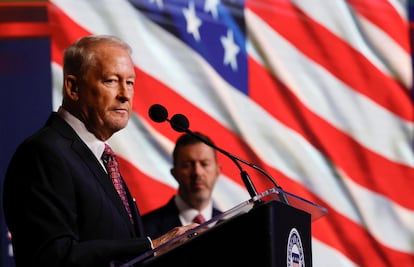
The former Green Beret mentioned the car bombs that exploded in Zacatecas as an example of cartel “terrorism,” and alluded to China without naming it: “Some foreign actors do not want this partnership between the U.S. and Mexico to succeed; in fact, some would like it to fail and for Mexico to fail. And they are willing to pay a high price for that to happen.” According to Johnson, this is happening because a bilateral relationship is being built that the rest of the world envies, and thanks to which North America is safer, stronger and more prosperous.
Along those lines, the ambassador read the part of Trump’s UN quote that says, “we have made great progress with Mexico, they [the Sheinbaum government] do not want the cartels either,” omitting the other side of the Republican’s remarks: “Mexico is the epicenter of cartel violence. Unfortunately, it is unacceptable that the United States shares a 2,000-mile border with a territory controlled by enemy cartels. Therefore, Mexico must regain control of its territory from the hands of the enemies of humanity.” Johnson chose the other official line, repeated constantly in U.S. statements and by U.S. officials: “We continue to extend a hand to Mexico to offer to do more, not as individuals, but as good neighbors.”
The American Society (Amsoc), founded in 1942 to bring the two countries closer and today serving two million people and 24,000 U.S. companies in Mexico, found itself in the eye of a storm a few months ago. It had held its annual dinner, sponsored — among others — by Grupo Salinas, and Sheinbaum accused it of being a meeting meant to damage the relationship with the United States and promote military intervention in the country. Amsoc president Larry Rubin clarified that members of her party were present at the dinner, to which she herself had been invited. The storm passed.
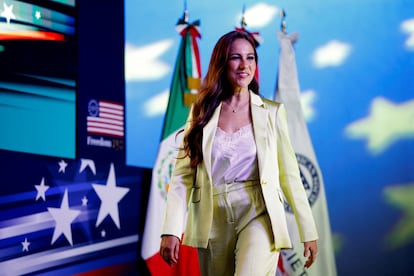
On Wednesday — where ADN Noticias, part of the Salinas conglomerate, was also a sponsor — plurality was not a problem: sharing the same panel were Michoacán Governor Alfredo Ramírez Bedolla of Morena; Jalisco Governor Pablo Lemus, from Movimiento Ciudadano; and PAN governors Libia Dennise García of Guanajuato and Mauricio Kuri of Querétaro. All were ready and prepared to boast about their ties and trade figures with the United States.
The governors
Ramírez Bedolla, who called his state “North America’s orchard,” touted avocado and lime export figures and said Michoacán hosts “the largest U.S. phytosanitary inspector program in the world.” The governor said there are 50,000 “North Americans” living in Michoacán and four million Michoacanos on the other side of the border, concluding: “We are a binational state.”
The definition Lemus chose for Jalisco was “the Silicon Valley of Latin America”: the governor pointed to the development of cabling, semiconductors and servers dedicated to artificial intelligence in the state. He said this development has helped position Jalisco as “the leading nonborder state in exports”: “Our main trading partner, our principal ally, is the United States across the entire electronics market.”
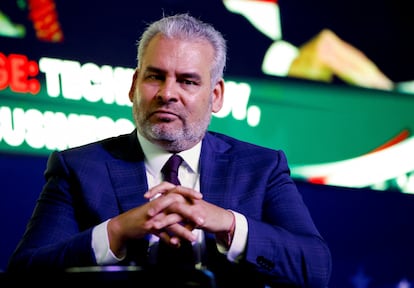
Querétaro, said Governor Kuri, is a “new cluster of data centers” (72% of the country’s total are in that state), making it “among the three top destinations for U.S. investment nationwide” thanks to the aerospace and automotive industries, and he said of the relationship with the neighbor to the north: “We are friends, we are allies, we are brothers.”
Governor Libia Dennise García used the figures (more than $33 billion in Guanajuato exports to the U.S. and $15 billion in imports of inputs) to assert: “There is no stronger example of the solid relationship we have with the United States.” The PAN governor emphasized what had been the central topic of all the meetings: the United States–Mexico–Canada Agreement (USMCA), still under negotiation. “We have to understand ourselves as a trading region and ally in order to confront this unfair competition, this protectionism coming from China,” García said, the first speaker of the day to explicitly name the Asian giant.
The ever-present USMCA
In July the United States decided it would not extend USMCA for another 16 years and would stick to annual reviews of the agreement until it expires in 2036. After repeatedly threatening to withdraw from the treaty, Trump said this month he would not do so, even with relations with Canada under strain. That is forcing Mexican officials to continue exhausting rounds of negotiations that sometimes end up as dead letters because of sudden decisions from the White House.
Luis Rosendo Gutiérrez, undersecretary for Foreign Trade and one of the leaders of a negotiation that has now lasted two years, participated in the Binational Convention just before leaving for a new meeting in Washington: “The United States used to have 15 trade agreements and today it only has one: USMCA.” The Economy Secretariat official framed the talks as part of Trump’s reworking of the rules of the game: “If we looked at it solely as the treaty, someone might say to me: ‘Hey, we’re in bad shape,’ but in the new game free trade is no longer necessarily central. The new game is about the relative advantage Mexico will have compared with the rest of the world.”
The undersecretary said that 85% of Mexico’s exports to the United States are tariff-free, that globally Mexico has “one of the lowest tariffs on the planet at 3.4%,” and that it maintains one of the “two closest” trade relationships with the U.S. trade team. He also outlined the path forward: diversification toward other markets for highly taxed products such as steel, aluminum or cars; trying to buy more from the U.S. to adjust the trade deficit, Mexico’s “happy problem,” and becoming less of an assembly stop and more of a manufacturing region.
No one hides it anymore: the efforts of economic teams will not be enough on their own. They are intertwined with security demands, the relationship with third countries, seizures and arrests, and with Mexico doing a little bit more still.
Sign up for our weekly newsletter to get more English-language news coverage from EL PAÍS USA Edition









































