
Michelle Pfeiffer and David E. Kelley break a 30-year rule: Never mixing love and work
The actress, nominated for the Emmy for ‘Margo’s Got Money Troubles,’ always considered it too risky to work with her husband, one of television’s most influential creators. Three decades later, a role she couldn’t turn down has finally brought their professional paths together
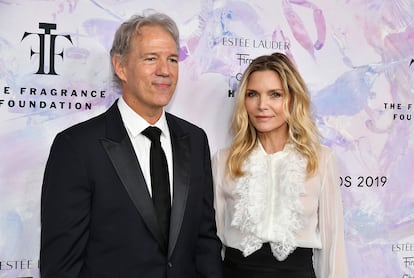

The history of cinema is full of couples who managed to balance their romantic and professional relationship on set. John Cassavetes used to say that, for him and Gena Rowlands, there was no distinction between life and cinema. Liv Ullmann explained that the “emotional telepathy” she developed with Ingmar Bergman spared them the need to give each other instructions on set, while Diane Keaton concluded that the characters Woody Allen wrote for her were amplified versions of the conversations they had at home.
But while intimacy, inspiration and efficiency can become powerful creative assets, many couples have also discovered that working together can bring professional tensions into their private lives. Michelle Pfeiffer is one of them. For nearly 30 years, the actress has refused to work with her husband, acclaimed television producer David E. Kelley. “I’ve seen a lot of couples where they seem to have a really great marriage, and then they work together and next year they’re filing for divorce,” the 68-year-old star explained.
A rule she has broken this year, however, with a television series that has earned her a nomination for the upcoming Emmy Awards.
For Margo’s Got Money Troubles, the series that will see Pfeiffer compete for her first Emmy on September 14, the actress plays the mother of a young aspiring writer (Elle Fanning) who has dropped out of college and is struggling to get by with a newborn baby and a mounting pile of bills. Pfeiffer portrays a former waitress with little patience and a strong personality, in what critics have hailed as one of the standout performances in the cast. However, the frontrunner to win the Emmy for Best Supporting Actress appears to be Britain’s Kate O’Flynn, from Widow’s Bay.
“When I read the book, I could only see one person playing it, and we’re lucky enough that she said yes, the second luckiest yes I’ve gotten from her,” Kelley joked about his wife finally agreeing to work with him after more than three decades of marriage.

The explanation for that exception began, quite literally, on the kitchen counter. Pfeiffer kept noticing Rufi Thorpe’s bestseller there every day, and when she asked her husband about it, Kelley explained that they had acquired the rights and that there was a character whom everyone involved agreed she would be perfect to play. Pfeiffer read the novel, discovered that the character was also from California’s Orange County, like her, and “fell madly in love” with her. This time, not even the couple’s longstanding rule could compete with the role.
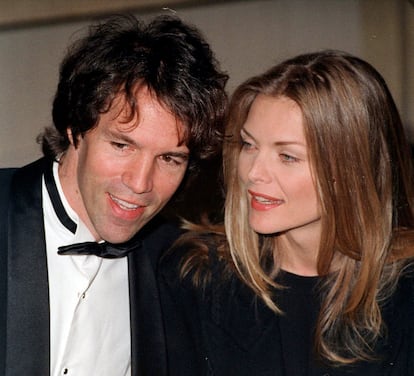
Pfeiffer and Kelley met on a blind date in 1993. The actress, who had already had her share of bad experiences with blind dates, was firmly against the idea, but a friend persuaded her to give it one last chance. Even the first meeting was not especially promising: gathered with a group of friends at a bowling alley, the screenwriter spent most of the evening talking to Pfeiffer’s sister, Dedee. In the end, however, they fell in love.
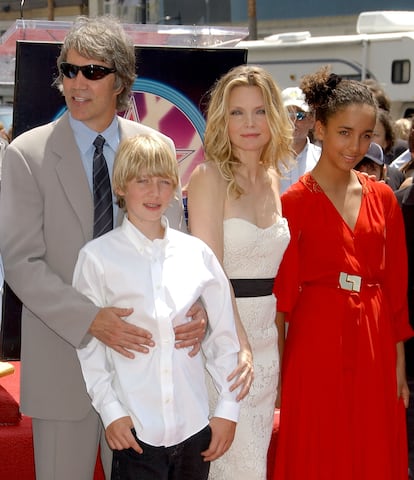
That same year, Pfeiffer had already begun the process of adopting her first child, Claudia Rose, who arrived just two months after she and Kelley started dating. “We had this child with us right away, and most people don’t have that. But I really got to see him in a situation that certainly would separate the boys from the men. Obviously, he really rose to the occasion,” the actress told Good Housekeeping. In November of that year, the couple married in an intimate ceremony in Santa Barbara, California, and Kelley legally adopted Claudia Rose. Their second child, John Henry, was born in August 1994.
Three decades later, in 2024, Claudia Rose made Pfeiffer a grandmother. It is a new stage of life: “I’m just really wanting my choices and the way I spend my time — whatever time I have left — to spend it meaningfully is what I’m focusing on,” she said.
Their decision to keep work and marriage separate was not due to any lack of professional respect. Quite the opposite. Before Margo’s Got Money Troubles proved that perhaps there was no need to maintain that boundary, the three-time Oscar nominee explained during an appearance on The Tonight Show Starring Jimmy Fallon why she had chosen not to work under one of the most influential television writers and producers of our time.
“Nobody writes, honestly, better for women than he does,” Pfeiffer said of Kelley, fully aware of the success of series such as Ally McBeal and Big Little Lies, two examples of his particular gift for creating female protagonists. “It’s unbelievable. And yet, I value our relationship more than a good part, and I just think it’s too risky.”
Pfeiffer also said the rule had endured for so long because of their personalities. “We’re both kind of fierce when we work, and so if I come home, and I’ve had a bad day, and I’m upset about something, I want him to be on my side because he hasn’t heard the other side,” she said. There’s value in that."
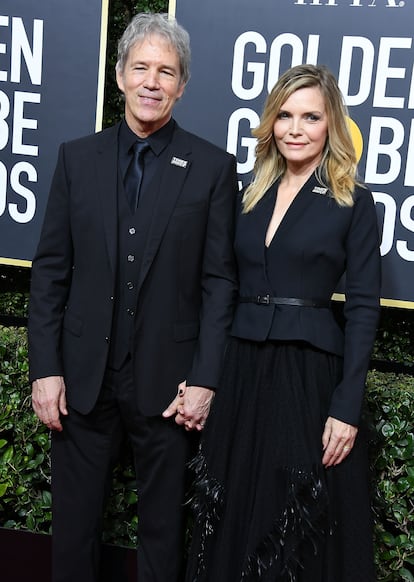
The couple have spent more than three decades proving that their formula works precisely because each has their own space. And it may not be a coincidence that Pfeiffer came to that conclusion after a very different marriage.
Before Kelley, and before becoming one of the most recognizable actresses of the past few decades, she married fellow actor Peter Horton in 1981. The two met at the age of 22 in an acting class in Los Angeles and were married for seven years, during which they did, in fact, work together on several projects. Horton, who would later go on to produce series such as Grey’s Anatomy, also played a pivotal role at another crucial moment in Pfeiffer’s life: helping her leave a cult she became involved with during her early months in Hollywood.
Recruited by a pair of personal trainers, Pfeiffer became part of a cult linked to breatharianism, a movement that seeks spiritual perfection through the rejection of conventional food. What began as an introduction to veganism evolved into pressure to survive without eating or drinking, while members monitored the young actress’s every move and drained her financially through regular meetings. Horton, who was preparing for a role in a film about a cult at the time, was the one who opened her eyes. “He was describing the psychological manipulation and I just clicked,” the actress told The Telegraph.
The experience did not diminish her interest in physical wellbeing. Over the years, she has embraced both veganism and the paleo diet, and has made yoga and Pilates part of a routine in which, by her own account, there are no shortcuts. “You have to eat right. You have to exercise. You have to get sleep,” she told ITV. “We’re always looking for that magic bullet and they don’t exist.”
It is a philosophy that, at 68, Pfeiffer appears to have applied to her marriage as well. Perhaps making a relationship last for three decades does not require sharing everything, especially not a film set.
Sign up for our weekly newsletter to get more English-language news coverage from EL PAÍS USA Edition









































