
The Azcatitlan Codex returns to Mexico from Europe after nearly two centuries
France is loaning the New Spain-era manuscript that chronicles the founding, splendor, and fall of Tenochtitlan to the National Museum of Anthropology and History
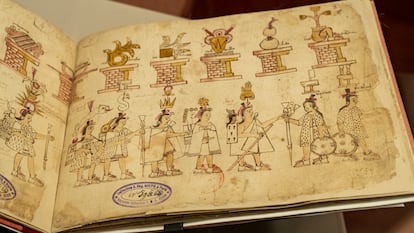

The Azcatitlan Codex, a 50‑folio summary of the Aztec empire’s history, has temporarily returned to Mexico on loan from France to mark the 200th anniversary of diplomatic relations between the two countries. The document left Mexico in 1840 and has come back nearly two centuries later to be exhibited for three months at the National Museum of Anthropology and History in Mexico City. Mexican president Claudia Sheinbaum and French president Emmanuel Macron agreed in November 2025 to exchange this codex and the Boturini Codex to mark the relaunch of Franco‑Mexican relations.
The manuscript recounts the departure of pre‑Hispanic peoples from Aztlán in search of the place where they later founded Tenochtitlan, the Aztec empire’s capital and the site of present‑day Mexico City. It also narrates the most significant episodes in the reigns of several of its tlatoani (rulers) up to the arrival of the Spanish conquistadors in 1519, led by Hernán Cortés, and the establishment of the caste system in New Spain. The Azcatitlan Codex dates to the late 17th century, and historians estimate its first owner was Fernando de Alva Ixtlilxóchitl, a politician descended from Nezahualcóyotl, one of Texcoco’s greatest rulers.
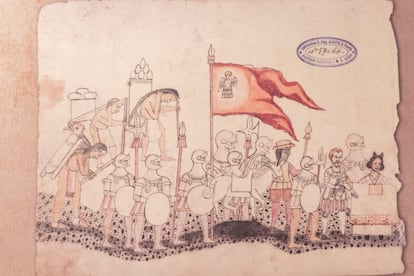
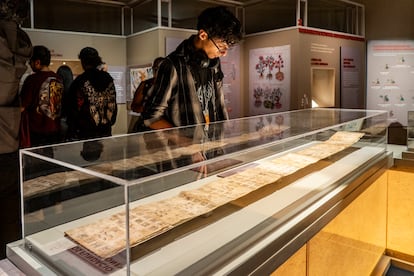
The codex is considered a late work because it was produced several years after the establishment of the colonial government of New Spain, and because it was drawn in color on European paper and bound like a book. “In that sense, I believe the codex is very important, because although it may be a somewhat late version, it is one that provides various relevant insights into the history of the Aztec people,” explains Baltazar Brito Guadarrama, director of the National Library of Anthropology and History. The illustrations, for example, already contain some Spanish words, which have made it possible to confirm the location of some of the sites on which the account of the founding of Tenochtitlan is based.
The Azcatitlan Codex’s journey from its origin has been an eventful one. After the death of its first owner, the document passed to the scholar Carlos de Sigüenza y Góngora, who bequeathed it to the library of the Society of Jesus. Part of the Jesuit order’s holdings was acquired by the Italian historian Lorenzo Boturini in 1737. His collection was ultimately confiscated by the viceroyalty and kept at the university. Finally, in 1830, the French historian Joseph Aubin acquired the codex and took it by ship to Paris, where he sold it to the Franco‑Mexican collector Eugène Goupil. After Goupil’s death, his family donated it in 1896 to the Bibliothèque Nationale de France, where it has remained under the custody of the French government.
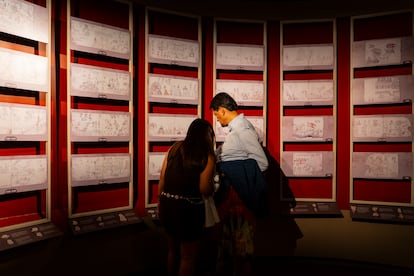
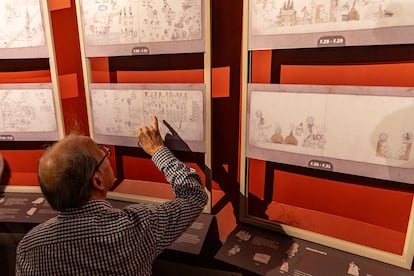
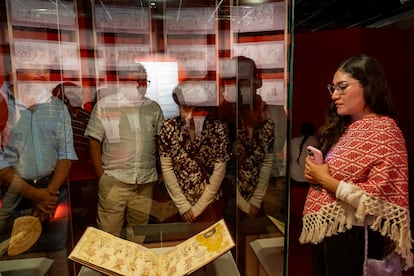
The codex is on display in a small temporary gallery at the National Museum of Anthropology and History. In the center of the room, protected by glass and under dim lighting, sits the original book opened to pages four and five, which show eight Indigenous peoples (Matlatzincas, Tepanecs, Chichimecas, Malinalcas, Cuitlauacas, Xochimilcas, Chalcas and Huejotzincas) organizing the search for the place where Huitzilopochtli (the god of the Sun and war) instructs them to found Tenochtitlan. Brito Guadarrama says those pages were chosen because they show the Aztecs’ multicultural origins and their foundational myth. “They allowed many other peoples to identify themselves, not just the Aztec people but seven other peoples as well. And in that sense I think it’s more appropriate that people come and identify with their historical heritage,” he says. The remaining folios can be seen in photographs on a museum wall. “Some of its pages were lost over time, but its content remains open to interpretation,” said Culture Secretary Claudia Curiel de Icaza.
While Mexico receives the Azcatitlan Codex, the Bibliothèque Nationale de France in Paris will, beginning next week, exhibit the Boturini Codex, also known as the Tale of the Mexica Migration, produced in the 16th century and recounting the Aztecs’ journey from Aztlán to their arrival in Tenochtitlan. That document has also been sent on loan — something that had not happened in nearly two centuries — because it belongs to the holdings of the National Museum of Anthropology and History. In December, the Azcatitlan and Boturini codices will return, respectively, to the countries that are hosting them. The Mexican government has no intention of reclaiming the Azcatitlan Codex from France. “Codices do not belong to institutions; they belong to the people and to the generations who recognize themselves in them,” said Roberto Velasco, secretary of foreign affairs, at the exhibition opening.
Sign up for our weekly newsletter to get more English-language news coverage from EL PAÍS USA Edition









































