
‘La Bola Negra’ enters the Oscar race with the biggest awards campaign ever mounted for a Spanish film
Trade publications are predicting as many as 14 nominations for the film, while Netflix could spend around $20 million promoting it
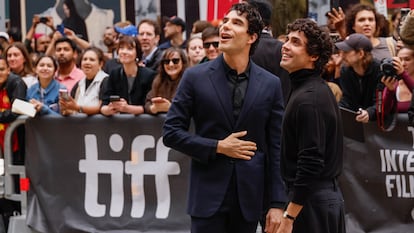

Never has a Spanish film entered international awards season from such a position of strength as La Bola Negra (The Black Ball), which Spain’s Film Academy announced on Wednesday will represent the country in the Oscar race for Best International Feature. Only Juan Antonio Bayona’s Society of the Snow and Oliver Laxe’s Sirât, which earned two Oscar nominations earlier this year, have come close to generating this kind of momentum.
Festival audiences have embraced it, critics have overwhelmingly praised it, and in North America it will have the financial backing of streaming giant Netflix for its release. If Laxe spent weeks in the United States campaigning for his film, Javier Calvo and Javier Ambrossi, the directing duo behind La bola negra, appear ready to do the same. “We’ll do everything we can,” they told Spanish reporters on Wednesday.
Since the Cannes Film Festival, both specialist publications and mainstream outlets, including The New York Times, have embraced the movie. According to Variety’s Oscar forecasts midway through the Toronto International Film Festival screenings, La Bola Negra could land as many as seven Oscar nominations, including Best Picture, International Feature and Adapted Screenplay. Toronto is not, strictly speaking, a festival but a showcase and marketplace, as there is no jury awarding prizes in official competition. The Hollywood Reporter goes even further, suggesting the film could earn up to 14 nominations, with Calvo and Abrossi — popularly known in Spain as the Javis — breaking into the directing race, Penélope Cruz contending for supporting actress and the film performing strongly across many of the technical categories.
Both publications, however, sound a note of caution. Cannes, Venice and Telluride have already unveiled most of their major contenders, but some heavyweight titles have yet to enter the conversation: Alejandro González Iñárritu’s Digger, starring Tom Cruise; Denis Villeneuve’s Dune: Part Three; I Play Rocky, about the making of the film that launched Sylvester Stallone to stardom; The Further Mis-Adventures of Cliff Booth, directed by David Fincher, written by Quentin Tarantino and starring Brad Pitt; Luca Guadagnino’s Artificial; and Aaron Sorkin’s The Social Reckoning, both focused on tech oligarchs.
That pack includes several serious contenders. Moreover, some recent Best Picture winners, including Oppenheimer and One Battle After Another, did not rely on launches at major European festivals. Awards season still has a long way to go, and the campaign trail is likely to deliver plenty of surprises.
Facing all of them, Netflix has a key asset for the awards season, which will run until the Oscars are handed out on March 14, 2027: Lisa Taback, the streaming giant’s vice president for Talent Relations and Awards. Taback learned the trade at Miramax under the Weinstein brothers, helping steer the awards campaigns of films such as The King’s Speech and The Artist. She is known for her ability to navigate even the most difficult situations, as she did when Netflix’s U.S. awards push for Jacques Audiard’s Emilia Pérez appeared to be unraveling after controversy erupted over past social media posts by its star, Karla Sofía Gascón.
“Lisa asked us whether we were willing to give this everything we had, and we said yes, that we would leave nothing on the table,” the Javis said via video call from Toronto after Wednesday’s announcement. “We know it’s going to be tough. We’ll be living out of a suitcase for months. But we’re excited to do it, not just because of the possibility of nominations, but because we want the film and its message to reach as many people as possible.”
Ambrossi added: “Until today, I hadn’t allowed myself to think about categories beyond international feature. Today, I’m allowing myself the luxury of believing it’s possible. The message we’ve received from Netflix is that the film’s greatest strength is that it’s the future.”
To which Calvo chimed in, “despite being about the past.”

They will be joined by producer Jorge Pezzi, who was head of Fiction and Partnerships at Movistar Plus+, La Bola Negra’s lead producer, when the project first got off the ground. “I had the privilege of reading the script when I joined Movistar and immediately saw its potential. The film has gone even further than I imagined,” he said.
A year later, Pezzi left Movistar to become CEO of Suma Content, the production company founded by the Javis. “Naturally, we’ve kept the other producers informed every step of the way, but the campaign effort is really a team undertaking led by Netflix U.S. and Suma. The Javis are ready to do whatever is required. They’re all in.”
Pezzi was also part of Oliver Laxe’s Oscar campaign for Sirât last year. “We need to be cautious,” said Pezzi. “People are already taking nominations for granted, and you never know. With Sirât, some predictions had us getting as many as eight nominations, and in the end we got two. That said, La Bola Negra will benefit from a team that lives and works in the United States. To succeed at the Oscars, you need people who understand the process from the inside because it’s a highly sophisticated machine.”
The Javis cite The English Patient and Titanic as touchstones. Calvo notes that “a lot of people praise the film’s classical sensibility.” “We’re told it’s the kind of film they don’t make anymore,” he added.
For Sirât, as many as 40 publicists were involved in the awards campaign. For La Bola Negra, the number is expected to be significantly higher.

The Javis learned two weeks ago that their drama had made Spain’s three-film Oscar shortlist, while they were in Los Angeles, where The New York Times published a major feature on them, boosting their visibility in North America. Since then, they have attended the Telluride and Toronto film festivals.
The film will be released in Spain on September 25. Then it is back on the road, with stops at the Rome, New York, London and Morelia film festivals, as well as a Paris premiere, all while keeping an eye on the film’s U.S. theatrical release on October 16 and its streaming debut on December 2.
“I get dizzy just looking at the schedule,” Pezzi laughs. “It includes Asia. But there’s a clear strategy behind the dates, despite an extremely packed calendar.”
To understand how much Netflix may be willing to spend on an Oscar campaign for a non-American film, industry estimates put the company’s awards push for Emilia Pérez at between $30 million and $40 million. Although the campaign was damaged by the resurfacing of old social media posts by its star, Karla Sofía Gascón, the film still won two Oscars: Supporting Actress for Zoe Saldaña and Best Original Song for El mal.
“We can’t discuss figures,” Pezzi says, “but it will be a significant amount. And yes, every bit of that money is necessary.”
Industry insiders expect Netflix’s investment in La Bola Negra to be on a similar scale to its Emilia Pérez campaign, despite the Spanish film’s production budget of €15 million ($17 million).

On the horizon lie several more key dates. The Governors Awards, where the Academy’s honorary Oscars are presented, will take place on November 15, an occasion publicists often use to rally support and court voters. It could prove especially valuable for La Bola Negra, as one of this year’s honorees is Glenn Close, who plays a Hispanist scholar in the movie.
The first round of Oscar voting, which determines the shortlists in roughly a dozen categories, will run from December 7 to 11, with the results announced on December 15. Voting on the nominations themselves will take place from January 11 to 15, ahead of their announcement on January 21. The Oscars ceremony is scheduled for March 14.
Film producer Agustín Almodóvar often says that, for Sony Pictures Classics, Spain’s selection of a Pedro Almodóvar film as its official Oscar entry was invaluable. The choice effectively served as a seal of approval from the Spanish film industry, strengthening the film’s profile in the U.S. market and providing a powerful boost to its awards campaign. Sony Classics has long been one of the industry’s most effective awards-season players, but when it comes to financial firepower in 2026, no company rivals Netflix.
Even so, securing Spain’s official endorsement remained a crucial hurdle for the streaming giant, one that was successfully cleared on Wednesday. What comes next is the most ambitious awards campaign ever mounted for a Spanish film.
Sign up for our weekly newsletter to get more English-language news coverage from EL PAÍS USA Edition









































