
The mystery of Salzburg’s missing mini Mozarts
The theft of 210 sculptures of the composer has cast a shadow over celebrations marking the 270th anniversary of his birth. In 2024, another 115 miniature Wagner statues disappeared from the Bayreuth Festival
Mozart emerged unscathed from the monument wars of 2020. No one vandalized his statues over the alleged racism of The Magic Flute or the orientalism of The Abduction from the Seraglio. Perhaps his reputation was helped by The Marriage of Figaro, with its challenge to aristocratic privilege. In any case, the bronze statue of the composer in Salzburg’s Mozartplatz had already been darkened by decades of exposure to the elements.
But now, in the composer’s birthplace, celebrations marking the 270th anniversary of Mozart’s birth have unexpectedly taken on the feel of a detective novel. And the reason is, of all things, a collection of statues
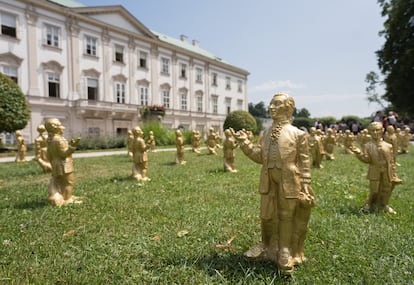
On July 15, two days before the start of the Salzburg Festival, an army of 320 gilded mini Mozarts appeared in the Mirabell Gardens and other locations around the city as part of an initiative by the Mozarteum Foundation. The installation was created by German artist Ottmar Hörl, known for his small-scale figures of famous composers and for a controversial series of garden gnomes parodying Nazi iconography. “In public spaces it’s normal to lose around 10% of the pieces,” Hörl says by email. “But what has happened these days in Salzburg requires some organization.”
In the first 12 days, a steady stream of thefts claimed 86 pieces. The Mozarteum Foundation then issued a public appeal for the thefts to stop, but by the end of July more than half of the figures had disappeared, and within little more than two weeks that number had risen to 210. “We’re talking about half-meter-high statues screwed to the ground with a metal rod,” the 76-year-old sculptor explains. “Each one still bears the marks of the mounting system — three holes in the base that allow you to identify where it came from. This is not something that can be done casually. It poses a considerable logistical challenge.”
So far, the Mozarteum Foundation has no leads as to who is responsible. “We don’t know who stole the figures and we don’t want to speculate,” a spokesperson for the institution says.
With no surveillance cameras in the Mirabell Gardens, all signs suggest the figures were spirited away under cover of darkness by thieves with a taste for classical music. As the losses spiralled out of control, the organizers decided to remove the remaining Mozarts that were still bolted down and close the exhibition 20 days ahead of schedule. “Replacing them wasn’t an option either,” they add. “The manufacturer had closed for vacation.”
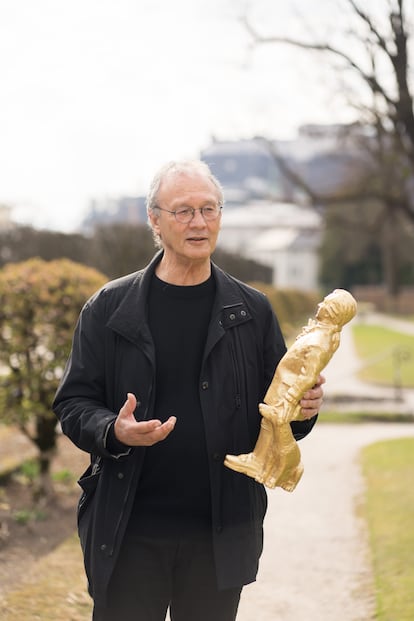
Hörl has reported the thefts to the police and estimates the losses at around €20,000 ($23,300), a cost he will have to pay out of pocket since the sculptures were not insured.
The artist dismisses the idea that the publicity surrounding the case could make up for the financial hit. “The publicity does me no good,” he laments. “The economic damage is not negligible and I’ll have to justify everything to the tax authorities.”
Nor does he place much faith in the theory that the disappearances were the result of a string of opportunistic thefts. “It’s still early to draw conclusions. But it’s reasonable to assume that no one casually takes 210 figures in this way.”
It is not the first time Hörl’s sculptures have found their way into the crime pages. In 2023, an installation dedicated to Wagner at the Bayreuth Festival suffered a similar fate: 115 miniatures of the composer of the Ring cycle vanished from the Green Hill, apparently taken by anonymous passers-by, although the unofficial explanation pointed to souvenir-hunting opera lovers as the more likely culprits.
When the episode was repeated the following year, the artist took it in stride. “These situations always involve a risk,” he acknowledges. “But the Salzburg incident has taken on a different dimension.” It has become a full-fledged police case.
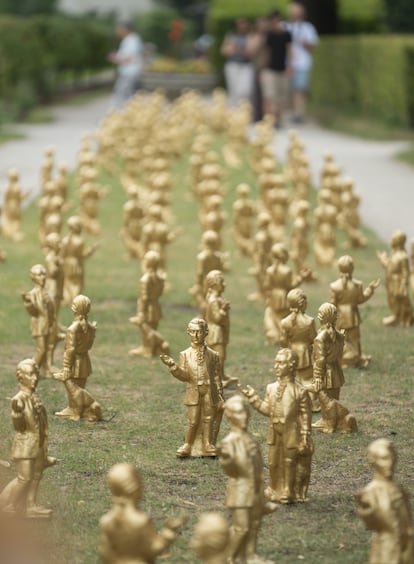
With the theory of souvenir-hungry tourists acting on impulse looking increasingly unlikely, investigators must now determine what became of the missing sculptures and why they were taken in the first place. In Hörl’s figures, Mozart is depicted alongside his dog, Pimperl, in an effort to present a more approachable, familiar image of the composer. Unlike the solemn marble of traditional monuments, the sculptures are made of plastic using a special vacuum-moulding process.
“So far, none of them has turned up for sale on online marketplaces,” Hörl says. Which raises an obvious question: who would bid for something online that could have been bought legally for €90 ($104)?
The answer may lie closer to home. Salzburg’s devotion to Mozart long ago spilled beyond opera productions and symphonic performances at the Festspielhaus. Nothing escapes the logic of the souvenir trade, from the famous Mozartkugeln chocolates to the most exclusive designer objects, including, perhaps, those that still bear the telltale marks of their removal.
“Outdoor works are not always understood the same way by the public,” Hörl reflects. “Removing them from the place for which they were created is, in any case, a sign of disrespect toward my work.”
Sign up for our weekly newsletter to get more English-language news coverage from EL PAÍS USA Edition









































