
National Library of France discovers unpublished Mozart manuscript
The score, seven short pieces for flute and harp, will be performed for the first time at Paris’s Fête de la Musique on June 21
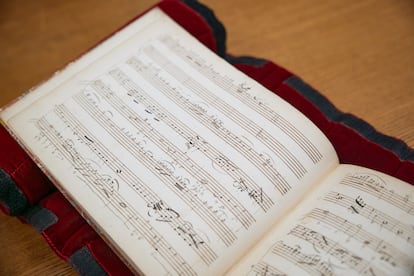

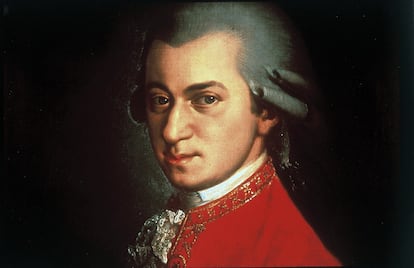
Wolfgang Amadeus Mozart’s creative genius, 234 years after his death, is still capable of bringing new music to the stage. A previously unpublished score by the Austrian genius has been discovered at the National Library of France (BNF) in Paris and will be performed for the first time this Sunday in the French capital to mark the annual Fête de la Musique — a frequent source of annoyance for residents not taking part in the street festivities — which will now find a much more subdued counterpoint in Mozart’s bars of music, hidden away for centuries.
The discovery, revealed by radio station France Musique, consists of 44 pages handwritten by Mozart himself in 1778 and contains seven short pieces for flute and harp. A musical rarity, since it is a combination of instruments that did not particularly excite him and for which the Austrian scarcely composed.
The score surfaced last February when François-Pierre Goy, a curator at the BNF responsible for pre-1800 collections, detected the maestro’s hand in the old notebook. “I recognize Mozart’s handwriting: the way he writes the brackets; the treble clefs, which are rounded and curve forwards; and the double bar lines with fermatas above and below,” he explained to Le Monde.
On February 2, while carrying out an inventory of stored documents, Goy came across a small 44-page notebook among some 20 manuscripts that were being reclassified for transfer to the archives. The researcher immediately consulted his colleague Laurence Decobert, curator of the 2017 exhibition Mozart, a French Passion, who confirmed the hypothesis. But any lingering doubt was dispelled at the end of April thanks to the expert opinion of Armin Brinzing, director of the Bibliotheca Mozartiana at the Mozarteum University in Salzburg, the institution that holds the world’s largest collection of Mozart’s manuscripts.
The manuscript dates from 1778, the very year in which Mozart lived in Paris between March 23 and September 26. However, not all of the score can be attributed to the composer. According to Goy, some minor clumsiness in the musical notation is due to another hand: that of Marie-Louise-Philippine de Bonnières de Guînes, daughter of the powerful Duke of Guînes. As reported by Le Monde, the duke, a close associate of Queen Marie Antoinette, was a flute enthusiast renowned for his talent. Between May and June 1778, he hired Mozart to give lessons to his eldest daughter, a harp virtuoso but, according to the musician himself, a rather uninspired composer.
Goy said the most likely explanation for how the manuscript ended up in the BNF collections is that it formed part of the “revolutionary confiscations” that took place at the time, since several items belonging to the Guînes family were seized before they emigrated to England in 1794 during the Reign of Terror of the French Revolution.
🎶 Quoi de mieux pour la #FêteDeLaMusique que de découvrir un inédit de Mozart ? ✨
— Radio France (@radiofrance) June 19, 2026
🎻Localisé en février 2026 au département de la Musique de @laBnF, ce document contient 7 pièces pour flûte et harpe. Pour cette occasion exceptionnelle, @radiofrance lui donne vie grâce à deux… pic.twitter.com/R5dKZCoLk3
The president of the BNF, Gilles Pécout, said that “according to specialists, this discovery is without doubt one of the most important of recent decades.” Goy also noted that it is not clear whether the Guînes family ever performed these pieces, just as Mozart’s famous Concerto for flute and harp in C major that the duke commissioned from him — for which the composer was never paid — may never have been played. In any case, these seven pieces enrich a relatively sparse repertoire.
The composition was recorded for the first time on Wednesday at the Maison de la Radio in Paris, but the public will not hear what the manuscript contains until next Sunday, June 21, when it will be performed in the BNF’s Oval Room to celebrate the Fête de la Musique. The annual event celebrates music with multiple free concerts and a wide range of activities across the French capital.
Sign up for our weekly newsletter to get more English-language news coverage from EL PAÍS USA Edition









































