
Georg Friedrich Haas, composer: ‘It is better to be a pervert than a murderer’
The Austrian musician, whose career has been marked by being the son and grandson of Nazis, inaugurates his artistic residency at Spain’s CNDM with ‘In vain,’ considered a masterpiece of the 21st century
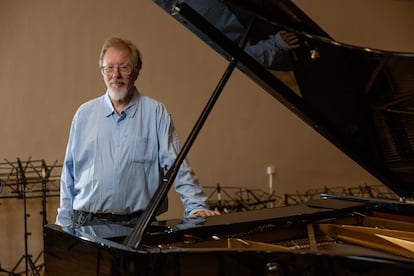
A recent photo of Georg Friedrich Haas, 72, at a well-known flamenco tablao in central Madrid has been circulating on Facebook. “I’m not exaggerating when I say it was one of my deepest musical experiences in my whole life,” the Austrian composer admits in a windowless room at the National Auditorium in Madrid. “It struck me that this expressive freedom didn’t belong to any ideology or Central European canon.”
Haas is the son and grandson of Nazis, and all his music grows out of the survival instinct born from what he describes in his memoir as the “inherited horror” of a childhood marked by physical and sexual abuse.
“My parents were criminals,” he says calmly. “I reached that conclusion after a long process of coming to terms with it, shaped by shame and fear. I could not speak about this in words, but I could speak about this in music.”
It was out of this need to exorcize his own demons that In vain (2000) emerged, a monumental piece that conductor Simon Rattle did not hesitate to call the first masterpiece of the 21st century. Haas composed it when the far-right party to which his family had once belonged entered the Austrian government. “I felt that everything we believed we tried to escape was returning. Hence the title: in vain,” he explains.
It will be the first work from his catalog performed as part of the series dedicated to him by Spain’s National Center for Musical Dissemination (CNDM), where he will serve this season as composer-in-residence. In the piece, Haas uses microtonal language to stretch the limits of listening through a harmonic spectrum that seems to knock on the door of another world. “What awaits us at the end of the journey is not a paradise,” he warns. “Far from it.”
During Friday’s concert in the Chamber Hall of the Auditorium — conducted by Jordi Francés with the Spanish National Youth Orchestra and several members of Vienna’s Klangforum — the lights were completely turned off to reinforce the ritual dimension of in vain. “That darkness is closely tied to Spain’s cultural tradition,” reflects Haas, who declares himself an admirer of Goya’s Black Paintings and El Greco’s “spiritual drama.” “But it also reflects a present that silently but relentlessly repeats the darkest patterns of our history. We can’t forget that Austria, Germany, and the communist states became dictatorships not through war, but through legal development. This is something I see happening now in America.”
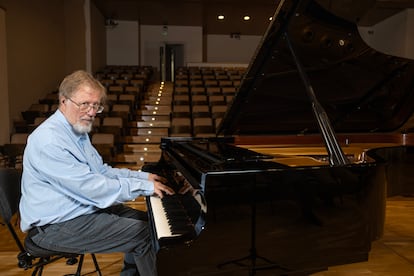
In 2015, a year before Trump’s first electoral victory — a moment that plunged him into paralysis and confusion — the composer married African American artist and activist Mollena Williams. Since then, they’ve lived together in a Harlem apartment overlooking the Hudson River. Both appear naked (literally) in the documentary The Artist and the Pervert, where Haas acknowledges his sexual identity as a dominant partner within a consensual BDSM relationship. Amid whips, dildos, and spanking sessions, the musician celebrates on camera the emotional and creative freedom he has found — something he insists is “not at all incompatible” with his feminist convictions. “My uncle went to the Waffen-SS so that he could live out his sadism. I’ve transformed that impulse into love. I have nothing to hide. It is better to be a pervert than a murderer.”
After Sunday’s performance of in vain in the Spanish city of Badajoz, the monographic series will continue next year at Madrid’s Auditorium 400, where listeners will encounter several hallmarks of Haas’s unique style: the microtonal processes of Tria ex uno based on the Renaissance polyphony of Josquin des Prez, the timbral richness of Anachronism, and the internal dramaturgy of Hommage à Bridget Riley.
On March 23, the world premiere of his Saxophone Quartet No. 2 — commissioned by the CNDM and performed by the Kebyart ensemble — will take place. “I wrote it this summer in England as a tribute to Mollena’s father, who served as a Marine in the Vietnam War. Before that trauma, from which he never recovered, he played saxophone in Times Square and worked hard so his children could study and travel to Europe.”
Haas studied under Iván Eröd, a Jewish composer who had taken refuge in Graz after the 1956 Hungarian Revolution. “One day I visited him at home and was alone with his mother,” he recalls. “When I asked her about her other son — who, unbeknownst to me, had died at the front — I understood for the first time what silence really was: it was as if there was a vortex in the room, and everything was falling down.”
Haas later studied with Friedrich Cerha in Vienna, befriended that “destroyer of beauty” Helmut Lachenmann, and even became familiar with French spectralism during his time at IRCAM in Paris. In the end, he found in the American avant-garde the solace that the theoretical dogmatism of the Second Viennese School had denied him. “Let’s just say, to put it simply, that you cannot be a Nazi and love the music of John Cage,” he says, laughing.
Sign up for our weekly newsletter to get more English-language news coverage from EL PAÍS USA Edition









































