
How an ancient book looted a century ago ended up in the hands of a US magnate
The ‘General and Natural History of the Indies’, published in 1535 by chronicler Gonzalo Fernández de Oviedo, was kept at Spain’s Academy of History. But the book was mutilated and the torn leaves are today on display at the Huntington Library in California
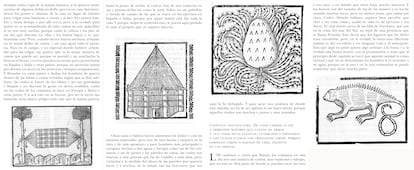

A prized codex — the ancestor of the modern book — that was kept at Spain’s Royal Academy of History (RAH) was looted a century ago and ended up in the hands of a private collector in the United States. Someone tore out portions of it and the torn-out leaves went to a London rare-book dealer, who allegedly sold it to the American magnate Henry E. Huntington (1850–1927). The desecrated codex was part of the Historia general y natural de las Indias (General and Natural History of the Indies), the manuscript by Gonzalo Fernández de Oviedo (1478–1557), whom Emperor Charles V had appointed in 1532 as the first official chronicler of the Indies. The alert about this hitherto unknown attack on Spain’s historical heritage was raised by journalist and history graduate Ramón Jiménez Fraile in the latest bulletin of the Spanish Geographical Society (SGE).
Jiménez suggests the likely motive for the theft of more than 150 pages was that the U.S. magnate —a cousin of Archer M. Huntington, the Spanish art collector and founder of the Hispanic Society of New York— was an avid botanist. For him, the value of the manuscript, written in Castilian Spanish, lay in the fact that its author was the first European to describe many plant species of the New World and also drew them in beautiful illustrations. He was fascinated, for example, by the pineapple, which he called “the best fruit in the world.” Jiménez notes that the eminent naturalist Alexander von Humboldt “praised Fernández de Oviedo’s botanical skills.” So it is not far-fetched to think Huntington coveted those descriptions and drawings of American flora. Today, the looted pages are in the California library that bears his name.
“The Academy of History is aware of what happened. It is well known that someone tore out the leaves,” sources at the institution say. “It is unknown who did it, although at one time it was suspected someone on the Academy staff and not an academic per se.” The source says litigation to recover what was stolen has been considered several times, “but the cost such a process could entail” has put an end to those intentions.
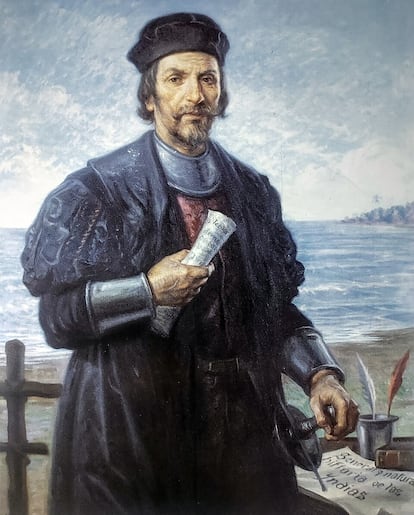
The Historia general y natural de las Indias was published in Seville in 1535. The monumental work recounts the conquest of the Americas, the Spanish colonial organization, and the flora and fauna, with a clear descriptive aim: “My lines will be stripped of an abundance of artificial words [...] but they will be very copious in truth,” its author wrote. “I write as an eyewitness, and what I have not seen I will relate by the testimony of trustworthy people.”
Born in Madrid, he led a fascinating life. His parents introduced him to court life as a page. Thanks to that position he witnessed the Muslim surrender of Granada to the Catholic Monarchs and Christopher Columbus’s arrival in Barcelona after his first voyage, an event that marked him.
In 1514 this adventurer reached the West Indies, the first of several ocean crossings he would make. There, amid political ambitions, he engaged in a controversy with Friar Bartolomé de las Casas, the great defender of the Indigenous peoples, who called him, among other epithets, “reckless, false, inhuman, hypocritical, a thief and a blasphemer.” Fernández de Oviedo was a propagandist for the conquest and he glorified the empire, which angered the Dominican friar. Early in his work, Fernández de Oviedo describes the Indigenous people as lustful, sodomites and idolaters, and the women as “incapable and ugly.” However, over time his view changed and he lamented that on the island of Hispaniola (today’s Haiti and Dominican Republic) the natives had been decimated by the Spanish. But he always left the Crown out of these criticisms.
For this article, a 2023 edition of the Historia general published by the José Antonio de Castro Foundation was consulted; it is based on a printed copy of the 1535 edition held by the National Library of Spain and can be consulted in the Digital Library of that institution. However, this edition does not include marginal annotations or other information contained in the original manuscript.
The José Antonio de Castro Foundation edition says the Historia general “is pleasant to read, for it combines other people’s testimony with amusing anecdotes experienced by the author, and a series of images drawn by him.” In its pages, Fernández de Oviedo described, for example, the plants, trees and medicinal herbs he found on the island of Hispaniola.
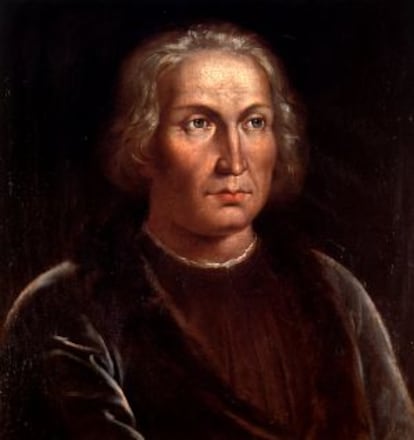
He also described living creatures, such as the flying fish: “The color of the back is like blue, the color that the water takes when the sky is very clear and free of clouds.” And he also described people, such as Admiral Columbus, of whom he left a detailed physiognomy: “Taller than medium, lively eyes, reddish hair and a somewhat flushed, freckled face.”
Jiménez stumbled upon the looting of this work by chance. A scholar of the colonial era and author of a book on Ferdinand Magellan, he was investigating what might have happened to the Victoria, the only ship to return to Spain after the three-year first circumnavigation of the Earth (1519–1522) begun by the Portuguese navigator and completed by Juan Sebastián Elcano. Fernández de Oviedo wrote in his Historia general that the ship had wrecked after returning to service, and this became the canonical thesis.
In the mid-19th century the Royal Academy of History commissioned an edition of the Historia general from the historian José Amador de los Ríos, published between 1851 and 1855, so at that time “the Academy had the complete manuscript,” Jiménez says. That original had been donated to the RAH by the chronicler Luis de Salazar y Castro in 1850. In that 19th-century edition commissioned by the RAH to Amador de los Ríos there was an anonymous annotation, from a later date than Fernández de Oviedo’s text, stating that the Victoria was in 1580 “on dry dock in Seville,” broken to pieces. Had the ship been wrecked or rendered unusable in the shipyards? Juan Gil, an academic of the language and an expert on the Seville of the period, has leaned toward the idea that the ship the anonymous informant saw was not the original, Jiménez says, who has collected other testimonies that corroborate the idea that the vessel ended its days in Seville’s shipyards.
In any case, the researcher went to the Academy of History to consult the original Historia general and see that annotation with his own eyes, but received this reply by email: “Those manuscripts are highly decimated and much of them are not even in our holdings.” The RAH added that they had a “copy” of the part Jiménez requested, “provided by the Huntington Library of California, which is where the original is located.”
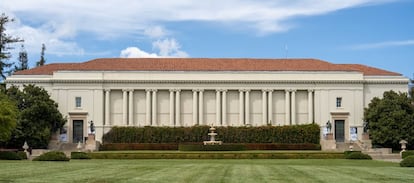
Jiménez then contacted the Huntington Library in Pasadena, which “houses 6.5 million manuscripts, more than one million rare books and is surrounded by a botanic garden of almost half a million square meters.” Its staff told him by email that the parts of the codex they hold are available only to doctors in history. However, they gave him the following reference, perhaps to dispel suspicions about how the manuscripts arrived there: “It was bought at Maggs [London bookseller], on February 25, 1926.”
Following the trail, the researcher asked the house Maggs, founded in 1853 and, he notes, “famous, among other reasons, for having resold Napoleon’s penis” and “for having been the bookseller to King Alfonso XIII.” The reply was: “We have reviewed some of our old catalogues from 1925 and 1926, but I am afraid we cannot find any entry for this manuscript. Another possibility is that it was offered directly to the Huntington Library.” One way or another, part of the codex was torn away a century ago at the Academy of History, in an era of free-for-all looting, without laws or awareness of the crime, and after passing through London it ended up in the hands of Henry E. Huntington, who made his fortune in railroad construction and liked to surround himself with rare and ancient books.
Sign up for our weekly newsletter to get more English-language news coverage from EL PAÍS USA Edition









































