
Marcel Duchamp, the creator who made art without his hands
New York’s MoMA is offering the largest retrospective of the French-American artist in the US since 1973, with 300 works ranging from Impressionism to Post-Industrial Art
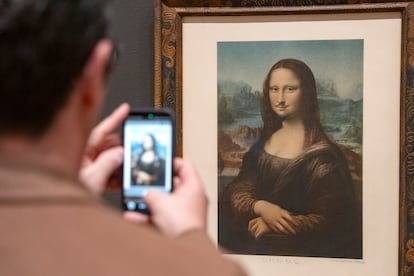

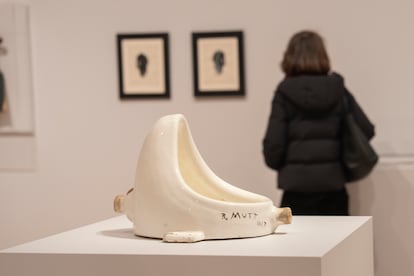
A century before a banana duct-taped to a wall blew up the very definition of art, Marcel Duchamp’s Fountain, an upside-down, prefabricated porcelain urinal mounted on a pedestal and signed with a pseudonym in 1917, was already making history as a seminal work of the avant-garde and, by extension, as an example of the renewal, or reinvention, of art. Duchamp went down in history for this creation, and for painting a mustache and goatee on an image of the Mona Lisa, but over more than six decades of his career, he explored every style and rode the wave of those that followed, from Impressionism to Dadaism and Calder-like installations. His work is a perfect chronology of 20th-century art, but so too is the lively biography of its creator.
That’s why the Museum of Modern Art in New York (MoMA) has chosen chronological order for the largest retrospective of Duchamp (1887-1968) in the United States since 1973, on view through August 22. From his early paintings, which are as familiar as those of any Impressionist, to the clean, schematic drawings where Toulouse-Lautrec seems to peek through, to the object installations of his later years, Duchamp’s 300 works are exhibited in nine rooms of the museum that could “also be nine exhibitions in themselves,” independent of one another, explains one of the curators of the show, Ann Temkin, chief curator of painting and sculpture at MoMA.
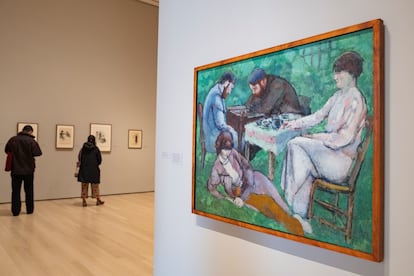
The exhibition is a journey guided by provocation, humor and irreverence, but also by emotion, such as that evoked by the paintings hanging in the first room: The Chess Game, from 1910—chess accompanied him throughout his life—, Impressionist landscapes and nudes with Fauvist touches. The two works that open the exhibition were painted when he was 15: born into a family of artists in Normandy, with two brothers who were also painters, he copied what was then considered great painting, but harbored the impetus of the avant-garde.
“In this first room, we see Duchamp training himself in contemporary painting at a dizzying pace, from Monet to Matisse, by way of Cézanne and Picasso,” explains Temkin. “With these early paintings, Duchamp asserts: I am part of the avant-garde. I want to provoke, as these artists did.”
Next, in the second room, comes the break with tradition: large-format canvases of profound cubism, such as the famous Portrait (Dulcinea), a serialist composition that shows five simultaneous sequences of a woman he met on the street when he was studying in Paris in 1911; a moving, or fragmented, image of reality, as if it were an animated photograph.
The best example of this period, and the first of his works to generate controversy, is Nude Descending a Staircase (No. 2), which resembles a collection of mechanical devices and was rejected by the Cubist Salon des Indépendants in Paris. A year later, in 1913, it was accepted into the Armory Show, a major exhibition that introduced European avant-garde art to the American public and which continues to be held annually. Even without a presence in museums, this painting became a symbol of the most transgressive art of the day, and for Duchamp, it marked his first encounter with widespread notoriety.
In the following rooms, copies and variations of his famous urinal rub shoulders with different versions of the Mona Lisa with a mustache, titled L.H.O.O.Q., a play on words that, pronounced in French (“elle a chaud au cul”), sounds like “she has a hot ass.” Regarding the reproduction of La Gioconda with a mustache and goatee, the irreverent filmmaker John Waters says in the exhibition’s audio guide that it constitutes the most outstanding act of rebellion in contemporary art.
Humor as rebellion runs through the work of an adult Duchamp, but so does transformism, as in Man Ray’s photographs in which the artist appears dressed in furs and jewels in 1924, embodying his female alter ego, Rrose Sélavy (read in French, Eros, c’est la vie). Like Fernando Pessoa, the master of heteronyms, Duchamp demonstrated that identity could also be an artistic object.
But it is the sixth room that houses the heart of the exhibition, according to curator Temkin: the project Box in a Valise (1935-1941), a series of “portable galleries” with miniature reproductions of his entire oeuvre. This project was created when the artist, driven by the threat of fascism and the drums of war, prepared his move to the New World with his studio in tow. He was 50 years old, and his works had not yet entered museums. This packed baggage, somewhere between a suitcase of objects salvaged from a shipwreck and a dollhouse, “was his way of creating his own retrospective when none of his works were yet in a real museum,” the three curators of the exhibition explained on Tuesday.
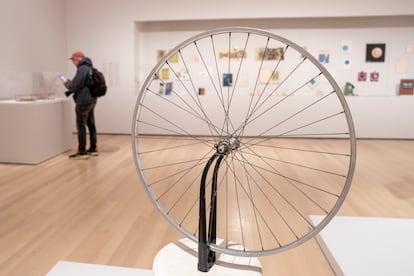
Duchamp’s was a Copernican revolution in the world of visual arts, a leap into the void from image to concept. “His great achievement was abandoning the idea that, if you were an artist, you used your hands, put paint on a brush, and brushed the brush across the canvas,” explains Temkin. According to another curator, Michelle Kuo, “he invented the type of work he called ‘ready-mades,’ which means that a work of art can be something that is already made, and in reality, what you do as an artist is select.” An example of ready-mades is the series of Hairy Mona Lisas.
The exhibition, organized in collaboration with the Philadelphia Museum of Art, which holds the largest Duchamp collection in the U.S.—the third curator, Matthew Affron, represents this institution—concludes with an image of an aged, gray-haired Duchamp in a 16mm black-and-white film shot by Andy Warhol in 1966 in New York, the city where he lived the last 25 years of his life. Numerous images of his two Manhattan studios complete the iconography of the artist, a skilled chess player and inventor, a figure as multifaceted as his creation. The demiurge who, along with Picasso and Braque, helped establish the post-industrial perspective in art history—transforming a bicycle wheel into a sculpture—and becoming the precursor of conceptual art.
Sign up for our weekly newsletter to get more English-language news coverage from EL PAÍS USA Edition









































