
Andrea Martínez Baracs, historian: ‘Indigenous allies saved the Spanish on the Night of Sorrows’
The specialist in Mesoamerican history warns against revisionism: ‘The course of the conquest could have been different without Indigenous support’


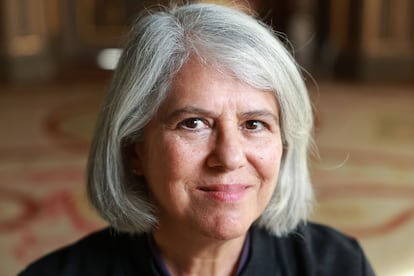
Andrea Martínez Baracs (Mexico City, 69) is a historian with a doctorate from El Colegio de México, specializing in the Indigenous history of Mesoamerica and the processes of conquest and colonization. This week at Casa América in Madrid, she spoke about the political alliances between Indigenous peoples, specifically the Tlaxcalans and the Spanish Crown, offering a critical and rigorous perspective based on both Spanish and Indigenous sources. Historical enemies of the Mexica people, the Tlaxcalan rulers decided to ally themselves with the Spaniards led by Hernán Cortés after initially fighting against them. They participated in the entry into Tenochtitlan, its final siege, and other campaigns of conquest. In Mexican historiography, they have been portrayed as traitors, although this view is quite simplistic.
Question. In what sense was it a real alliance and not an immediate subordination?
Answer. We can say both. In every town they passed through, the Spanish encountered resistance. The Tlaxcalans did everything possible to avoid defeat. But they were careful not to appear defeated and have their city sacked. They had never been defeated by the Triple Alliance (the political-military bloc that gave rise to the Aztec empire). And they fiercely defended their status as an undefeated nation against the Spanish.
Q. Did this prove useful?
A. A great deal, to both sides. First, for strategic reasons during the war of conquest. The Tlaxcalans were enemies of the Triple Alliance. They supported the Spanish with great resolve and intelligence in the conquest of the Mesoamerican peoples, both before and after the fall of Tenochtitlan. They knew many things the Spanish did not: weak points, for example. Their alliance with the conquistadors was one of necessity, of survival. And that included some of the infamous massacres. In both Cholula and Tenochtitlan, the Spanish justified their violent actions by claiming to have uncovered conspiracies against them. It was said that during religious celebrations, when the population dressed in elaborate attire to honor their deities according to the ritual calendar, a trap was actually being set to attack and kill the Spanish. This supposed threat was presented by the Tlaxcalans as a reason to act first. The result was large-scale massacres carried out by the invaders and their Indigenous allies.
Q. Did the Tlaxcalan leaders make decisions that altered the course of the conquest? Did they have influence beyond mere force?
A. Yes. On the Noche Triste [the “Night of Sorrows” of June 30, 1520, when the Spanish and their Indigenous allies attempted to secretly flee Tenochtitlan and were discovered and attacked by the Mexica: the result was a devastating defeat for Cortés]. It was the moment of greatest weakness for the Spanish. They were defeated, beaten, wounded, lost. And at that moment, the Tlaxcalans guided them, supported them, fed them, gave them everything they needed, and helped them get back on their feet. The course of the conquest could have been different without Indigenous support.
Q. Every so often, the highly polarized debate arises about whether or not Spain should apologize for the conquest. A few months ago, Spanish Foreign Minister José Manuel Albares called for an apology for the “pain and injustice” inflicted on the Indigenous peoples of Mexico. On [Spanish state broadcaster] TVE, a writer, Juan Miguel Zunzunegui, refuted this, arguing that there had been no conquest, but rather a great Indigenous alliance against the Mexica.
A. Certain recent revisionist historiographical currents — primarily disseminated from the United States — have emerged which, as a reaction against the old Eurocentric colonial history, overcorrect and end up making exaggerated claims. For example, saying that “the Indigenous people were the true conquerors” of Guatemala because allied Indigenous troops participated in Spanish campaigns. If these Indigenous people went as subordinate allies or even enslaved, it makes no sense to call them “the true conquerors.” It would be like saying that Julius Caesar’s slave soldiers were the conquerors of Gaul. I recall a 16th-century Nahuatl saying, collected by the eminent Nahuatl scholar Luis Reyes: “Don’t be confused, aren’t we conquered?” But it is also true that in the conquest and the subsequent establishment of the viceroyalty, the law of the victors included rights and privileges for the Indigenous peoples and their later republics.
Sign up for our weekly newsletter to get more English-language news coverage from EL PAÍS USA Edition









































