
Belle da Costa, the woman who concealed her origins in 1905 and ended up running New York’s most legendary library
The Morgan Library in New York pays tribute to its first director, who navigated a racist society and went on to lead the cultural institution for over two decades
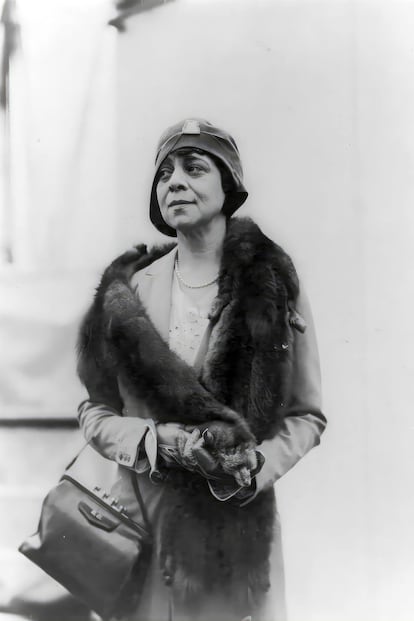

One of New York’s most legendary institutions, the Morgan Library, celebrated its centennial in 2024, providing an opportunity to remember its first director and librarian: Belle da Costa Greene (1883-1950), a figure whose legacy only grows with time. Her father, Richard Theodore Greene, was the first African-American graduate of Harvard University and a renowned civil rights activist. Encouraged by her mother (but never by her father, with whom she severed all ties), she gradually integrated into the city’s elite thanks to her fair complexion. She chose to conceal her racial background and adopted the surnames Da Costa and Greene, which suggested a Portuguese, Latin, exotic background. She stood out for her beauty and elegant style of dress, and she moved in circles inaccessible to most Black people.
The Morgan Library was originally conceived as the private library of financier John Pierpont Morgan. Between 1902 and 1906, he commissioned architect Charles Follen McKim to design a Renaissance Revival-style building adjacent to his Madison Avenue residence. After J.P. Morgan’s death in 1913, his son, J.P. Morgan Jr., took over. The 2006 expansion was designed by Renzo Piano. It is visited by scholars and tourists who appreciate its architecture and its unique collection of over 350,000 manuscripts.
Belle da Costa Greene was the driving force behind this treasure from 1905, when she became J. P. Morgan’s personal librarian. He appointed her director when the institution opened to the public in 1924, a position she held until 1948. Morgan disregarded malicious rumors about her ethnic background. Greene responded with tireless dedication to ensuring the library achieved international renown. For two decades, she oversaw every detail of this intellectual universe and managed the acquisition of rare books, manuscripts, and drawings (some by Rembrandt). Her greatest pride as a medievalist was acquiring the only surviving copy of the complete first edition of Sir Thomas Malory’s Le Morte d’Arthur, printed by William Caxton in 1485.
Hers was not an easy path. As an anecdote, Celia McGee recounts in The New York Times that the collector Isabella Stewart Gardner, Morgan’s rival, distilled her malice in a letter addressed to the influential art critic Bernard Berenson in 1909, referring offensively to Greene as “a half-breed who couldn’t help lying.”
In 2021, the historical novel based on her life, The Personal Librarian, written by Marie Benedict and Victoria Christopher Murray, became a bestseller. Until last May, the library hosted the exhibition Belle da Costa Greene: A Librarian’s Legacy, which highlighted her brilliant career and the personal struggles she endured due to racism. Philip Palmer, head of the literary and historical manuscripts department, and Erica Ciallela, curator of the exhibitions project, explain: “Belle da Costa Greene thrived in a world that tried to limit her because of her race and gender. Her story inspires future generations of women. Greene’s legacy is evident in the collections she helped develop, the reading room services, and the exhibition programs she established. Her ideas about access to books and manuscripts were groundbreaking. She believed that collections should be open to researchers and enjoyed by the public in major exhibitions — both guiding principles of the Morgan Library & Museum today.”
Sign up for our weekly newsletter to get more English-language news coverage from EL PAÍS USA Edition









































