
David Rieff: ‘To be truly woke, we’d have to even censor the pyramids of Tenochtitlan’
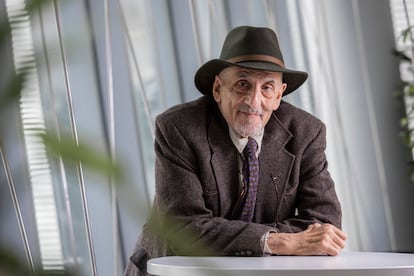
The US historian and essayist, who has just published a book of essays titled ‘Desire and Fate,’ reviews his life as an intellectual globetrotter and his reasons for becoming an ‘anti-utopian’

In the 1990s, Burger King’s advertising slogan was “sometimes, you gotta break the rules.” Today, another iconic brand — Kellogg’s — uses a trans woman to advertise its cereal.
These two anecdotes serve to support David Rieff’s thesis. The 73-year-old Boston-born historian has long argued that, since the late-1960s, the countercultural rebellion has been playing into the hands of big business interests — that is, capitalism.
In his books of essays — Desire and Fate (2025), published by Eris Press — the writer and former war correspondent presents a fierce critique of the left. He believes that progressives have forgotten about unions, labor and class, in order to embrace other causes, such as race, gender and the environment.
This could be a rough definition of “woke culture,” the derogatory term (coined in the U.S.) to discredit policies of diversity, equity and inclusion and their implications on culture and academia. For Rieff, the result is a perverse paradox: “A world whose good intentions will destroy what’s good about this civilization, without improving its many equally cruel and monstrous aspects.”
The essay collection by Rieff follows the narrative of his recent books, marked by disillusionment and the traps that can be hidden behind ideas like progress or development.
In his latest book, to offer expressions of this paradox, the author highlights the speech given by Angela Davis — the historic leader of the Black Panthers — before an audience of bankers from Goldman Sachs. He also points out how BlackRock — the world’s largest investment fund — waves the rainbow flag on the International Transgender Day of Visibility.
Rieff doesn’t consider himself to be a leftist. He’s more of a pessimist, or “an anti-utopian,” despite the fact that one of his first mentors was Ivan Illich. He met the lucid priest and educator — who had ties to anarchism — at an experimental university that he founded in Mexico, in the 1970s. Later, in Paris, he was a student of the philosopher Emil Cioran, the great pessimist.
Rieff was once an editor at Farrar, Straus and Giroux, a symbol of American high culture. It was also the publishing house of his iconic mother, Susan Sontag, one of the great intellectuals of the 20th century. He was also a war correspondent in Kosovo, Bosnia, Rwanda and Afghanistan. Reiff’s life and work are those of an intellectual globetrotter, as demonstrated by the excellent Spanish he uses to answer the questions in this interview, which took place at his publisher’s office in Mexico City.
Question. Did Illich teach you to believe in something? And did Cioran make you feel disillusioned?
Answer. I never shared [Illich’s] faith. He, as a Christian, still had hope. But optimism and hope are completely different categories for me. Optimism needs empirical justification. Hope is a moral, metaphysical category: there’s no need for proof or probabilities.
I would never be against hope, even though I don’t share it. I’ve always been a pessimist; the common thread in my work is a kind of underlying anti-utopianism. That’s why I’ve never been able to align myself with the left. I believe that, to be a serious leftist, both morally and politically, one must cultivate a certain optimism.
Q. Does that pessimism also stem from your family history?
A. Well, my mother was very left-wing.
Q. But your father was one of the great American experts on Freud. You know, the master of suspicion and the harbinger of bad news.
A. I think that my father was right in his view of Freud as a conservative thinker. The funny thing about my background is that I had a very conservative father and a radical mother. That might explain a lot of my confusion.
Q. Very psychoanalytic. Have you never been in therapy?
A. No. I had a total psychological breakdown when I was 30; I went to a shrink who gave me pills. But I’ve never been in psychoanalysis. I have an Argentine partner, but we can’t discuss psychoanalysis. It’s a taboo subject.
Q. In this collection of essays, you talk about woke culture as a blend of Freudian subjectivism, disdain for the past and Mao’s notion of the ‘new man,’ William Blake’s spiritualism, and Schumpeter’s capitalist drive, with the creative destruction that it entails.
A. Beyond the fact that it’s a mixture, it’s an absolutely legitimate emancipatory idea. It has to do with the biblical idea that “the last will be first and the first will be last.” I see it as, fundamentally, a moral reform movement.
This tradition has received much more attention from left-wing thinkers. But woke culture is the only movement that imagines itself as revolutionary that does not have economic analysis. It reminds me more of Calvinism, of the Catholic Counter-Reformation of the 17th century. Judith Butler and Wendy Brown identify as left-wing and anti-capitalist, but they pose no threat to the system. Large corporations are quite comfortable incorporating a, shall we say, “watered-down” version of woke culture.
Q. What do you mean by that?
A. I’m thinking, for example, of the reaction in Silicon Valley to the anti-Israel demonstrations. Google or Meta aren’t going to abandon a multi-million-dollar contract with an Israeli contractor. But they can agree to be friendly to Trans Pride. The only space in our society where [proponents of the woke movement] have power is in culture. And, for me, this rejection of the cultural past — except for the hidden culture of the victims — is not “anti-system,” it’s more like “anti-culture.”
The moralization of the artist is the classic example. Picasso was a son of a bitch. And, according to [woke] logic, a horrible person cannot create art. This is the opposite of the very principle of art. For the woke crowd, even the pyramids of Tenochtitlan would have to be censored, because they were places where horrors occurred.
Q. You’ve received criticism for playing into the hands of Trump and other authoritarian leaders.
A. Yes, some very intelligent people have asked me, “Why are you concerned with woke culture when there are these infernal right-wing populists destroying everything?” My answer is simple: the assault on cultural history is, for me, a very serious matter, and it’s one that will outlive Trump. There’s a saying: “culture is a conversation that took place long before you were born and will continue long after you die.” For woke culture, everything is a prologue to its moral reform.
Q. I’m thinking about feminism, which centers on caregiving and the vulnerability of life. Isn’t that a critique of the capitalist logic of profitability at any cost?
A. Yes, but for me, that’s a completely privileged position. Woke culture is a bit of a luxury movement. It’s no coincidence that its most significant achievements have taken place in universities and museums. I’m also thinking of the feminist phrase from the 1960s: “the personal is political.” These are psychoanalytic ideas. They assume that a change in morality will lead to a fundamental change in the economy. I don’t believe this.
Q. Your mother did a lot to popularize that phrase, precisely here in Mexico, at a conference in 1971.
A. Well, this [concept] was already around in the early years of the Russian Revolution. Lenin’s [comrade] — Alexandra Kollontai — had already thought about this, but it disappeared from communist debate, especially after the 1930s. But perhaps I’m not only a pessimist; I’m also too materialistic. This book is almost Brechtian, in the sense that morality comes after material things. “Food first, then morality” — that was [Bertolt Brecht’s] saying.
Q. There’s a nostalgic faction of the left that longs for working-class culture, for factories. But don’t you think that, today, this working class would be represented, say, by a migrant woman? Someone in a state of precarious employment who works, for example, driving for Uber?
A. Yes, but those workers today would still benefit more from a union. There aren’t factories like there were in the 19th century anymore, but the problem of wages remains. Obviously, we’re in a different world. But I think that, in the woke movement, there are anti-materialist ideas that show contempt for people’s material needs. They’re the fantasies of privileged people.
Anyway, I’m not a leftist and I don’t want to use the weapons of classical Marxism. What worries me most is the fate of culture, of high culture. And I think the effects of the woke movement will be that we won’t see art like that envisioned by the avant-garde. Instead, we’ll have Taylor Swift and K-pop.
Sign up for our weekly newsletter to get more English-language news coverage from EL PAÍS USA Edition









































