
Creators of highly anticipated ‘Zootopia 2′: ‘We always knew we wanted to return to that world’
Disney’s first installment grossed over $1 billion in 2016. The sequel sticks to the successful formula of funny and heartwarming moments, while introducing some new characters
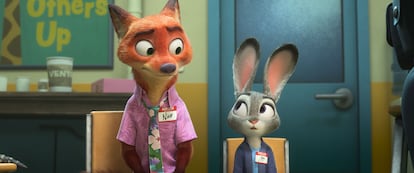

At Disney Studios in Burbank, just a few miles from Hollywood, the references to Zootopia are so numerous they’ve turned the whole thing on its head: it’s not just that there are drawings of the animal characters on hallways and doors (and even the bathroom doors): there are even real rabbits. The studio’s animators have brought them in to try to explain how they draw them, to showcase their refined technique, and perhaps to demonstrate to the tenacious journalists who struggle to follow their lines with paper and pencil that, despite all the computer programs and artificial intelligence, animation remains a craft done by hand, with care and time.
Hence the sequel, Zootopia 2, a full 10 years after the original, which was successful, funny, and heartwarming — the three ingredients that Disney always seeks. But the question, as is often the case lately, is: was it really necessary?
Disney’s latest films (including those made in collaboration with Pixar, owned by Disney for the last two decades) have ranged from original albeit with very limited success (Soul, Raya and the Last Dragon, Luca, Diary of a Wimpy Kid, Red, Wish, and Elio; the exception being Encanto), to stretching out popular titles with sequels and third installments while losing originality, such as the sequels to Frozen and Toy Story, the sequels to Moana and Inside Out, both in 2024, and now, presumably, the new installment of the adventures of Nick the fox and police officer Judy in Zootopia 2. It’s difficult to maintain those elements of fun and success that even earned them an Oscar. Was there anything left to tell in a film like this?
The screenplay is by Jared Bush, as is the direction, shared with Byron Howard. Both had similar roles in the first film, and they quickly realized that the world of talking animals had many opportunities for expansion.
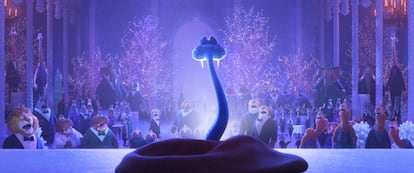
“Well, I think Jared and I knew that the first movie could only hold so much. It was a huge world. There was actually tons of stuff we could not fit in there, including other species of animals‚” Howard admits. “We honestly loved spending time in that world working on the first movie. It was just so fun because there’s all these places you get to go,” Bush recounts. In fact, they say that when they were finishing Encanto, back in the pandemic, “Jared had done a little sketch that said Zootopia 2, and the 2 was a snake. So that snake, from wherever it came from in this brain, that was already slithering around up there. But it seemed like the perfect way in, because we had not talked about reptiles at all in the first movie.”
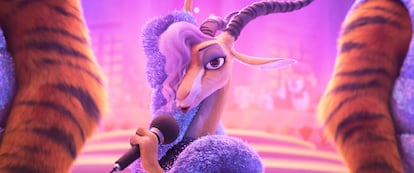
In the U.S. version, the snake is voiced by Ke Huy Quan, known for his roles as a child actor in Indiana Jones and the Temple of Doom and in The Goonies, and more recently for Everything Everywhere All at Once. He is one of the new additions 10 years later, with other actors reprising their roles: Shakira as Gazelle (with her corresponding song, in this case, Zoo), Jason Bateman as Nick and Ginnifer Goodwin as Judy. The three protagonists now explore new settings, such as swamps and a huge ice party; quite a challenge for the creators.
“We always knew we wanted to return to that world. But I think the question was: what would the story be about?” Bush asks, hitting on the key: obviously, the universe of the city that is Zootopia is very appealing, but it had to have something more behind it. “We really want to talk about the Judy and Nick relationship and how do you put pressure on that? Having this outside group of reptiles be part of that, specifically a snake that would make Nick nervous was a part of it. And then where are parts of Zootopia that we didn’t get to visit in the first one? How can we bring our characters into those as well?”
The 2016 film was an undeniable success: released in 4,000 theaters, it grossed over $1 billion at the box office (two-thirds of it outside the U.S.), and had characters that resonated deeply with the public. Returning to it could be as risky as appealing. Weren’t they a little afraid of facing the blank page of the sequel? “I’m still scared,” Byron Howard laughs. “We’re terrified,” Jared Bush confesses, looking amused.
“That’s exactly it,” Howard explains. “I think the first one was successful because of those characters, and that’s the strength of Disney movies—they have real great characters. And if we ever forget that, because sometimes we get so caught up in the plot or details or those big, overwhelming sequences, [let’s remember that] people care about two characters coming together and getting to know each other, and how fun that is.” For him, it all clicked, and they wanted it to do the same: “We wanted those relationships between the characters, the humor, the emotion, the new worlds, loads of new animals, because, as Jared says, we’re animal lovers, so the more animals, the better.”
But they also acknowledge that it was scary because there were so many expectations, Bush confesses. People want to see the characters as they remember them, but they also want something new, so the filmmakers always have to find the balance between making sure people feel, ‘Yes, this is a world I know,’ and also, ‘What else is out there?’ But the directors also believe that, above all, the greatest pressure comes from themselves, as they adore the characters and their stories. “This is a world we love, and I think everyone here at Disney Animation Studios is a guardian of that world, and it’s really important to make sure we bring out something meaningful for those characters in that world. And then, of course, people go to the movies, and we want them to have a great time. It’s a huge movie. But at its core, it’s a very simple character story, and we’ve spent a lot of time making sure that’s the case.”
Isaak Fernández is one of the animators who worked on the film, and who also contributed work to the first one. The Spaniard, with two decades at Disney, explains that, as a craftsman, he always tries to add a little more to these sequels. “When you create characters like Nick and Judy, it doesn’t end there; there’s always something more. In this film, within the new mystery, we delve a little deeper into the characters’ relationship. This one begins a week after where the first one ended; there are some interesting things to explore,” he explains. Although elements from the first film are reused, he explains, the first one came out in 2016 and was therefore made in 2015, “and now everything has improved.” “This is the first film they’ve made with new animation software. It’s much more complex than the first one,” he says.
Humor and physical comedy were key to its success. “Since they worked so well and people love them so much, we reviewed the first film and saw what made it so popular, and decided to bring it back to the second one and explore more facets. They’re just so funny and so easy to work with, it’s wonderful, I had a great time. It’s a lot of work, very complex, much more than it seems. Everything that’s been created, the sets, it’s a huge amount of work by many people. However, during the process we have screenings of the film, and seeing how good it is, is incredibly motivating. I know people are going to receive it well.”
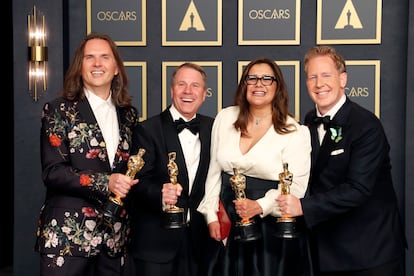
So, how do you balance having such charismatic characters with the need and desire to introduce others, without overshadowing them? The balance isn’t easy, the animator and directors admit. “The important thing is to do it through Judy and Nick’s eyes,” says Byron Howard.
“Regardless of the story we tell, Nick and Judy are the center,” they reflect. “if there’s one thing we’ve learned is that we’re only just starting to kind of just scratch the surface of what the world can be and the stories that you can tell here. It’s just vast.” Does that mean the world of Zootopia can continue to grow, with more movies? “Yes, I think so,” Howard acknowledges with a wry smile, especially now that they’ve begun exploring more animals, stories, and environments. “I would say: stay tuned.”
Sign up for our weekly newsletter to get more English-language news coverage from EL PAÍS USA Edition









































