
Jeff Bridges, the reluctant actor who has earned seven Oscar nominations: ‘It’s kind of like pretend and playing’
The son of a renowned Hollywood character actor, Bridges wanted to be a painter and musician, but his natural talent and knack for picking roles led him to stardom

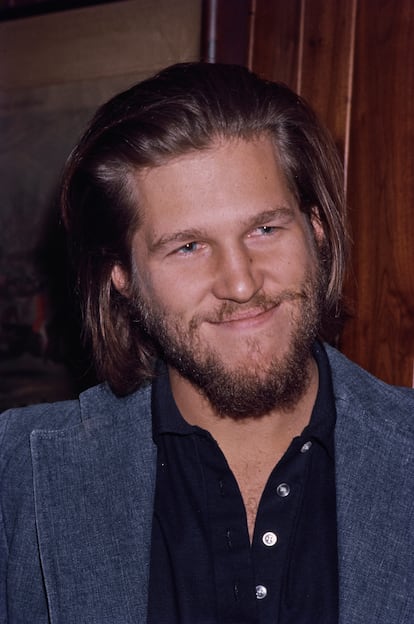
Perhaps there’s only one person who can rival Keanu Reeves for the title of Hollywood’s nicest actor. He could also easily win the award for most charismatic, effortlessly attractive, and for what some call “having chemistry.” Jeff Bridges, 75, the owner of all those attributes, was literally born in Hollywood and made his film debut as a baby, long before people talked about the privileges of nepobabies, which he’s well aware of.
Seventy-five years later, he’s still going strong. He’s just premiered Tron: Ares, a new installment of the classic he starred in in 1982, and continues to write music for his band, The Abiders. His long career includes hits in every genre, public acclaim, the affection of his colleagues (whom he often photographs with the Widelux camera he always carries with him on set), and critical recognition as well. Even the most demanding critic, Pauline Kael, succumbed to his charm and said of him that he was “the most natural and least self-conscious film actor who ever lived.”
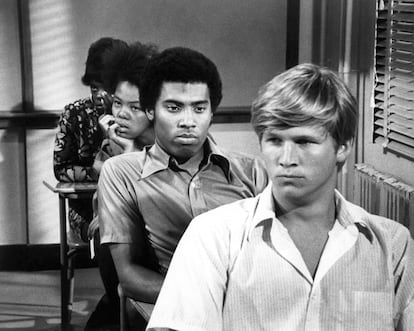
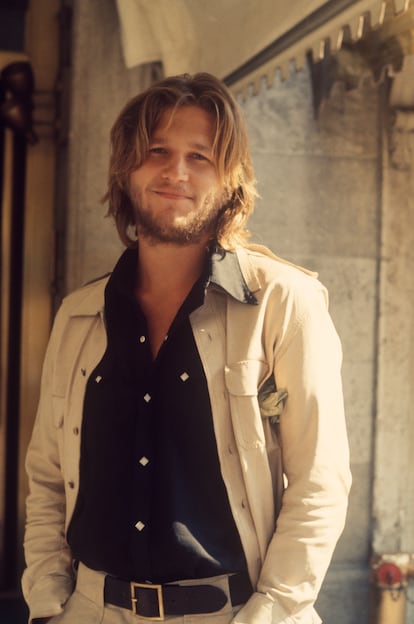
Always chameleon-like and magnetic, whether in his sweet or tough-guy persona, Bridges is one of those actors you can’t ignore even when he’s in the background. And he’s also humble despite his success. He never tries to impose his own opinion. “You read what people are saying about your character. And then I count on the director to help me transcend myself. I don’t have ideas. I do my best to hold the director’s opinion above my own,” he told Vanity Fair.
The new Tron has brought Bridges back into the spotlight, but so has the (partial) return of one of his most memorable characters: The Dude from The Big Lebowski (1998). This happened when the promotion of Tron took him to Jimmy Kimmel’s show. He was one of the first guests to appear after the hiatus caused by pressure from the Trump administration, and the host took the opportunity to ask him to offer the wisdom of his iconic character to try and calm a polarized and agitated society. Bridges donned his character’s cardigan and sunglasses, and with a White Russian on the table — The Dude’s signature cocktail — he delivered a speech: “Hey, world, The Dude here. Yeah, man. Can we just all calm the fuck down? I mean, come on, I’m talking about all the wars, the fighting, the canceling. Just chill out, man. Come on, tone it down, you know. We’re at what? Lika a nine? We ought to be at zero, you know. Or zero and a half at max.” The audience applauded wildly.
Although it’s now a cult classic whose value is undisputed, box office for The Big Lebowski was modest (although it later became a hit in video stores and on television), with critics considering it inferior to the Coen brothers’ previous film, the Oscar-winning Fargo. This was unexpected for Bridges. “I thought it was going to be a big hit,” he admitted to The Hollywood Reporter. “I was surprised when it didn’t get much recognition. People didn’t get it, or something.”
No one can now imagine anyone else in the role, but he almost turned it down. “My first impression was it was a great script and I had never done anything like it,” he said in the same interview. “I thought the [Coen] brothers must have spied on me when I was in high school.” The Dude was so much Bridges that many of the clothes he wears in the film were his own. However, he considered rejecting the part for fear of how it might affect his daughters if he played a stoner. He was afraid of setting a bad example and of them being ridiculed. “Being a child of a celebrity, I know what that’s like for a kid.” The Dude is a character for the history books, but he only represents a part of the dazzling filmography of an actor who took a while to realize he wanted to be one.
The Bridges’ son
Jeff Bridges is the son of actors Dorothy Bridges and Lloyd Bridges, a distinguished character actor and television star in the 1960s. To the general public, he’s the guy who chose a bad day to quit smoking, drinking, taking tranquilizers, and sniffing glue in Airplane!, to name just one title in a career that includes classics like High Noon. He was also a member of the Communist Party and was on McCarthy’s infamous blacklist. The Bridges always encouraged their children’s love of acting: Jeff, his brother Beau, and his sister Lucinda. There was a fourth child in the family who died shortly before Jeff was born.
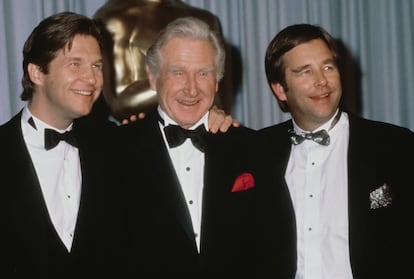
Being born into a family of actors meant he made his screen debut as a baby. “My father gave me my profession. I was six months old at my first job. I fought against it for a long time because I didn’t want to be a product of nepotism.” But he was just a kid, and he eventually gave in. When the opportunity arose for him to appear on Sea Hunt (1958–1961), his father won him over by telling him it was a way to earn money to buy toys after school. “He just got me!” he joked in Vanity Fair. He agreed and later admitted it was fun. “It’s kind of like pretend and playing.”
Despite his family’s enthusiasm, he wasn’t convinced. Not even when he received the first of his seven Oscar nominations for Peter Bogdanovich’s melancholic The Last Picture Show (1971). He was only 21, and Hollywood was very different from today. “I remember getting a nomination for Last Picture Show — no campaigning, none of that. Just woke up at 6 a.m. to someone saying, ‘I can’t believe it! You’re nominated!’” Even so, he still had doubts: he wanted to paint, he wanted to be a musician, and his father told him the obvious: that by becoming an actor, he could do all those things.
“Not getting divorced”
The great directors were clamoring for him. He filmed Thunderbolt and Lightfoot (1974) for Michael Cimino alongside Clint Eastwood, and reunited with the filmmaker for the beautiful Heaven’s Gate (1980), the film that sank United Pictures and ended the era of star directors in Hollywood. He has fond memories of that time: “When Heaven’s Gate came out, many critics called it a flop, a disaster. Well… that’s just their opinion, man. To me, and many others, it’s a masterpiece, and grows in beauty each time it’s seen.”
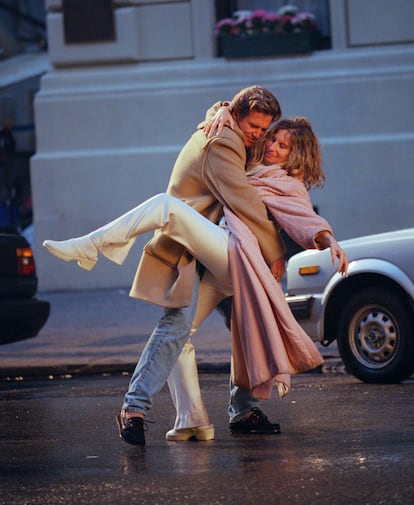
In between these two film shoots, the most significant event of his life took place; during the filming of Rancho Deluxe (1975) in Montana, he met Susan Geston, his wife of almost half a century. She worked at the hotel and showed up with black eyes and a broken nose from an accident. It was love at first sight. He couldn’t take his eyes off her and asked her out; she declined, but added a laconic yet hopeful, “It’s a small town. Maybe I’ll see you around.” Years later, the film’s makeup artist found a photo among his belongings and sent it to the actor; it had captured the very moment she had rejected him.
They are one of Hollywood’s most solid couples, and for him, the secret is simple: “Not getting divorced.” Of his love for Geston, he has said: “It just keeps getting better, more intense, and more beautiful. It’s crazy. I’m still with my girlfriend.”
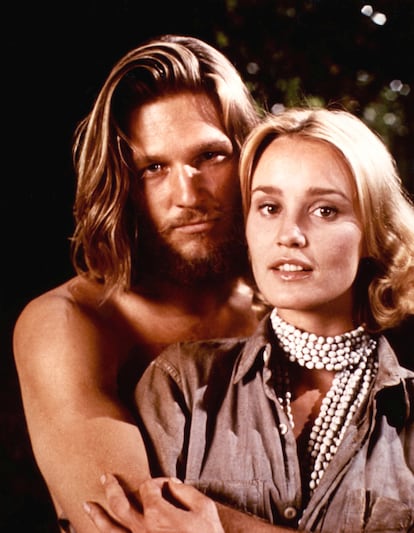
He’s worked in every genre. He was the leading man opposite debutante Jessica Lange in Dino De Laurentiis’s King Kong (1976) and appeared in a number of 1980s thrillers. He co-starred with Glenn Close in Jagged Edge (1985), Jane Fonda in Sidney Lumen’s The Morning After (1986), and Kim Basinger in Nadine (1987). In the fantasy genre, he starred in two classics: Starman (1984), which earned him his first Oscar nomination for Best Actor, and Tron (1982), the first in a saga that is still going strong.
And he continued to add great directors to his filmography; he worked with Francis Ford Coppola on Tucker: The Man and His Dream (1988), and with Terry Gilliam on The Fisher King (1991) and Tideland (2005). He remembers the long, but incredibly fun, hours of filming on the former and the improvisations by Robin Williams that Gilliam encouraged. He also appeared in one of the most memorable snapshots of late 1980s cinema: Bridges playing the piano while Michelle Pfeiffer performs Makin’ Whooppee in The Fabulous Baker Boys (1989), in which he co-starred with his brother Beau.
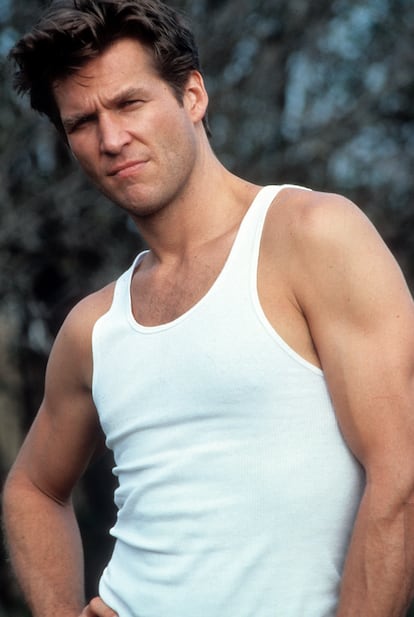
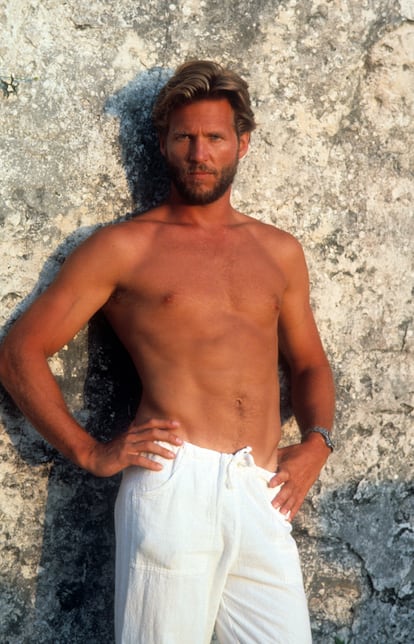
His filmography also includes the inevitable superhero titles that every veteran star appears in, projects that fill their coffers with sums they never imagined and, at the same time, lend prestige to the productions. He shaved his head to play the villainous Obadiah Stane in Iron Man (2008), the film that kicked off the Marvel Cinematic Universe: “I’m very biased, but I think ours was the best.” He didn’t expect the phenomenon that would follow, but he doesn’t disown it. When asked about Scorsese’s opinion that it’s not cinema, he gives a wise response: “I think there’s room for both.”
He won the Oscar for Best Actor for his role as Bad Blake, a 1970s country singer in the throes of artistic and personal decline, in Crazy Heart (2009), where he delivered a masterful performance. “He is believable and endearing, pathetic and seductive, a hustler and dignified. He is style, subtlety, magnetism, humanity. He even sings well,” wrote Carlos Boyero in his review in EL PAÍS.
He once again came close to the statuette by taking on a role previously played by John Wayne in the remake of True Grit — the drunken and irascible “Rooster” Cogburn — and was again nominated as best supporting actor for Hell or High Water (2016).
The man who was unsure whether to dedicate himself to film has devoted his life to it, although he has also made time for television. He starred for two seasons in The Old Man. Despite critical acclaim, Disney confirmed months ago that it would not be renewed for another season.
During filming, he experienced serious health problems. “In the first season when I was doing these fight scenes, I had a 9-inch by 12-inch tumor in my body, in my stomach, that didn’t hurt at all. So that’s surprising to me,” he told Entertainment Weekly. He didn’t find out until production was forced to halt due to Covid. He discovered then that he had non-Hodgkin lymphoma, and underwent successful treatment. However, his immune system was severely damaged, and when he contracted Covid a couple of years later, he thought he wouldn’t survive. He spent five weeks in intensive care and the virus “made the cancer look like nothing. It just kicked my ass,” he explained to The Independent.
He didn’t give up, because “one of the things that the illness brought to my attention is how much I love being alive.” Nor did he slow down. Quite the opposite: he decided that at 73, what he should be doing was polishing some melodies he had tucked away. And continuing to make films, although he’s still not entirely convinced. He’d prefer to paint and take photographs, another of his passions, but Hollywood pays better. Bridges is as wise as The Dude.
Sign up for our weekly newsletter to get more English-language news coverage from EL PAÍS USA Edition









































