
Decoding Glenn Close, the actress who escaped a cult and confronted Hollywood’s sexist clichés
Close, who frightened a generation of unfaithful men in ‘Fatal Attraction’ and turned down David Lynch because she didn’t want to portray feminine weakness, opens up in a documentary about her life
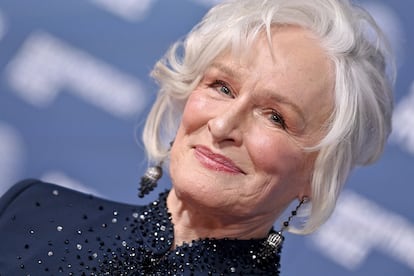
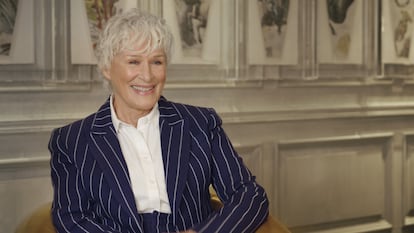
Director Catherine Ulmer Lopez (Gien, France, 55) had assumed that Glenn Close (Connecticut, 78) would never agree to a documentary interview about herself. Her film was practically finished when, after seven months, the actress’ agent responded affirmatively. They had an hour and a half in London to speak with her. “Hollywood actors don’t give interviews like they used to. They promote their films, and it’s difficult to talk to them at a later time; they don’t give you a morning,” says the Franco-Spanish director. “Before speaking with her, we interviewed her friends James Nadeaux and Pierre-Yves Gayraud, costume designers, who filled her in. Let’s just say we came well-recommended, and that made things easier,” the director explains to EL PAÍS. The only condition Close imposed was that her personal life not be discussed.
She played along, and the result, Glenn Close, l’art de la transformation (Glenn Close, the art of transformation), will premiere on Movistar+ in Spain on May 24, after its release in France and Germany. The film profiles the actress based on her own words, but also on archival footage and interviews with some of her closest collaborators, such as Swedish director Björn Runge, director of The Wife (2017), a film that won the performer a third Golden Globe, a statuette that has not resisted her, unlike the Oscar, for which she has been nominated eight times.
The documentary praises the life of an actress who didn’t hesitate, for example, to turn down a role in David Lynch’s Dune when she was just starting out in film at the age of 35. “I think it was the first or second film they offered me. I read the script, and they had this typical scene where the characters are running through the sand, and the woman, who always wears the wrong shoes, falls as the monster approaches. And the others have to go back and save her. I said, ‘I don’t want to play that role. I don’t want to be the one who falls,’” she says in the film. A version of events that is a far cry from the one Lynch himself and his team gave to costume designer Bob Ringwood, who suggested Close for the role of Lady Jessica after seeing her in The World According to Garp (1982), her debut film. “She’s bland and will never be a star,” they said after meeting her, according to Ringwood’s account a few years ago in a book about the film. “I think you’re making a mistake,” he told them. Ulmer Lopez believes the actress’ version: “She’s a straightforward woman, just as you’d imagine; she has no filters, she’s approachable and professional. Everyone who’s worked with her speaks highly of her. They probably said she was difficult because she didn’t want to do it.”
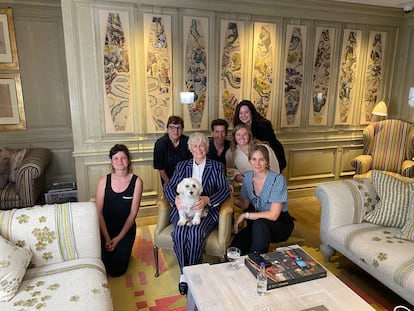
It wouldn’t be the only time Close would impose her decision on the sexist perspective of other creators, as was the case with Air Force One, in which she plays the U.S. vice president. In the original script, her character bursts into tears during a crisis meeting. The scene was changed for her. “Can you imagine Kamala Harris bursting into tears? No, women aren’t like that. It’s a cliché,” Close says in the documentary.
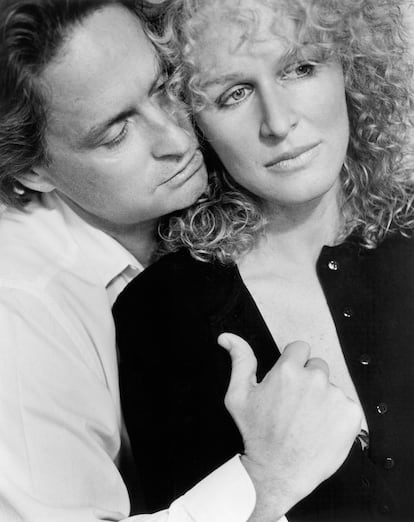
She had less of a say in the decision to rewrite the ending for Fatal Attraction after test audiences — with her character, Alex Forrest, committing suicide and Michael Douglas’ going to prison — became too upset. “They needed the promise of family reunion to make them feel good about themselves. It was very hard for me to reshoot that scene (spoiler: where she is killed by her lover’s wife). I cursed as much as I could,” she admits now. Forrest forever became the archetype of the crazy, obsessive, and spiteful ex, to the point of embodying the expression “Bunny Boiler,” after the pet her character puts in a pot in the film.
“I didn’t know how to have a relationship”
Close had already achieved a degree of fame by then, but in 1984, when she rejected Lynch, she still had a lot to lose. She came from a theater background, joining at 22 after leaving the community where her family lived, which had been absorbed 15 years earlier by Moral Rearmament, a cult founded by evangelist Frank Buchman that promised its members a new golden age of civilization. Close’s parents, a doctor and former World War II pilot and a housewife, “vulnerable and idealistic,” fell into the trap and placed their children in centers where they were told how to dress, how to behave, and how to speak. “I wanted to be liked and to be part of a community, so I became a diligent little soldier, denying this fragile child her identity for the good of the group,” she confesses. A trauma that took years to overcome and that affected her mental health, leading her to seek therapy years later: “You think you have no reason to be traumatized if your parents weren’t violent, but the mental damage it did to me was devastating. I didn’t know who I was. I didn’t know how to have a relationship, how to stand up for myself. I felt frozen. It’s a huge humiliation.”
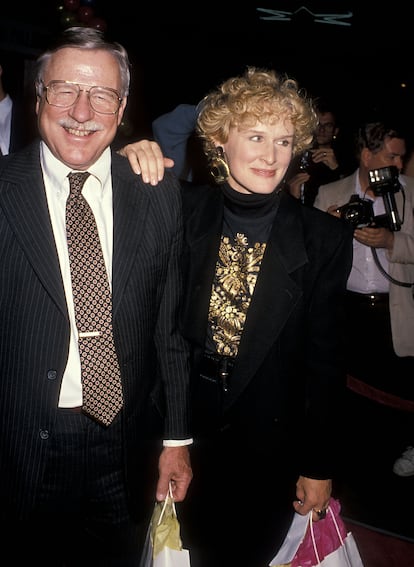
At 22, she enrolled at a university in Virginia, where she became passionate about theater and witnessed a televised interview that changed her life. She was painting theater sets when she heard Katharine Hepburn speak and froze: “She was fully asserting herself, whereas I didn’t know who I was. I have so much respect for women who seem so self-assured,” Close recounts. Hepburn gave her the courage to take control of her life: “You have to consider all the reasons why you shouldn’t do something, and if you don’t have a satisfactory answer, just do it. You can’t just sit there and say no, because everything is scary,” said Hepburn, the star of The Philadelphia Story. “The next day I went to the head of the theater department and asked him to write me a letter of recommendation for a series of auditions in New York, and that’s how I got my first role, following that feeling of ‘just do it,’” Close recalls.
She was later cast by George Roy Hill, who gave her the role of a feminist leader who decides to have a child with a dying World War II pilot in The World According to Garp. She gave a performance in homage to her own grandmother, like other roles she later took on, seeking to honor the women in her family. “None of them were able to fulfill their own dreams. That’s terrible,” she says in the documentary.
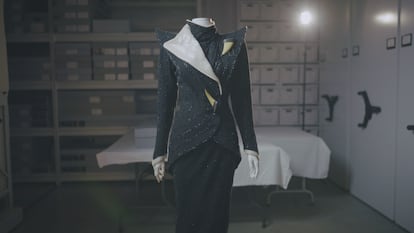
In addition to her feminist commitment, the film also recalls her appearances in defense of the LGBTQ+ community, democracy, and against the stigmas suffered by people with mental health issues, but it is also an opportunity to discover her passion for wardrobe and fashion. Since 2019, Indiana University in Bloomington has archived the more than 800 outfits Close has collected since the beginning of her career. A clause always included in her contracts stipulates that she retains one or two outfits from the film. Until she decided to store them in Indiana, her New York apartment housed Cruella de Vil’s spectacular costumes, the baroque dresses of the Marquise de Merteuil in Dangerous Liaisons, and even Alex Forrest’s leather jacket. A treasure trove that scholars can now access for reference.
“What amazed me most about her is her ability to transform,” the director confesses. “When you see Cruella, Albert Nobbs, or her character in Hillbilly Elegy… She makes real transformations. But I’m also talking about her ability to become who she is today, despite the dark place she came from. It’s a very powerful message for those who will come after her, showing that there is hope.” Just as Hepburn showed her the way 50 years ago, Close is now embodying the message of “just do it.”
Sign up for our weekly newsletter to get more English-language news coverage from EL PAÍS USA Edition









































