
Bjørn Hallstrøm, the man who deceived all of Scandinavia
‘The Agent – The Life and Lies of My Father’ won the Best Docuseries Award at Cannes
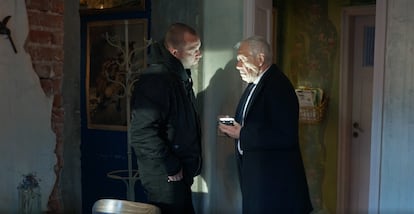

There is a father, Bjørn Hallstrøm, and there is a son, Didrik Hallstrøm. Between them, the memory of a moment in the family car — an instant that, like lightning, splits an existence in two — when the former confesses to the latter, who is twelve years old: “I am a secret agent.”
Three decades later, that son, who has just become a father himself, decides to find out if that shimmering, almost lifelike phrase — “I am a spy” — is true. This is the premise of The Agent — The Life and Lies of My Father (written and directed by Magnus Skatvold and Oyvinn Haugerud Kastnes, 2025), winner of the Best Docuseries award at Cannes.
Didrik takes taxis, trains, planes, and drives to different parts of Norway and Europe to talk to people who worked with his father when he was a television journalist. And each one, in their own way, confirms something he already knows: Bjørn is a very strange man.
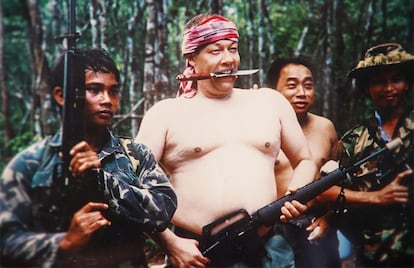
Despite not having a smooth relationship, driven by a question that hammers in his head, he decides to go visit his father in Sofia (Bulgaria), where Bjørn lives in retirement. The question that keeps Didrik awake at night is: could it be that all those trips to Afghanistan, Cambodia, Nicaragua, Kosovo, and Iraq to make news reports and documentaries about the suffering and violence that conflicts generate in ordinary people — sold to television networks in Norway, Denmark, Finland, and Sweden — were actually a cover for spying? Was it possible that all that dedication and enthusiasm for his program Kom nærmere (or, Get Closer), a groundbreaking show that was a hit in Scandinavia and consisted of taking a handful of teenagers to countries like Cuba during the harshest time of the Special Period, to Colombia in the midst of the war against drug trafficking, or to Kuwait (curiously, the day after the Iraqis left the country in 1991), so that the young people could “discover other ways of life,” was actually to carry out secret CIA missions?
Starting with Didrik’s journey, the docuseries exposes a family labyrinth filled with silences, strain, and a terrible secret that a Norwegian newspaper, dated April 8, 1950, headlined Revolverdrama. Along the way, the series follows the geopolitical thread of the Cold War — “a competition of nightmares,” in the words of British historian Eric Hobsbawm — through the final years of the 20th century and the first decade of the 21st.
NATO and 007
Throughout the six 30-minute episodes of The Agent, we discover the many layers of the life of a man who, before the age of 20, dreamed of buying a Volvo — until he saw the film Dr. No and wanted a much better car — and of traveling more: much more. A man enamored with the trappings of uniforms and weapons, he started out by setting up an advertising agency specializing in political propaganda, well-known for a campaign in favor of NATO. A seemingly ordinary Norwegian citizen and, therefore, the owner of one of the most coveted passports in the world during the 1980s and 1990s: beneath its veneer of a peaceful, social-democratic country, that passport was a magic key that opened the doors of every country in the world and allowed entry into military barracks, offices and embassies, refugee camps, or guerrilla training centers.
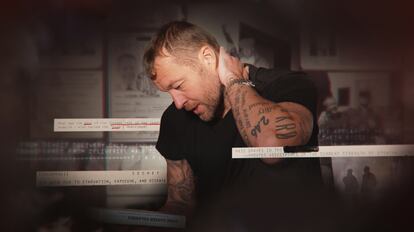
Drawing on rich family video footage, The Agent is also a chronicle of the unveiling of the paternal figure in all its mystery, because, don’t a father and a mother have something of a mythological quality in the eyes of their children? It’s the story of an aging television presenter who can only converse with his son when he sees the camera light come on, and who, at one point, casually, says to him: “It’s good to get to know each other a little before we die.”
And we glimpse the infinite faces of a giant deceiver, now an elderly compulsive smoker of Rothmans cigarettes, of a snake charmer who claims to have taken 1,000 flights in 25 years, of a husband whom his wife, Jane Hallstrøm — young and beautiful in some early video tapes, sad and exhausted shortly afterward — describes as a man with two personalities: that of a family man at home, and that of a “king on a mission,” where he manipulated and controlled everything and everyone until he got what he wanted.
On this path of confession, the gruff agent only breaks down when recalling his work in Sarajevo and Srebrenica in the 1990s, and it is then that a revelation involving witnesses illuminates his shadowy figure a little: he once disguised himself as Chief of Staff to help two Bosnian teenagers escape the war, obtaining refugee status in Norway for them.
In The Agent, we see the puzzle of Bjørn’s life unfold before Didrik’s questioning eyes. And moral judgment is not pleasant for him. “Reprehensible, pure narcissism,” says one of the teenagers — now in his fifties — who participated in one of his Get Closer programs. “A case of megalomania,” declares his ex-wife. “Pretty creepy,” his son finally manages to say.
Bjørn worked for the CIA, but also for Mossad and MI6. The truth is that the geopolitical landscape of the last 50 years reveals a vast network of agents serving various intelligence agencies. This is coming to light through anonymous people like Didrik, and also by well-known public figures. Recently, actor Jackie Chan revealed that his father had been a spy, as did Julian Nagelsmann, coach of the German national soccer team, and Stewart Copeland, drummer for The Police.
Sign up for our weekly newsletter to get more English-language news coverage from EL PAÍS USA Edition









































