Ela Taubert, singer: ‘Dreaming big from Latin America is also possible’
In an interview with EL PAÍS, the young Colombian singer and Latin Grammy winner spoke about her creative process, the importance of her Latin roots, and the release of her first album
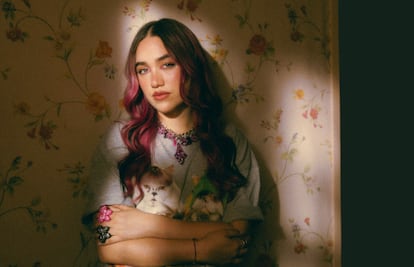

Vulnerable, sensitive and loving. That’s how Ela Taubert defines herself.
The Bogotá-based artist turns 25 this year. And, in her own way, she’s writing her own story in a music genre that’s still dominated by male voices. Like many girls raised by a network of strong women — her mother, her aunt, her grandmother, her cousin — Taubert grew up understanding that being a woman is often synonymous with resilience. And that tenderness — far from being weakness — can also be a form of power.
Taubert gets emotional easily. She laughs often while speaking. And in her voice, there is something that can’t be faked: sincerity. She says that she never had a “plan B,” because she always knew that music was her path. And today, with a Latin Grammy for Best New Artist, a collaboration with Joe Jonas, as well as scheduled appearances at major Latin American music festivals, she can confirm this. Her career hasn’t been a stroke of luck, but rather the result of dedication and a lot of intuition.
Her first album — Preguntas a las 11:11 (Questions at 11:11) – doesn’t appear to be part of a marketing strategy. Rather, it feels like a confession. It sounds like the kind of album you put on in the wee hours of the morning, when you’re not looking to distract yourself, but to understand yourself. There’s something almost therapeutic about her lyrics, where self-love, pain and sweetness embrace each other, without conflict.
In her conversation with EL PAÍS, the Colombian singer-songwriter talks about the leap of faith that is deciding to make a living from what you love. She also describes the fear of growing up in uncertain times, while explaining that she’s learned to look fondly at the girl she once was. Taubert says that “dreaming big from Latin America is also possible.”
Question. How did your journey into music begin?
Answer. Since I was little, I never saw music as a hobby, much less as a backup plan. It was always the only option. I believed the story I told myself from the beginning: I wanted to be an artist, period. Like when a child says “I want to be an astronaut” and dresses up to play. I would put on Hannah Montana wigs, stand in front of the mirror and say, “This is what I want to be and no one’s going to take it away from me.”
I’m also lucky to have a mother who has supported me completely. Very alcahueta as we say in Bogotá. She supported me from the very beginning, saying, “Is that what you want? Well, we’re going to do it right.”
Q. In a male-dominated genre, what has your experience been like while breaking through as a young woman?
A. Along the way, I encountered people who tried to put obstacles in my path. But every setback has reaffirmed that music is my place. Being a woman isn’t a disadvantage: it’s a superpower. For me, it’s been an experience of resilience, strength and determination.
Q. Your first album is called Preguntas a las 11:11. At what point did you decide that your own questions could become songs?
A. Ever since I wrote my first song — Dime si hay algo (Tell Me If There’s Something) – the first thing that came out were questions. I’ve always thought about everything a lot. And, from thinking so much, what ended up emerging were doubts. “Why did this happen? How do you get from here to there? Is something missing?” Questions were my natural way of writing, like a way of organizing what I felt. And so, without realizing it, all my songs began to build from there: one question, then another, then another.
Q. What was it like to make such a personal album?
A. It’s been one of the most healing and creative experiences of my life. It took two years of understanding who I am, who I want to be and why I feel the need to write so many songs about heartbreak.
I’m always asked the same thing, and now I’m asking myself: “Why talk so much about heartbreak?” And the truth is, this album captures moments from the last 10 years of my life, from the age of 15 until now. They’re stories that maybe I never would’ve been able to get out of my system otherwise. It’s been like looking back and seeing, song by song, the different chapters of my life: the people who passed through, the lessons learned, the mistakes and the successes.
Q. You’ve said you’re inspired by artists like Adele, Taylor Swift and Miley Cyrus, but also by your Latin roots. How have you achieved that balance between the global and the local in your music?
A. Finding that balance has been a process of trial and error. When I started working, everything was very experimental. I debated between writing Adele-style ballads, something more narrative like Taylor, or songs with the feeling of Jesse & Joy. But in the end, I realized I was never going to write like any of them, because my thing is to write from myself, from who I am. And that’s when everything started to take shape: creating, making mistakes, trying again.
Q. What was it like to win the Latin Grammy for Best New Artist?
A. I felt so much gratitude. It was very special. It’s not just about me: this is also about my team, my family, my mom and — above all — the fans. They’re the heart of all this. I feel deeply grateful and happy. It’s a moment I will carry with me forever.
Q. ¿Cómo Pasó? — your song with Joe Jonas — has become a worldwide hit. How did this collaboration come about?
A. It all started when I found out I was nominated for a Latin Grammy. I wanted to make a special post on social media and started looking for photos from my childhood. Among the memories, I found a video of me at 10-years-old singing This Is Me [the 2008 song by Demi Lovato and Joe Jonas]. I was singing Joe Jonas’ part. And I was so overcome with nostalgia that I decided to write to him on Instagram. I told him what I was experiencing, how grateful I was for his music, and how much he had inspired me since I was a child. I never thought he’d respond. But, a few days later, his message was there. Then, our record labels got in touch. And that’s how the collaboration was born.
It’s been one of the most magical experiences of my life: I met one of my childhood idols, we shared a song I love and I confirmed that dreams — no matter how crazy they seem — do come true.
Q. You say that colors play a very important role in your life. What do you mean by that?
A. Pink gives me a feeling of security, because it represents that moment when I learned to put myself first. To give myself my space: to respect myself and demand respect. For me, pink symbolizes strength, but a gentle, firm strength, rooted in self-love. It was also the color that marked my awakening, when I understood that I could defend what I believe, what I feel, and also defend others.
Q. Your songs deal with self-love, setting boundaries and healing. How has your relationship with yourself evolved?
A. As a child, I was very sensitive. I was always vulnerable. For a long time, I felt like it was almost a curse, as if crying about everything was a bad thing. People would say to me, “Oh, you’re crying again!” And I would think, “No, no more of this, I have to change.” When I left Colombia, I met people who didn’t do me any good. It was a tough process. But at the same time, everything started to take off. One song worked, then another. And, with each step, I discovered something new within myself. Amidst all that chaos, the color pink appeared. For me, that was the color of putting myself first, of learning to be strong, of embracing my sensitivity instead of hiding it.
Q. What’s changed now?
A. Now, when someone says to me, “You’re just very sensitive,” I reply, “Yeah, so what?” It’s part of who I am. That evolution is what I reflect on the album. That’s why the cover is blue, because deep down, I’m still that emotional, intense person who cries about everything. But now, as they say here [in the United States], “I embrace it.” I embrace it, I defend it and I proudly wrap myself in it.
Sign up for our weekly newsletter to get more English-language news coverage from EL PAÍS USA Edition