
Judith Butler: ‘We are witnessing the restoration of patriarchy and racism’
The leading figure of queer theory, a globally influential voice in feminism and political thought, takes part in an EL PAÍS subscribers’ event
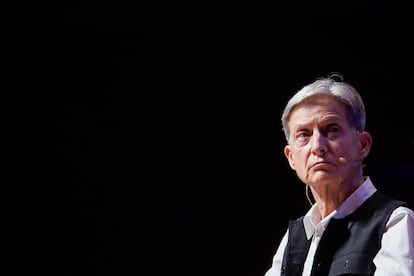

“We are witnessing the restoration of patriarchy, nationalism, racism, and capitalist individualism. It is the nostalgic fury of right-wing movements that want to return to an idealized past — one that perhaps never truly existed — and to reestablish hierarchical orders.” This is the “terrifying” panorama described by Judith Butler.
Butler, 69, spoke last Friday at the Reina Sofía Museum auditorium in Madrid with Joseba Elola, coordinator of EL PAÍS’s Ideas supplement, during a subscriber event marking the publication’s 10th anniversary. Butler was introduced by Julia Morandeira, Director of Studies at the Reina Sofía: “You have shown us that thought is not limited to books and universities — that thought is public action,” she said. And by Jan Martínez Ahrens, editor-in-chief of EL PAÍS, who pointed out how Butler has never bowed to the attacks of an “ultramontane” far right that is obsessed with fighting gender studies and trans people.
When Butler appeared, the audience responded with the fervor of fans, applauding and cheering — a reaction not typically seen at a philosophy event, even taking into account that Butler is the leading figure in the development and spread of queer theory, and one of the most influential voices in global thought, including in feminism and political philosophy. Butler is an intellectual icon and, judging by the audience’s reception, something of a celebrity. No wonder they topped the list in the Ideas supplement’s special 500th issue, which surveyed experts to identify the most influential thinker in global current affairs.

Butler downplayed the attention: “There’s a difference between a thinker and thinking. As a person who thinks, I value being celebrated and named, but there’s something called thinking that goes beyond me, which I receive from others. I rely on the thinking of others, I put my thinking into the world, and there’s a circulation of thought. It’s not my thinking; it relies on so many people.” Butler identifies as non-binary and requests the use of gender-neutral pronouns.
Butler also ranked second in a special issue of Ideas published in June 2023, which highlighted the most influential thinkers on today’s left. In that ranking, Butler placed just behind Karl Marx, who topped the list. The two represent different currents: on the one hand, the classical, worker-centered left, and on the other, the one that emerged from the emancipatory movements of the 1960s, encompassing environmentalism, feminism, antiracism, and LGBTQ+ struggles. Some call the latter woke. Others frame it as a false dilemma between the two. “We have to think of all these things together, because they are connected,” said Butler.
Class cannot be separated from gender, race, or sexuality — everything is intertwined. “We need to revive a Marxist analysis in light of the new social movements,” Butler said, praising Spain’s anti-eviction movement while also highlighting the defense of the environment, reproductive rights, and public health. “We must commit ourselves to saying what we want to see realized, and not just complain about what is going wrong.”

Butler’s landmark work Gender Trouble, published in 1990, quickly became a touchstone in feminism: in its pages, they presented the seminal — and controversial — idea that gender is a social and performative construct. Butler described that text as a moment when feminism and queer theory came together. “And I thought only 20 friends were going to read it!” they joked.
In their recent book, Who’s Afraid of Gender?, Butler examines anti-gender movements devoted to spreading the notion that ideas like theirs pose a threat to family, local cultures, civilization, and even to men. The trans issue, meanwhile, has opened a rift between transfeminism and trans-exclusionary feminism.
Can bridges be built? “Everyone who thinks trans people should live however they want are building bridges. In fact, there are many bridges being built. But then there are groups that say they don’t want bridges,” Butler said, drawing applause from the audience. On the thorny question of gender and youth, they added: “We can debate hormones or surgery, but gender assignment is a form of coercion that we must name and resist. We have to support young people, not tell them that they can’t experiment or imagine how to live [in] their bodies in the world: let’s leave that path open.”
In The Force of Nonviolence: An Ethico-Political Bind, Butler condemns state violence, while in other words, they delve into methods of resistance against it. Butler has been barred from entering Israel for condemning the genocide in Gaza, and appears on a list of 160 professors and students compiled by UC Berkeley for the Trump administration over “alleged antisemitic incidents,” a measure that has been compared to the McCarthy-era blacklists.
“I received a message from the university’s legal department saying my name is on that list. No one has filed a complaint against me in my three decades at the university… But they wouldn’t let me see the file or know what the accusation was. It’s a Kafkaesque world where you want to know the accusation, but no one tells you,” said Butler.
Fighting for trans rights or denouncing the genocide in Gaza (“we need strong policies that go beyond the protests happening in so many places”) is enough to earn anyone in the United States the label of terrorist. “If you denounce the genocide the Israeli government is carrying out, you are a terrorist. If you denounce violence, you are violent. Or they associate you with Hamas, even if you have never shown support for it.” Butler’s call was clear: “We must stand together, not as heroic individuals, but in solidarity.” At that, the entire auditorium leapt to its feet, cheering and applauding.
Sign up for our weekly newsletter to get more English-language news coverage from EL PAÍS USA Edition









































