
The spies of the pharaohs and the double agents of the Caesars: How intelligence services operated in antiquity
In a new book, 17 specialists analyze the secret military and political activities of the Eastern civilizations of Greece and Rome. The Assyrians, it is revealed, were masters of psychological and counterinsurgency warfare
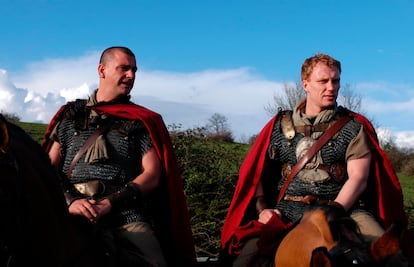

It may sound anachronistic to use terms like espionage, counterintelligence, secret services, or double agents in relation to ancient times. But activities, organizations, and personnel that largely fit our current concepts were widely deployed by the civilizations of the ancient world, giving truth to the saying that there is nothing new under the Sun (or, in this case, the shadows).
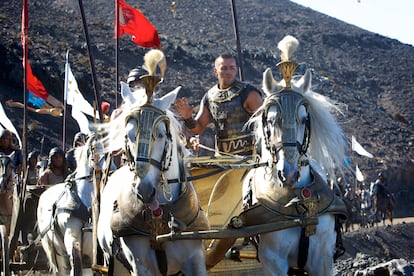
To provide a few examples: Ramses II was nearly defeated at the Battle of Kadesh (which ended in a stalemate) due to a glaring failure by his military intelligence services and a counterintelligence operation staged by his enemies, the Hittites. The Egyptians captured two Bedouins (who were actually spies) who gave them false, unverified information, leading part of the pharaoh’s army into an ambush by the deadly chariots of Muwatalli II.
The Spartans, for their part, developed sophisticated cryptography techniques (the scytale, a cipher consisting of a stick and a strip of leather).
As for Alexander the Great, he not only had an intelligence service that allowed him to advance his army through Asia in full knowledge of exactly where he was going, but he also had — thanks to secret agents — a detailed understanding of the internal state of his troops, their morale, and their occasional discontent, as well as control over the conspiracies brewing around him.
Hannibal was a master intelligence gatherer, and his brilliant maneuvers were not limited to the great battles in which he defeated the Romans, such as Cannae and Trasimene, but also extended to the realm of espionage and counterintelligence.
Another great general of antiquity, Julius Caesar, who used his own cipher in his communications, deployed a sensational system of military intelligence during his conquest of Gaul, including the launching of a message on a javelin. However, it could also be considered a mistake to fail to detect the uprisings that would later set the territory ablaze, such as those of Ambiorix — who destroyed 15 cohorts by providing false information to the Romans — and Vercingetorix (not to mention Caesar’s failure to see the plot coming that would cost him his life on the Ides of March).
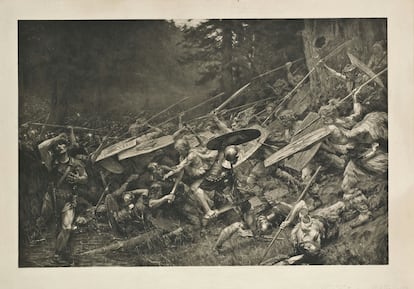
Without leaving the Roman world, not even the Cambridge Five proved as capable of double-dealing as the Cheruscan Arminius, who led the annihilation of the three legions of the legate Publius Quintilius Varus (the clades variana, or “the Varus disaster”) in the Teutoburg Forest. The blunder Varus and his intelligence service walked into in ignoring the clear signs of treason and jeu d’agent, to put it in modern terms, and falling into the trap set by their supposed ally was resounding and resulted in one of the greatest defeats ever inflicted upon the Roman army.
The book Servicios de inteligencia en la Antigüedad is dedicated to exploring a topic that is both sensational and diverse (and innovative). In its chapters, 17 specialists — including several international authors such as the renowned Rosy Mary Shelton, a retired U.S. Army colonel and PhD in Ancient History (which already qualifies her as a double agent), and the volume’s coordinator, Fernando Bermejo-Rubio, from the Department of Ancient History at UNED, Madrid — analyze various aspects of the phenomenon.
The book covers espionage in the Egyptian New Kingdom 2,300 years ago and the extremely effective Neo-Assyrian intelligence services (911-612 BC), as well as intelligence agents and actions in the Visigothic Kingdom (6th and 7th centuries), while also examining the services of the Persian Empire and the Greek, Hellenistic, and Roman worlds.
Of particular note are the unexpected chapters devoted to spies, the secret police, and agents provocateurs in ancient India, and to the efficient intelligence service operated by Herod the Great and his dynasty in his small client kingdom of Judea, Galilee, Samaria, and Idumea. Figures such as John the Baptist (no, Salome wasn’t his nemesis) and perhaps Jesus of Nazareth himself fell into the nets of his son Herod Antipas. It’s worth remembering that in the turbulent Jewish landscape, there’s another major figure who could be considered a double agent: the defector Flavius Josephus, the surprising escape artist from Jotapata.
As is often the case in a collaborative book, the chapters are very disparate in scope and style, with some weighed down by an excess of academic zeal and others a little unfocused. However, the overall work is fascinating and clearly demonstrates — as Bermejo-Rubio (who also wrote the introduction) emphasizes in a conversation with this newspaper — not only the existence of intelligence activities in ancient times, long before the emergence of the modern states with which we associate them, but also their high level of complexity and refinement, in some cases greater than one might assume.
“Neither Alexander nor Caesar, for example, would have been able to achieve their feats without informants and spies,” he reflects. In this regard, the compiler notes that “it has rightly been said that the work of a spy in the service of power could challenge the honor of being the oldest profession in the world.”
Bermejo-Rubio, who points out that the book is being published in the wake of the first international conference on intelligence activities in the ancient world (2023), emphasizes the difficulty of finding documentation on these types of activities — which include covert operations, targeted assassinations, and fifth-columnism — given their secret and often clandestine nature, in addition to the passage of time. “Sometimes we have to rely on small clues, but, quoting Momigliano, no less serious than finding things where they don’t exist is inferring that something doesn’t exist just because we can’t find any evidence.”
The book opens with the chapter Spies, Informants and Border Controls in New Kingdom Egypt, in which the Valencian Egyptologist José Lull examines, in sources such as the Amarna letters, information activities at the borders, police (medjay), or the interrogation of prisoners, and explains in detail the Hittite disinformation operation in Qadesh — the Egyptians avoided disaster by capturing two haputi (sic), explorers or spies, enemies who under torture confessed the true position of their army. The pharaohs relied on individuals categorized as the “eyes and ears of the king,” a title that also appears in the Achaemenid Persian world.
Francisco Giannone, a research doctor at the Sorbonne, addresses the “intense and systematic” espionage and intelligence activity in the Ancient Near East during the second millennium BC, especially in Mari and Hattusa (the Hittite capital). He attests to the procedure of issuing false orders to messengers and entrusting the true report to a tablet, and the practice of mutilation and elimination by the state of individuals considered problematic.
In Mari, agents were called sa lisanim, “long-tongued men,” or nasrum, “secret man,” and sapasalli, (spy) in Hittite. The Neo-Assyrian intelligence services, as Assyriologist Peter Dubovsky discusses, were extremely skilled in psychological and anti-subversive warfare under Sargon II, and although he considers that they did not constitute, as has been said, a true deuxième bureau — an autonomous intelligence office — the scholar compares them as systems typical of totalitarianism with the Soviet NKVD and KGB and the Czechoslovak StB, rather than with the CIA and MI6. Among the cases presented by Dubovsky is that of the kidnapping of the son of a king who refused to collaborate with the Assyrians, in order to pressure him.
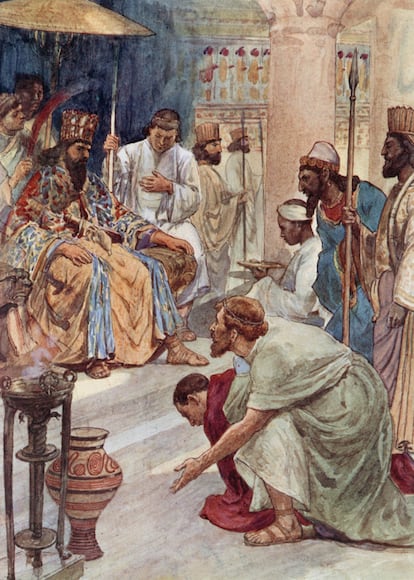
Joaquín Velázquez, a doctor in history from the Complutense University of Madrid, writes about the intelligence services of the Achaemenid Persians, essential in such a vast empire and which relied on the express messengers known as pyrradazzi. He praises the military intelligence harvested by Cyrus the Great and extends it to his son Cambyses II and his conquest of Egypt, which is surprising given that he was capable of losing an entire army by taking the wrong directions to the Siwa Oasis. We must also remember Xerxes’ excellent use of the double agent Ephialtes, the traitor at Thermopylae.
In the aforementioned chapter on ancient India, the Sanskritist Francisco Javier Rubio Orecilla highlights the use, illustrated in the Ramayana and Mahabharata, of undercover agents, sometimes in the guise of snake charmers and wandering ascetics (echoed in Kipling’s Kim), bribery, murder, and the use of sex to obtain information, à la Profumo.
One of the most thought-provoking texts in the collection is by Fernando Echeverría, professor of ancient history at the Complutense University of Madrid, who analyzes the concept of information in Greece and suggests that the Sirens in the Odyssey are more informants than anything else, representing, he says, the Greek suspicions of informants. The legendary Ulysses, of course, can be seen as a great gatherer and manager of intelligence, in addition to appearing as a spy in the Trojan camp in the Iliad alongside Diomedes. And isn’t the episode of the horse an example of a covert operation and infiltration, swapping Black Hawks for the wooden beast?
In any case, in the chapter by U.S. historian and classicist Frank Russell, we see the deployment of spy-scouts (skopoi), agents and informants in the Peloponnesian War, and the scholar points out something very curious: that the concept of Greek intelligence must include manteia, divination, such as the oracular pronouncements at the sanctuary of Delphi.
Although the world of Greek intelligence — leaving aside the Macedonian services, which are addressed by Adolfo J. Domínguez Monedero, professor of ancient history at the Autonomous University of Madrid, in his chapter — is portrayed in the book as unprofessional compared to other civilizations (it is noted that espionage was seen as amoral in Athenian democracy), one cannot help but think of the disinformation practiced by Themistocles at Salamis or the tricks and underhandedness of Alcibiades.
In Cases of Maneuvers and Military Intelligence in the Second Punic War, UNED historian Sabino Perea Yébenes reviews Hannibal’s merits in obtaining information from the enemy, considers that the Carthaginians were better prepared for this type of warfare and operations (a Punic spy spent two years in Rome before being discovered), and debates the theory that Scipio Africanus was the inventor of Roman espionage, or at least the general who systematically used it to counter the “dirty" methods — the famous Punic perfidy — of their rival. In psychological warfare, the Romans quickly caught up, as evidenced by the catapult launching of his brother Hasdrubal’s head into Hannibal’s camp after the latter’s victory at Metaurus, precisely because he had intercepted a letter from him.
The studies Intelligence Services in the Works of Julius Caesar by Denis Álvarez Pérez-Sostoa, a classicist from the University of the Basque Country; Internal Security in Early Principate Rome, or How to Kill an Emperor by Rose Mary Sheldon; and Information Gathering in the Provinces by Juan José Palao Vicente from the University of Salamanca, fully immerse us in the world of espionage and secret operations in ancient Rome, from the late Republic to the High Empire. This was the world of exploratores, speculatores, and frumentarii (agents in rebus from the time of Constantine, as noted by historian Raúl González Salinero), generally specialized soldiers tasked with shadowy duties that included infiltration, conspiracy detection, and even assassination.
Margarita Vallejo, professor of ancient history at the University of Alcalá, contributes a chapter on intelligence services in the Eastern Roman Empire (5th to 7th centuries). The Romans, Sheldon points out, did not have a central intelligence and security institution like the FBI or the CIA, and these agents sometimes overlapped with the Praetorian Guard. The scholar emphasizes that despite the similarities we sometimes see between the U.S. and ancient Rome, Roman leaders were never murdered by a lone assassin...
Sign up for our weekly newsletter to get more English-language news coverage from EL PAÍS USA Edition









































