The palace in an Italian village where two retired US sopranos ‘repair’ broken opera voices
Voice coaches Lisa Paglin and Marianna Brilla have transformed an old palazzo in Osimo into a ‘bel canto’ sanctuary where promising young artists and established opera singers alike come to retrain their vocal cords
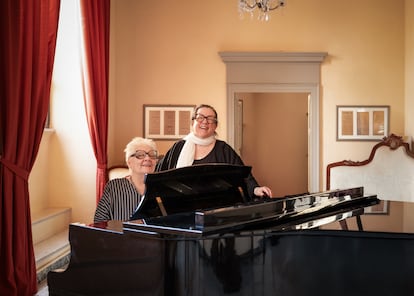
They met in the early 1970s at Indiana University. Sitting on the floor, Lisa Paglin was reviewing some sheet music for her piano class. “Marianna, already a great opera singer fresh from New York, wrapped in an elegant coat and high heels, approached me to ask about Margaret Harshaw’s classroom,” recalls the retired soprano and co-founder of the New Voice Studio. After that first meeting, they never lost touch. “Lisa became a star at the Vienna State Opera,” Marianna Brilla recounts over the phone. “But, like me, she began to feel that something in her technique wasn’t working, that her voice wasn’t responding as it should.”
Almost simultaneously, they decided to put their singing careers on hold to retrain their voices. “We studied historical recordings, consulted specialists like Maria Carbone, and read treatises by the great masters in search of our own method,” continues Brilla, who, after consulting 27 teachers, applied for a Fulbright scholarship that allowed her to research the roots of bel canto in their place of origin, Italy. “We lived in Rome, Florence, Milan…” adds Paglin. “But it was in Osimo that we set up our own studio.” Almost three decades later, the locals of this historic hill overlooking the Adriatic Sea describe the former palazzo the pair acquired at the time as a “sanctuary of voices.”
Singers of all backgrounds come here every year: fresh out of the conservatory or with five-figure fees per performance, mainly from the world of opera, but also from pop and jazz. “Our three basic principles are spontaneity, beauty, and freedom,” Paglin sums up. “These days, the voice is highly planned; natural singing isn’t cultivated, and there’s an unhealthy obsession with power and volume that generates great muscular tension.” For Brilla, the key lies in breathing: “You only need a thimbleful of air, but it must be well managed, as babies do intuitively. That was baritone Gino Bechi’s best-kept secret…”
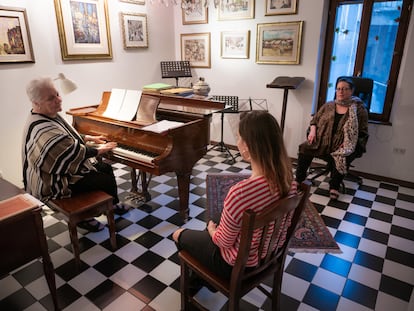
Their revolutionary method of vocal training and rehabilitation has been enthusiastically received by artists’ agents and veteran conductors, accustomed to witnessing careers as meteoric as they are fleeting. “There’s no need to point the finger at anyone, as unfortunately there are plenty of examples,” Brilla acknowledges. “[Enrico] Caruso didn’t need to shout to fill the theater; it all came down to a question of balanced tone: high in the head and deep in the body.” Paglin adds: “In the 1970s, singers struggled to reach maturity with a solid voice. Today, the phenomenon has worsened with the trend of big voices in immense halls.”
A few years ago, the Rossini Festival hired them to give a master class in Pesaro. “Maestro [Alberto] Zedda was desperate,” they recall in unison. “He said that many singers excelled in auditions, but then couldn’t endure a full opera.” The conductor and musicologist complained about the singers’ excessive power, their exaggerated gasps of air, and their intonation problems in the multi-part passages. “What was worse: if it weren’t for the surtitles, no one in the audience would be able to follow the plot of the libretto in question. Where is the expression of phrasing and the beauty of the legato lyrics [sung smoothly without interruptions between words]? You only have to see the strained expressions of some singers to realize the worrying state of modern singing.”
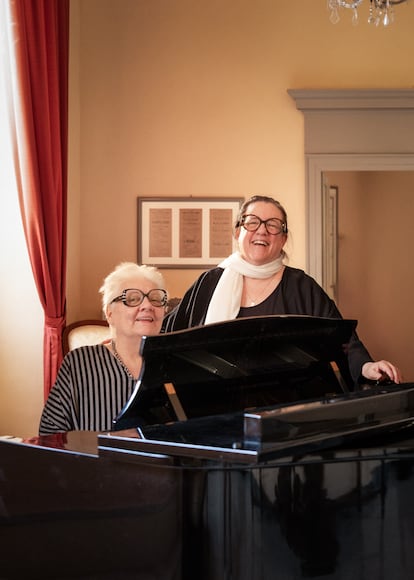
There’s no exact date for the decline of the old-school technique. “The good old cantabile all’italiana style was gradually lost,” Paglin confirms. “Little by little, the fluid and versatile delivery gave way to new vocal theories about resonance and volume that didn’t do justice to the composers’ true intentions.” These two American sopranos consider it a mistake to blame the composers Wagner, Verdi and Puccini for the sensationalist overacting devoid of nuance that became part of the operatic repertoire. “Later generations indulged in an excess of emotion that, without proper preparation, is doomed to disaster.”
This explains the almost total absence of divas today. “This unique artistic condition, most recently represented by Tebaldi, is due to a rare blend of talent, musicality, charisma, good looks, and, most importantly, absolute confidence in one’s technique,” reflects Brilla, who once met Maria Callas in a “tiny elevator” at the Juilliard School in New York. “I dared to ask her if she would return to teach her masterclass the following year, to which she replied: ‘My dear, I don’t teach…’ And that has been the great tragedy of opera: that those who sang best were unable to pass on their knowledge to others.”
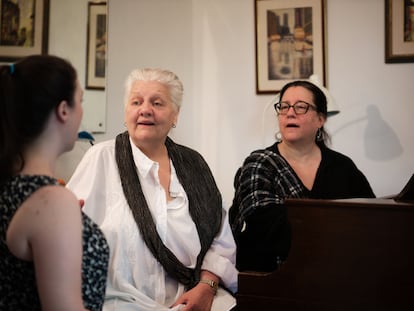
Nearly 50 opera singers have already ascended to the Brilla-Paglin studio in Osimo, with its imposing slopes and famous statues of headless men. “Each case is unique, but our success rate remains at 100%,” they boast. “We have helped very famous people, but we cannot name names, as vocal injuries remain a stigma, a sign of weakness.” Some Spanish artists, such as the soprano Raquel Andueza and the countertenor Nacho Castellanos, have openly acknowledged the effectiveness of their method. “In addition to group seminars, we have been providing online follow-up for years, which greatly speeds up the process.”
In 2012, an article by Paglin went viral, warning of the dangers of the surgeries the British artist Adele had undergone. After reading it, she was on the verge of putting herself in their care. “It’s a perverse machine that, on the one hand, ruins singers’ voices and then surgically repairs them while waiting for the next injection,” the author of the article denounces. Then Brilla speaks: “Vocal rehabilitation offers many more guarantees. Because instead of adding more weight to the backpack, it empties it of stones to demonstrate that the solution always lies within oneself, not outside.” And she concludes: “In the end, the best technique is the absence of technique.”
Sign up for our weekly newsletter to get more English-language news coverage from EL PAÍS USA Edition