
What are deep technologies or ‘deep tech’?
The concept is so ambiguous that there is no established definition at either the international or European level. But its characteristics are clear: it it capital intensive and involves a great deal of uncertainty about the results
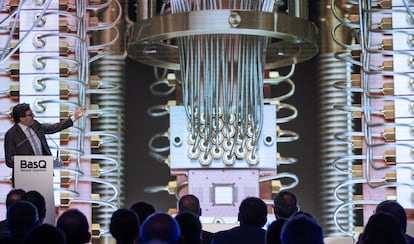

Deep tech is, despite the historical distance, a bit like Christopher Columbus’ persistent proposals to the major monarchies of the late 15th century to reach Asia via a new route. “It is geared towards solving complex problems and challenges of great social and global relevance, and it has a disruptive character, with the capacity to generate new markets or profoundly transform existing ones,” as defined by the Spanish Ministry of Science.
Although deep tech doesn’t start from geographically uncharted territory like the explorers of old did, but rather from advanced science, they share two common characteristics: they require large investments, and the uncertainty surrounding the future returns on these investments is high.
The concept of deep technology is so ambiguous, says Raquel Jorge, Director of European Affairs at the Spanish Association of the Digital Economy (Adigital)—which brings together some 500 companies, including many of the major tech firms— that “there is no established definition at either the international or European level.” But its characteristics are clear: “It it capital intensive and involves a great deal of uncertainty about the results.”
This field includes proposals for the development of quantum technologies, such as photonics and sensors, or artificial intelligence (AI), such as those aiming for near-human capabilities. It also encompasses sectors like biotechnology and healthcare.
Some specific fields involving deep technologies are related to gene therapies, nanotechnologies, energy storage, nuclear fusion, new therapeutic materials and compounds, or space applications, among others.
From these fields, there might emerge the great solutions that humanity longs for. In this regard, Peter Barrett, an investor in deep-tech companies through Playground Global, writes for MIT Technology Review: “With large-scale quantum computers on the horizon and advancements in quantum algorithms, we are poised to shift from discovery to design, entering an era of unprecedented dynamism in chemistry, materials science, and medicine. It will be a new age of mastery over the physical world.”
Spain’s National Deep Tech Strategy is scheduled to begin implementation this year with an allocation of €1.5 billion for AI and €808 million for quantum computing, with the potential to attract investments of up to €1.5 billion. Spain has around a thousand deep tech companies, two-thirds of which originated in universities, according to the latest report from Mobile World Capital, representing a 3.6% increase compared to the previous year. They generate approximately €1.4 billion in revenue and employ around 13,500 people, primarily in the energy, information technology, and industrial sectors.
Raquel Jorge believes this ecosystem is still in its infancy and that it is necessary to “work more with both the business and government sectors” to reach the 15% of GDP that the technology sector represents in Europe. “Developing these deep technologies,” explains the Adigital representative, “is an opportunity to generate new solutions that provide important well-being services, for example, in the health sector.”
The main obstacle for these entities, once they overcome the challenge of finding a disruptive technological niche, is navigating the so-called “financial valley of death,” the initial critical stage where revenues are scarce and costs skyrocket. “This is where we encounter the major barrier in the case of Spanish entities, but it also occurs in other countries, such as Italy, Portugal, Poland, Lithuania, France, Germany, and the Netherlands. In Spain, there are venture capital funds with resources, but startups sometimes lack the organizational and human capacity to commit to a series of results within the required timeframe. Institutional and private investors are making significant efforts and overcoming some regulatory and bureaucratic hurdles. More flexible instruments are now beginning to be activated, but today we still don’t have a specific public entity in Spain to invest in deep technology, and we have called for one in our submissions.”
“Until now,” adds Raquel Jorge, “we have had a wide range of public funding options, but we have lacked coordination mechanisms. There should be an entity or department within the Spanish public administration responsible for this oversight.”
The Forum of Innovative Companies (FEI) agrees in its latest report on deep technologies that “knowledge”, which it refers to as the “essential foundation for offering disruptive solutions”, is not enough on its own to reach the market and become value for society.
This entity demands action in areas of complementary research, financial management, protection of intellectual and industrial property, and rules of the game in the international market, among others.
Regarding specific proposals, among others, they call for a better law for startups, the creation of an Entrepreneur Defense Office, specific scholarships, interregional and international entrepreneurship networks, reinforcements of tax and commercial incentives for investment, and the establishment of testing environments to guarantee the safety of development proposals.
Sign up for our weekly newsletter to get more English-language news coverage from EL PAÍS USA Edition









































