
Animal talk: How AI is helping us understand other species
We have changed from wanting animals to understand human language to wanting to understand how they communicate with each other
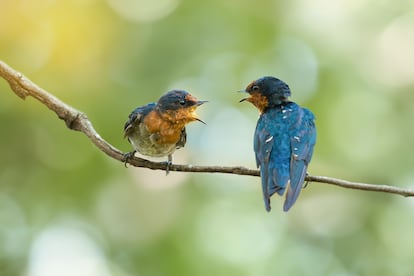
Communicating with other species has been on the radar since we began to scientifically study the rest of the planet’s inhabitants. Darwin argued that language was “half art, half instinct” and that the use of organized sounds to express feelings and be understood by others was not an activity exclusive to human beings. Understanding other animals was one of the priorities of science in the last century. However, these studies aimed to teach human language to dolphins, parrots, mice, dogs, chimpanzees and gorillas.
In 1984, Lou Herman taught the Akeakami and Phoenix dolphins a complex grammatical system; Allan and Beatrix Gardner from the University of Nevada taught Washoe, a female chimpanzee, sign language; and Irene Pepperberg from Brandeis University showed the world that her African parrot, Alex, had language proficiency equivalent to that of a two-year-old and cognitive abilities equivalent to those of a six-year-old.
The first mistake we made in understanding the linguistic capacities of other animals is anthropocentric: in short, we used a human scale to measure the communicative skills of other species. Although these investigations showed it was possible to narrow the gap that separated us both in cognitive skills and in communicative capacity, the focus of these studies was the ability of other species to understand us rather than the other way around.
The Earth Species Project, an NGO dedicated to studying how animals communicate via AI models, explains that the challenge now is different: “Rather than asking whether animals communicate like humans, we are asking how animals communicate on their own terms.” To achieve this, the NGO has developed the world’s first audio language model, NatureLM-audio (open source), designed to track animal sounds. They have trained it with data ranging from human speech to music and bioacoustics. It is a way of contributing, via technology, to the field of animal linguistics.
According to Holly Brewer, spokesperson for the Earth Species Project, “AI makes it possible to process millions of vocalizations, identify patterns, compare signals between contexts and connect communication to behavioral and social functions on a scale that was previously impossible.” One of the aims is to find out to what extent concepts such as phonology, syntax and semantics might be applied to other species. “There is growing evidence that some animals combine signals in structured ways and use communication flexibly depending on context, audience, or social relationships,” Brewer explains.
This does not mean that we already have the key to animal language. “When AI identifies patterns, what it reveals first is structure, not meaning,” Brewer says. “We may discover that certain signals consistently occur in particular social, behavioral, or environmental contexts, but understanding what information is actually being conveyed requires much more evidence.”
One of the most recent studies, in collaboration with the University of León, looked at the carrion crows that live in the León region of Spain and suggest a cooperative model of behavior. “We mapped the complete vocal repertoire of this wild population and discovered that around 60% of their vocalizations are soft, low-amplitude calls that humans rarely hear,” Brewer explains. The results are still preliminary, but we are one step closer to knowing what is behind the carrion crow’s characteristic squawk.
Flagging up one of the main obstacles to understanding how animals communicate with each other in the past, Dr. Frans de Waal explained in his book Are We Smart Enough to Know How Smart Animals Are?, that it is “difficult to assess these capabilities if you never have access to raw data.” Caregivers collected and analyzed the data without being able to contrast it. This resulted in a bias that AI can tackle by collecting, analyzing and processing large amounts of data with more precision. It is also possible to study the information that the researchers discarded on account of being unable to distinguish which animal, in the case of whales in the wild, was emitting which sound.
“AI is not a substitute for scientific interpretation. It helps to identify patterns and generate hypotheses, but researchers must validate the findings through observation, experimentation and interdisciplinary collaboration,” the Earth Species Project spokeswoman says. Jeff Sebo, a professor at New York University and a Doctor of Philosophy, believes that much more research and translations predicting behavior are still needed and calls for more convergent tests.
The study of animal communication can teach us about our own. Sebo points out that “human communication and signals constitute an embodied, multisensory and partly subconscious process.” Perhaps it will help us understand why it is difficult for us to recognize ourselves as part of the animal kingdom. “Part of society believes in human exceptionalism: the idea that we are independent and superior to the rest of nature,” says Brewer. The aim is to challenge this belief to ensure that we have a better relationship with other species.
Despite scientific advances, both the Earth Species Project and the Center for Environmental and Animal Protection at New York University call for caution over whether we manage to decode the communication successfully or whether we misinterpret the results. According to Sebo, success could be “useful for assisting animals, but also useful for interfering with them”. Misinterpretation, on the other hand, “could give humans false confidence about what animals are thinking, feeling, or trying to do, leading to bad decisions about how to treat the animals.”
Communication is basically the transmission of information. We could endanger millions of animals if advances are made that become popular and the technologies that emerge are not regulated, such as an app that translates in real time what animals say during the breeding season. An expert in animal ethics, Sebo explains: “These practices might be culturally transmitted and important for survival, including mating, parenting, foraging, and migration. So the risk is not only that we alter animal cultures, but also that we undermine the capacities that allow animal communities to persist.”
The red lines are drawn: no to invasive research, no to harmful intervention on an individual or community basis, and no to commercial use that leads to further manipulation and exploitation. “If understanding communication simply gives humans more power over other species, we will have failed to achieve our mission,” Brewer concludes.
Sign up for our weekly newsletter to get more English-language news coverage from EL PAÍS USA Edition









































