
What is Lo-TEK, the ecological alternative to extractive technology
This proposal is a way to recover ancestral knowledge to shape our cities and rural environments. It advocates for regenerative and environmentally just systems
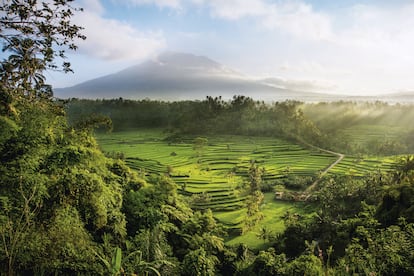

In the 1960s, the ancient irrigation systems of Bali, Indonesia, were replaced by scientific ones. The proponents of the “green revolution,” based on cutting-edge Western technology, discarded the water management practices of the priests at a Hindu-Buddhist temple dedicated to Dewi Danu, the goddess of the lake. They opted for fertilizers and genetically modified seeds to increase production. They dismissed what they called the “rice cult” as magic and superstition.
“The government threatened the farmers. It imposed a green transition, which was really an industrial one. Everything collapsed in four harvests,” explains Australian architect and landscape designer Julia Watson, author of the 2024 book Lo-TEK Water: A Field Guide for TEKnology, via video call.
The use of high-tech in Indonesian rice cultivation had catastrophic results. Without the natural fertilizer from minerals dissolved in water, the soil degraded, and insect biodiversity declined. The traditional subak system, also based on cooperation among farmers, took decades to be restored. In her 2019 book, an international bestseller, Watson included this case study on the sacred Mahagiri terraces in Bali.
The author also explains how Bangkok’s modern Chalongkorn Park replicates the agricultural engineering of subak. “I am trying to define a technology without the contemporary obsession with artificial intelligence and satellites. The last 200 years of humanity have been dominated by a white colonialism that barely recognizes any single type of knowledge,” says Watson, who is also a professor at Harvard University’s Graduate School of Design.
Natural systems
The cover of her 2020 book, Lo-TEK: Design by Radical Indigenism, features a living bridge built by the Khasi people in the Indian jungles of Meghalaya. By guiding the aerial roots of rubber trees with betel‑nut palm trunks, the Khasi have shaped bridges for centuries, some stretching up to 30 meters. Watson also documented yakchals, mud-brick structures used by the Persians to make ice. Built partly underground and oriented toward prevailing winds, they capture cool night air and preserve it within their thick walls.
Both examples embody the Lo–TEK concept, which plays on low‑tech—technology that is simple and predates industrialization—while also invoking TEK, or Traditional Ecological Knowledge. Watson argues that “Lo-TEK is an opportunity to change exploitative and extractive Western technological systems for regenerative, relational, and more socially and environmentally just systems.”
The Australian researcher advocates for nature-based, community-led systems. One illustration is the Sangjiyutang system at the river deltas of Guangdong, China, where natural and human technologies work in symbiosis: mulberry trees feed silkworms; silkworms nourish fish; fish fertilize ponds; ponds mitigate flooding; and the resulting silt enriches the soil. Agriculture, fish farming, and textile production complement each other.
Architect and art curator Pablo de Soto warns about the risk of high-tech “solutionism”: “We are at a crucial moment in the relationship between ecology and technology due to the massive energy and water consumption of AI,” he explains in writing. As an example, he cites the reopening of the Three Mile Island nuclear power plant in Pennsylvania, which was closed after a reactor accident in 1979 and reopened to power IBM data centers used by the company OpenAI. “Because of events and challenges like this, it is so important to recognize a diversity of technologies and consider non-Western technologies that do not subjugate the Earth but rather work in harmony with it.”
In Art and Cosmotechnics, the Chinese philosopher Yuk Hui explains that there is no single definition of technology. Against what he sees as the false diversity of the free market — built on a fundamentally uniform technological model — he calls for technodiversity. Instead of a single digital framework imposed by Big Tech, Hui advocates for multiple cosmotechnics. “There is no universal and homogeneous technique,” he says. “Therefore, what we need to reinvent is not a specific technology that might be more ecological or efficient, but a new way of thinking about technique in its totality and diversity.”
In her books, Julia Watson attacks the Enlightenment’s “mythology of technology,” which — under the influence of colonialism and racism — ignored local wisdom and Indigenous innovation, deeming it primitive.
Ecuadorian sociologist Juan Manuel Crespo, who works with Indigenous communities in the Amazon, warns that progress and development —Enlightenment concepts associated with industrialization — lead to unsustainability. “The universal horizon is an exclusionary straight line. The idea of the pluriverse, in contrast, opens the possibility that ancestral technology can converge with modernity,” he explains over the phone.He points to the Achuar people’s Kara Solar project, which seeks to “decarbonize” Amazonian rivers through solar‑powered boats.
While Watson’s first 2020 book focused on Indigenous systems worldwide, her 2024 follow‑up opens the door to ancestral European practices. It includes the mussel‑farming techniques of Brittany and Normandy in the bay of Mont‑Saint‑Michel, as well as the valli da pesca — a network of canals, reed beds and fish farms sustained by the Venetian lagoon.
It also presents 23 urban projects inspired by ancestral technologies. The book documents, for example, how Bangladesh’s floating‑farming methods are being adapted elsewhere: Seattle’s Green Futures Lab grows floating wetlands on the Duwamish River to restore degraded habitat, while Pakistan’s National Institute for Biotechnology and Genetic Engineering uses similar aquatic systems to clean polluted waterways.
“When communities start working with engineers and scientists, we see climate technologies evolving like never before. It’s a new space for innovation that isn’t dominated by high tech,” explains Watson, who also co-directs the Lo-TEK Office for Intercultural Urbanism, which has developed 10 urbanism principles to transform extractive systems into regenerative relationships with the planet.
In Epistemologies of the South (2014), a foundational text of decolonial thought, Portuguese sociologist Boaventura de Sousa Santos argues that in the case of the rice terraces of Bali, the sense of superiority of scientific knowledge led to “bad science.” During the Green Revolution, experts dismissed the island’s rice‑terrace system — managed through the socio‑religious practices of the priests of the goddess Dewi Danu — only for complex‑systems research, 30 years later, to show that this traditional method was in fact the most efficient scientific solution.
Sign up for our weekly newsletter to get more English-language news coverage from EL PAÍS USA Edition









































