
Heat waves in rivers increase four times faster than atmospheric heat waves
A study using data from over 1,000 rivers shows that these extreme events now last almost twice as long on the water as they do in the air

As anyone who lives near one knows well, when the heat hits, rivers serve as a climatic refuge. However, this is beginning to change. By studying the impact of heat waves since 1980 on more than 1,400 rivers, American researchers have discovered that these extreme events are increasing at a rate four times greater than that of atmospheric heat waves. The work, published in the journal PNAS, is based on data from the United States, but European experts believe the phenomenon is global. The impact of these heat waves does not remain limited to the river.
Heat waves are becoming more frequent, more intense, and longer. At the same time, scientists are confirming that climate change is warming large bodies of water, such as the oceans. But what happens to rivers during a heat wave? In principle these waterways, fed by melting ice or underground inflows, buffer the temperature of their immediate surroundings. Even in the current context of global warming, they are portrayed as climate islands or refuges. But the data contradict these assumptions.
“Rivers constantly mix heat through moving water. This mixing smooths out temperature spikes, so rivers don’t typically warm as much as the surrounding air,” says Li Li, a Pennsylvania State University professor and co-author of the research. “But the downside is that once a river warms, the entire system tends to stay warm, prolonging the duration of the heat wave,” adds the researcher, head of a laboratory that studies the state of aquatic systems. This is the first result they have obtained from temperature measurements of 1,471 freshwater streams in the United States.
Specifically, between 1980 and 2022, the duration of conventional, atmospheric heat waves has increased to an average of four days. But in rivers, extreme thermal events now last 7.2 days on average. “Water has a greater thermal memory than air. This means that once a river warms up, it tends to stay warm for days because the water retains heat. Air, on the other hand, can heat up and cool down rapidly from one day to the next,” Li explains.
The vast majority of creatures that live in rivers, especially fish, are ectothermic, or cold-blooded. And they also live in cold water. In the northern hemisphere, species as basic as trout begin to suffer heat stress when the water temperature reaches 15ºC. The authors set the threshold for critical thermal stress at 20°C. Since 1980, the number of days exceeding these temperatures has increased by an average of 11.6, although in some basins, such as the Appalachian, it has already reached 13.8. In total, episodes of thermal stress have increased in 82% of rivers, reaching the critical level in 74% of them.
In addition to duration, heat waves have two other relevant dimensions: their intensity and frequency. Here, rivers have yet to match the atmospheric heat: extreme events are not as torrid in the water (an increase of 2.6°C compared to 7.7°C in air temperature) nor as frequent (2.3 heat waves per year, compared to 4.6). But in both cases, the gap is narrowing, as they are growing (also in duration) between two and four times faster than atmospheric ones.
In principle, the key cause of the worsening of heat waves in rivers would be the same as in the atmosphere: climate change. However, the hydrographic network has its own factors, also related to climate: “Cold groundwater or melting snow can help cushion the impact of warm air,” Li points out. The problem is that it snows less and less frequently. Furthermore, the overexploitation of aquifers doesn’t help either. “As the snow cover decreases and groundwater inputs decrease, with climate change, rivers can’t cool down as quickly.”
There are other human factors that affect river warming. One is dams, which lengthen the duration of thermal extremes. The study’s authors confirmed this by linking a greater number of reservoirs and barriers in certain basins with the duration of these events there. The other factor, this time mitigating, is agriculture. “It has been mitigating riparian heat waves through cooler air and water due to irrigation, as indicated by decreasing trends in the frequency, duration, and intensity of riparian heat waves in cultivated areas,” says Kayalvizhi Sadayappan, co-author of the study, in a note from Pennsylvania State University. This implies that the progressive abandonment of agricultural land (a phenomenon much less pronounced in the United States than in Europe) could amplify the impact of heat on river systems.
Sadayappan and Li have been able to study the situation in American waterways because the U.S. Geological Survey has been recording the temperature of the country’s river network for decades. But they are convinced that riverine heat waves are increasing worldwide. In Europe, there is no single database, nor even a single monitoring network for its rivers, but there are some partial studies that follow a similar line.
A few years ago, Italian, Dutch, and Swiss researchers studied the thermal stress suffered by 19 Swiss rivers during the three most severe heat waves Central Europe has experienced since records began: those of 2003, 2006, and 2015. The study was published in 2018, so it doesn’t include the most recent heat waves, which surpassed almost all of the previous ones. The worst occurred between late July and mid-August 2003, which in Spain alone caused thousands of deaths. The study shows how lowland rivers lost a significant portion of their water flow, but not those fed by snow, which, when melted rapidly, had the opposite effect. The worst aspect was the observed temperature deviation. Nunzio Seviglia, a researcher at the Swiss Federal Institute of Technology in Zurich, estimates it at “almost four degrees” compared to the average recorded since 1984.
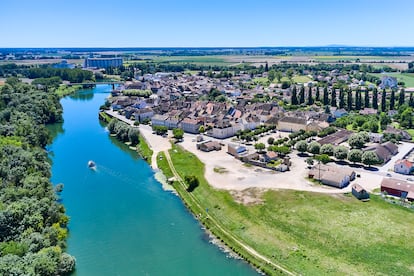
The impact of river heatwaves doesn’t affect humans, at least not directly. It’s the river’s ecosystems that suffer. A study of mollusk populations in the Saône River (France) shows how several species of the genus Pisidium, tiny clams, practically disappeared after the summer of 2003. More than a decade later, in 2015, a new count at various points along the river showed that they had still not recovered. But beyond fewer clams, Seviglia recalls the conclusions from his work on Swiss rivers: “The effect of an extreme heatwave as a pulse-like disturbance has a greater likelihood of causing a change in the state of ecosystems, providing the impetus for them to cross ecological thresholds toward new and potentially irreversible ecosystem states.”
Luz Boyero, researcher and co-leader of the River Ecology Group at the University of the Basque Country, has not investigated heat waves per se, but rather the impact of extreme heat on the basis of the river life cycle: the decomposition of organic matter. For Boyero, who considers the results obtained by her American colleagues “generalizable and global,” the interesting aspect of their work is that “in the case of rivers or aquatic ecosystems in general, in addition to climate change per se, human modifications, such as dams, play an important role in high-temperature waves.”
In an experiment with leaves from three species collected from the banks of the Agüera River (Cantabria and Vizcaya), Boyero’s group exposed them to temperatures of up to 40º to see how excess heat affected both the speed and quality of the decomposition process of their essential nutrients, which are the basis of detritivorous organisms (detritus), which in turn are essential for other organisms that serve as food for smaller fish, which in turn give life to larger fish, and so on up the food chain.
Sign up for our weekly newsletter to get more English-language news coverage from EL PAÍS USA Edition









































